

The fall of the Maduro regime in Venezuela has ramifications far beyond Latin America — especially in the Islamic Republic of Iran, another oil-dependent state on the brink of economic and political collapse.
Another dictator — Iran’s supreme leader, Ayatollah Ali Khamenei — is beginning to reap what he has sown.
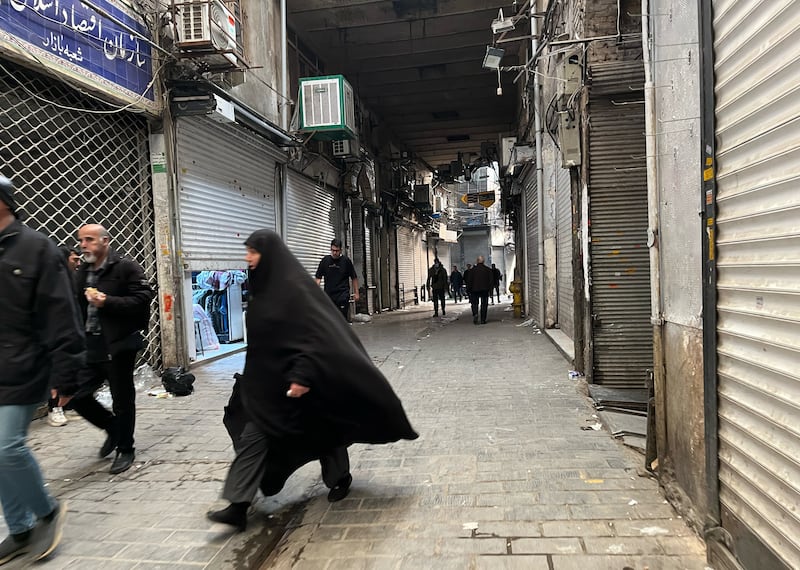
What started as a strike by shopkeepers in Iran’s Grand Bazaar on Dec. 28, 2025, has escalated into a nationwide protest against Khamenei’s corrupt and failing kleptocracy. The Iranian rial — the ultimate gauge of trust in the leaders, policies, institutions and future of the Islamic Republic — has collapsed, losing half its value in just the past year.
The threat Khamenei poses to Iran is immense. He regards Iran as his personal fiefdom, with the Islamic Revolutionary Guard Corps as his private militia and the Iranian people as subjects, not citizens — sacrificial pawns bearing the mounting costs of his proxy wars against the United States and Israel.
But the change happening right before our eyes is not just economic. It is also political, demographic and cultural. After enduring the unbearable costs of Khamenei’s utopia — a religious nightmare that has allowed charlatans posing as clerics to exploit the Iranian people — a new generation is turning away from a forced fundamentalist ideology that condemns them to misery and martyrdom. What they care about is reestablishing Iran’s sovereignty under a secular government that safeguards Iran’s territorial integrity, political independence and economy.
Iran has seen uprisings before: the Green Movement of 2009, sparked by stolen votes; the bloody Aban protests of 2019, triggered by fuel price hikes; and the 2022–2023 “Woman, Life, Freedom” movement. Each was brutally suppressed. But each also revealed a regime growing weaker — and more afraid. Fortunately, even within the IRGC, long considered the regime’s backbone, signs of strain and quiet dissent are emerging as some members increasingly identify with the long-standing grievances of the Iranian people rather than the dictates of the clerical elite and survival of the corrupt system.
The recent Twelve-Day War between Iran and Israel has done more than destroy Iran’s nuclear program; it has led the people to question Khamenei’s corrupt government more and more. Far from being an infallible leader and the guardian of a powerful Islamic state, Khamenei has pushed Iran to the edge of destruction. His kleptocracy has destroyed Iran’s security, bankrupted its economy and left its youth without a future.
President Donald Trump has sent a clear message to the Iranian people: The United States will not sacrifice their dreams and aspirations for the sake of the nuclear program. The days of appeasement — buying the ayatollahs’ cooperation with rewards for nuclear blackmail — are over.
Fortunately, when it comes to confronting the Ayatollah, President Donald Trump’s national security team is fully aligned with the Iranian people, none more so than Secretary of State Marco Rubio. As a longtime friend of the Iranian people, Secretary Rubio has repeatedly drawn a firm distinction between the Iranian regime and the Iranian people, stating, “I don’t know of any nation on earth where there is a bigger difference between the people and those that govern them than there is in Iran.”
U.S. Ambassador to the United Nations Michael Waltz has been active, sharing on X, “The people of Iran want freedom. They have suffered at the hands of the Ayatollahs for too long. We stand with Iranians in the streets of Tehran and across the country as they protest a radical regime that has brought them nothing but economic downturn and war.”
There is also a long-standing and deep history of support for the Iranian people in Congress. On Nov. 16, 2019, Sen. Tom Cotton, R-Ark., made a statement that, in hindsight, is nothing short of prophetic: “The Iranian people are tired of the regime ignoring their basic needs while funneling vast sums to terrorists throughout the Middle East. We must stand with these brave protestors demanding accountability from the ayatollahs.”
And earlier still, on Sept. 10, 2015, Utah’s venerable Sen. Orrin Hatch took to the Senate floor to thunder against the Ayatollah for seeking to plunge Iran and America into a war; he said, “The Iranian people are not our enemies. They are our friends. No people have paid a higher price for the regime’s record of terrorism, mass murder, corruption, and duplicity.”
The reality is that the Twelve-Day War between Iran and Israel not only dismantled Iran’s nuclear program but also exposed Khamenei as a diminished and feckless leader.
With America once again by their side, the Iranian people are shifting the ground beneath the Ayatollah. Even China and Russia — his former strategic allies — can see the signs of change.
When the Berlin Wall fell, it did not collapse because of foreign armies. It fell because ordinary people lost their fear — and the world chose not to look away. Today, the Iranian people are doing the same. As they do, some in the IRGC are beginning to side with them rather than enforce the regime’s will. Indeed, the Iranian people are rejecting a regime that has squandered their wealth, stolen their future and dragged their country toward ruin. America’s role is not to choose Iran’s leaders, but to stand unmistakably with those demanding the right to choose for themselves.
By tying sanctions relief to free and fair elections, the United States can help open a peaceful path forward — one that avoids civil war, rejects extremism and allows the Iranian people to reclaim their rightful place among nations. Iran’s youth — not the Ayatollah — are the future of the Middle East. And for the first time in a generation, that future is within reach.