

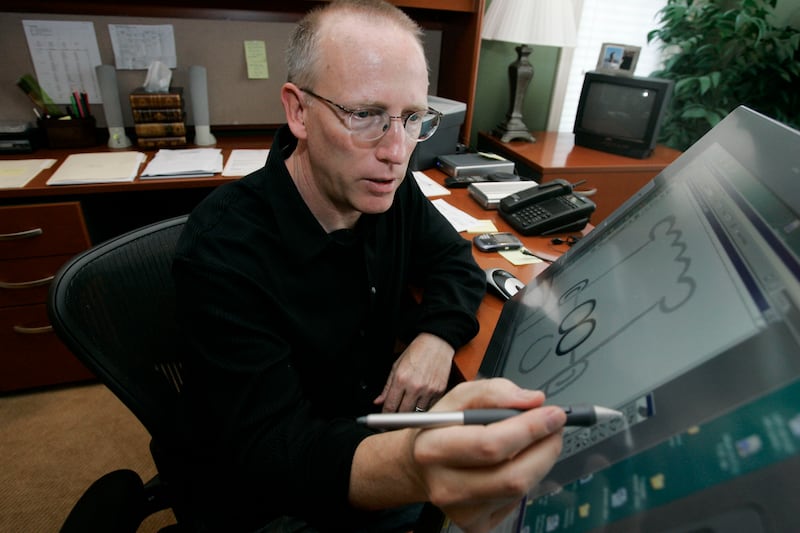

In his final statement to the world, shared on social media on the day he died of cancer, Scott Adams made no mention of the words he said in 2023 that brought on a mass cancellation of the beloved cartoon “Dilbert” and relegated him to the sidelines of mainstream.
He didn’t need to. He knew that it would be mentioned in every obituary, sometimes with emphasis that seemed unnecessarily callous.
“Scott Adams, disgraced ‘Dilbert’ creator, dies at 68,” was the headline on USA Today’s home page. People magazine used the same language, sparking a backlash. Other publications weren’t willing to go that far, but most made sure to work in the controversy in the opening sentence.
Was the focus on the most recent controversy surrounding Adams justifiable? In terms of reporting the most recent and salient facts of a person’s life, of course. Was it fair to Adams, and to his fans and loved ones? They would certainly say not.
Our tendency to evaluate people by the worst moments of their life is most apparent on social media, but also in staff-written obituaries.
It is near certain, for example, that a “White House intern” will be mentioned near the top of the obituary when a certain former president passes, and that “twice-impeached” will be prominent in the obituary of one of his successors. Even Jimmy Carter, widely beloved by the end of his life, suffered the indignity of a Washington Post obituary that mentioned at the outset that he had been “rejected by disillusioned voters after a single term.” Such is the risk of being a public figure whose obituary is written by a journalist, not a loved one.
But the passing of Scott Adams — who also was generally beloved until, abruptly, he wasn’t — offers an opportunity to consider what I have previously called “the timeline of grace.”
If Adams hadn’t been stricken with cancer, if he had lived another 20 or 30 years, would any of the newspapers that had canceled “Dilbert” (including this one) brought the strip back?
Adams himself didn’t think so, saying on YouTube at the peak of fury over his disturbing remarks, “Most of my income will be gone by next week ... My reputation for the rest of my life is destroyed. You can’t come back from this, am I right?”
He was right in one sense. He didn’t come back to the pages of the publications that canceled him, instead continuing to draw “Dilbert” for subscribers and fans, and sharing his thoughts about politics and life on his podcast “Coffee with Scott Adams,” which he continued until the day before he died. Last week, he invited some of his fans to join the livestream, where they shared what he had meant to them as Adams listened and watched, clearly deeply touched.
There is life after cancellation, it turns out, and this was evident on the empathetic faces of people who admired and appreciated Adams for his full body of work, and were not at all dissuaded from their affection by the worst thing he said over the course of a long life.
In fact, it could be said that the worst thing Adams said has now been eclipsed by the best thing he did: which has nothing to do with a comic strip or the many books Adams wrote, but has everything to do with how he faced the end of his life.
In May of 2025, when he announced his diagnosis, Adams was talking about ending his own life when it got too difficult to bear. He had long been a supporter of assisted suicide, in part because of having watched his father suffer at the end of his life.
At the time, he expected to die before autumn arrived. But as the months passed and people rallied around him, including the president he supported, Adams seems to have abandoned that idea, and made comments to that effect. He was working until the end, as much as he was able, while suffering partial paralysis and evident discomfort, despite hospice care. He also honored his Christian friends’ wishes and said he was accepting Jesus Christ as his Lord and Savior, adding poignantly that he hoped his life would qualify him for heaven.
As legacies go, that’s a great one: honoring the wishes of your friends and being useful to the end, and in Adams’ case, likely beyond. The internet has a long memory and won’t let us forget the worst thing that Adams ever said. But for those of us who believe in God and grace, it’s past time to try.