

By the time you read this, the United States may be considering or may have already taken military steps against the Islamic Republic of Iran. For many Americans, that prospect triggers a familiar fear of another Middle East war.
I understand that fear. But I also know what it means to live under a government that survives by crushing hope and what it looks like when a society reaches the point where fear no longer works.
I was born in Iran in 1979, the year the Islamic Revolution reshaped the country. I grew up in Shiraz, one of Iran’s most beautiful and poetic cities. But beauty doesn’t protect you when the state decides you are the wrong kind of citizen. My family belongs to a religious minority that faced intensified persecution after the revolution. My parents were forced out of their teaching jobs. For a period, my siblings and I were removed from school; later, we were blocked from higher education. Like many minorities and dissidents, we learned early that the system was not designed for us to succeed. It was designed to break us.
At 20, I left Iran because I had no real choice. I had to build a life somewhere else — somewhere my future wasn’t predetermined by radical ideology and discrimination. Leaving was painful, but I was at least able to leave.
The question is not whether the U.S. can “create democracy” in Iran. It cannot. The question is whether the free world will do what it can to stop a regime from murdering people who are asking, plainly and bravely, for the right to live freely.
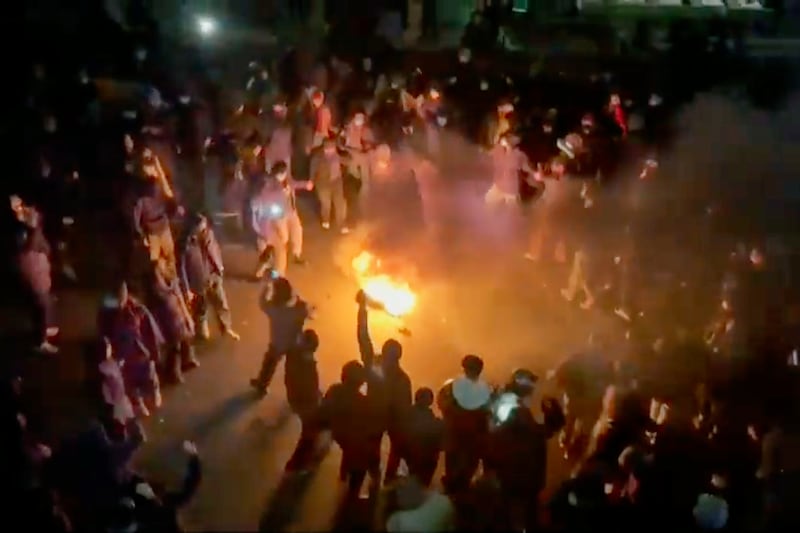
Today, millions of young Iranians are living the life I lived in 2000, but with a cruel twist: They have nowhere to go. They are trapped in a collapsing economy under leaders who respond to peaceful demands with bullets, prisons and blackouts. In recent days and weeks, reports of the crackdown have been horrifying. Death toll estimates vary widely — some reports have cited roughly 2,000 deaths, while opposition outlets claim numbers as high as 12,000.
Last week I saw a message attributed to a young person in Tehran: “We have nothing to lose. If we die, we’d rather die standing than on our knees.” That sentence stayed with me. It captures something new in Iran’s streets: not just anger, but resolve. A generation raised on broken promises has decided that survival without dignity is not survival at all.
Iranians have protested before. They have demanded rights before. And the Islamic Republic has answered with brutality — mass arrests, torture, executions and violence that turns public squares into warning signs. But this moment feels different, not because the regime has grown kinder, but because it has grown weaker.
Iran’s leadership has been battered by events it can no longer control. The country is still reeling from the June 2025 conflict with Israel — the “12-day war” — which included U.S. strikes on Iranian nuclear sites and exposed vulnerabilities the regime spent decades insisting did not exist. The economic picture is equally grim: inflation, currency collapse and deep public exhaustion. Even officials now concede the scale of the turmoil.
So what should the United States do?
First, American policy should be clear about its moral center: Stand with the Iranian people. That includes supporting credible democratic alternatives. Many protesters have voiced support for Reza Pahlavi, and he remains, in my view, the most viable figure to help unify the opposition and guide a transition. At the same time, standing with the people also means prioritizing measures that protect civilians and expand the space for Iranians to organize and communicate — especially when the regime cuts internet and phone networks to isolate the country from the world.
Second, the U.S. and its allies should increase focused pressure on the individuals and institutions responsible for repression — especially the IRGC and the security commanders tied to killings and mass arrests. If military action is contemplated, it should be limited, targeted and designed to deter further slaughter while minimizing risk to civilians. Many Iranians understand the difference between outside support aimed at punishing the regime’s enforcers and a foreign-imposed “regime change” project.
Critics will argue that America has no business getting involved — that Iranians must decide their own future. They are right about one thing: Iran’s freedom cannot be delivered from the outside. But outside actors can still matter. History shows that revolutions are often shaped by whether the world isolates a tyrant or shields him. The question is not whether the U.S. can “create democracy” in Iran. It cannot. The question is whether the free world will do what it can to stop a regime from murdering people who are asking, plainly and bravely, for the right to live freely.
As an Iranian American, I know democracy is not cheap. People pay for it — sometimes with their lives. But the lesson of that cost should not be indifference. It should be urgency: When a government is killing its citizens in the open, the world’s most powerful democracies should not hide behind fatigue.
Iran is at a decisive moment. The courage is already there — in the streets, in the prisons, in the whispered messages that still escape censorship. What remains to be seen is whether the leaders of the free world will match that courage with principled, concrete support — before the regime writes the next chapter in more blood.