
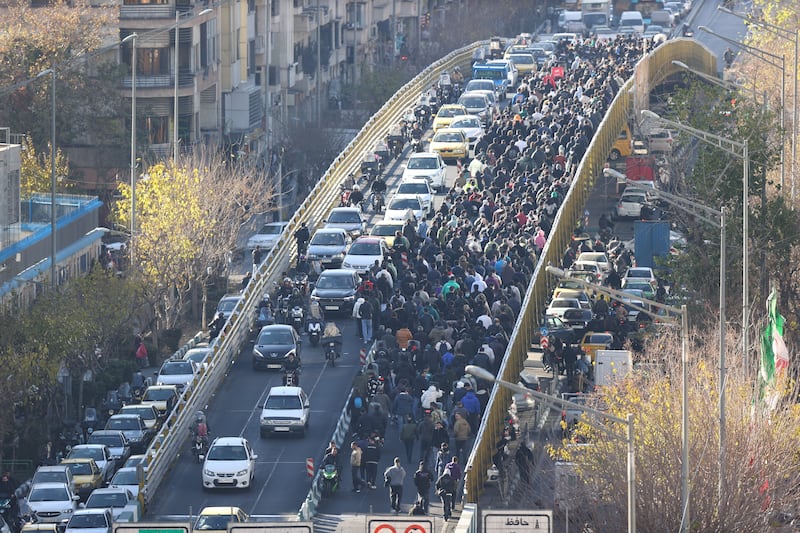

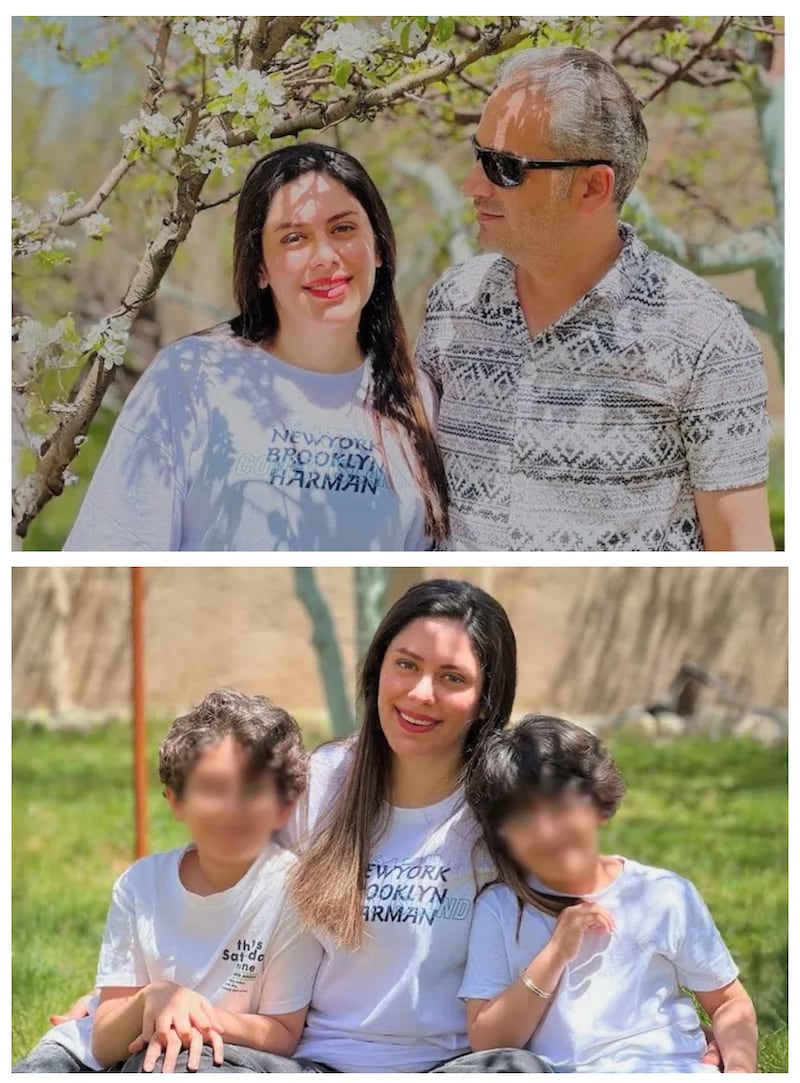
Last Thursday evening, Mansoureh Heydari, left her two children, 7 and 10, with family — before joining her husband, Behrouz Mansouri, in a protest down the streets of the city center of Bushehr, a coastal city in Southern Iran a half day’s drive from Tehran.
According to IranWire, witnesses describe the protest as peaceful until 7 p.m., when the crowd approached the Masjed-e Quran mosque where shots were fired directly into the protesters, along with tear gas, killing 30, including the father and mother.
As of Thursday, 619 recorded protests had taken place in 187 cities. Many people in Iran had hoped that they were witnessing something new emerging. “It’s like a dream. This is Tehran” posted one Iranian Navid Rezvani, an Iranian hip hop artist living in Norway.
First warning ‘If Iran kills peaceful protesters’
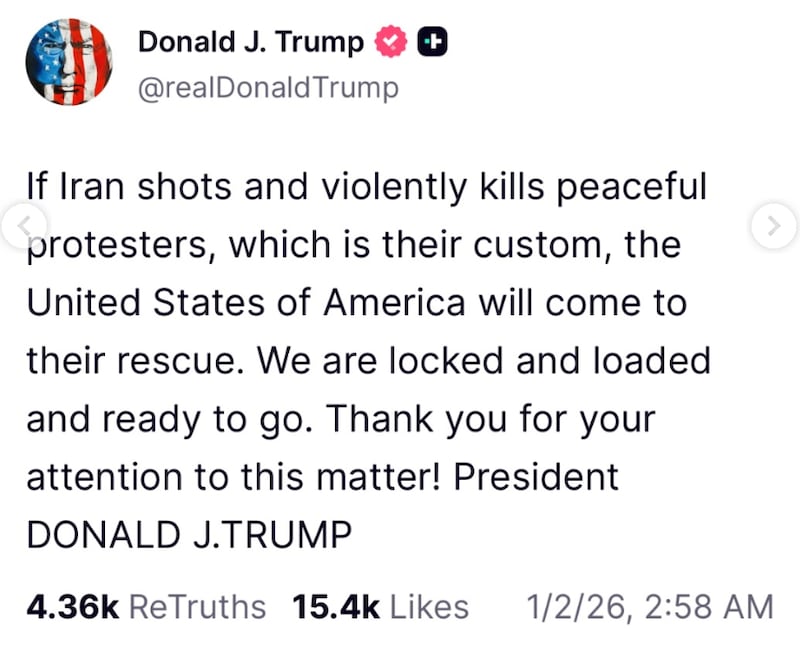
President Donald Trump’s warnings that protesters should not be hurt amplified hopes among some protesters, writing on Jan. 2 that the United States was “locked and loaded” to “come to their rescue” if Iran “shoots and violently kills peaceful protesters, which is their custom.”
By that time, the protests — sparked by a historic devaluation of Iranian currency and a spike in gas prices — had been going on for a week, since Dec. 28. The first fatalities took place the day before Trump’s remark, when one soldier and six protesters were killed in three different provinces.
Hundreds more were killed the following week. Among them was Rubina Aminian, a young college student aspiring to be a fashion designer, shot in the head at a Jan. 8 protest in Tehran. Her aunt, Hilala Noori, told CBS News how her mother searched through stacked up bodies at the morgue to find her. “The children of people, all of them had been shot in their heads, their necks, directly in their heads.”

Noori described Aminian as “a girl who was full of passion and love for life,” who “wanted to create her own future.” She took to the streets “to gain her freedom,” she said.
“I’m proud of her choice, even though it’s very painful for me,” this aunt told CBS. “I hope that her blood has not been spilled in vain.” Noori expressed hope that Trump would follow through on his warning. “It’s now time for action,” she said. “It’s not the time for him to think about what to do.”
Nine days after Trump’s first warning, with an estimated 540 people killed, the president responded that the regime was “starting” to cross a red line — acknowledging an interest from Iran in wanting to “negotiate.”
Second warning ‘until the killing stops’
Eleven days after Trump’s first warning about killing peaceful protesters, estimates of the number of dead range from 3,428 to 12,000 dead, according to Iranian human rights groups and sources inside Iran reported by CBS News. The United States hadn’t taken action yet, but Trump further elevated hopes for action by posting on Tuesday that “HELP IS ON ITS WAY.”
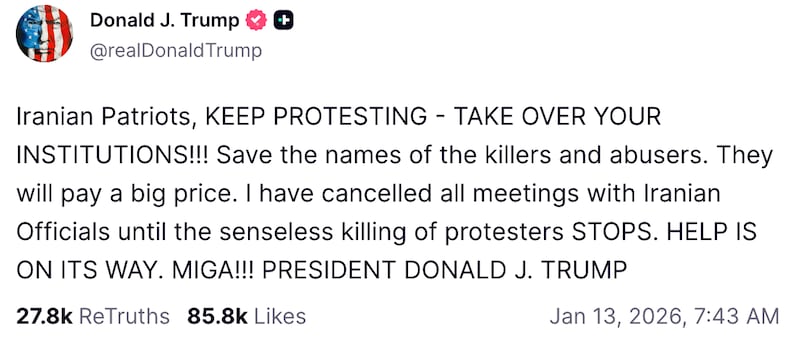
He added that no further conversation would be happening with Iran “until the senseless killing of protesters STOPS.”
When CBS News asked to clarify, Trump said on Tuesday Jan. 13: “There’s a lot of help on the way, in different forms, economic help from our standpoint, and we’re not going to help Iran very much. And, you know, we put Iran out of business with their nuclear capacity.”
The president said “nobody’s been able to give us accurate numbers about how many people they’ve killed.… But it looks like it could be a pretty substantial number, and that’s gonna be a lot of problems for them.”
On that point, Tony Dokoupil pressed, “you did say the U.S. would get involved if Iran started killing protesters.”
“Yeah. Yeah,” Trump acknowledged.
“They have,” the CBS correspondent said. “By the many thousands, according to reports.”
When Trump again pointed to a need for more clarity on numbers, Dokoupil reiterated the point on the mind of so many observers: “Have they crossed your red line, or has the line moved?”
Reflecting on this shifting messaging, Narguess Farzad, senior lecturer in Persian Studies at the University of London, said in a U.K. interview: “I think what is very dangerous is to dangle this carrot in front of them and give them hope. And then not do anything about it and then negotiate.”
‘Mass unlawful killings’
Amnesty International cited verified videos and eyewitness testimony on Wednesday to say “mass unlawful killings” are being committed on an “unprecedented scale.”
A physician was interviewed by the Center for Human Rights in Iran on Sunday about his experience in Tehran following the first days of violence. “The images and data broadcast by the international media do not represent even one percent of the reality, because the information simply does not reach them,” he said.
By Saturday the 17th, the Human Rights Activists News Agency (HRANA) had confirmed a total of 3,090 deaths since the protests began on Dec. 28, with 3,882 additional deaths under review.
These deaths include 2,885 adult protesters and 19 children or teenage protesters under the age of 18, along with 165 government-affiliated personnel and 21 nonprotesting civilians.
Another 2,055 protesters have been seriously injured, HRANA reported, with one estimate reported by IranWire of 600 injured protesters requiring eyes surgically removed.
Security personnel reportedly took some people directly from the hospitals into custody, with approximately 22,123 protesters arrested, including 169 individuals under 18 years old and 52 students (as well as reports of some family members of the slain protesters being arrested).
Third warning ‘if they hang them’
Upon hearing about the threat of expedited trials and possible execution of protesters in the same CBS interview, Trump issued a more specific warning: “If they hang ‘em … we will take very strong action. If they do such a thing, we will take very strong action.”
On Wednesday, from the Oval Office the president said he had learned something from “very important sources on the other side.”
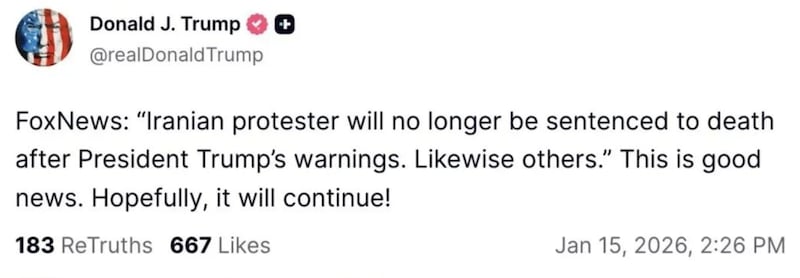
“We were told that the killing in Iran is stopping, and there’s no plan for executions,” the president said. “The killing has stopped. The executions have stopped.”
“It was supposed to be a lot of executions today, and the executions won’t take place.”
With a more narrow threat, the Iranian government appeared to have pivoted based on the U.S. president’s words.
Asked if this means that military action is now off the table against Iran, Trump responded: “We’re going to watch and see what the process is. But we were given a very good statement by people that are aware of what’s going on.”
“This is good news,” Trump wrote on social media Thursday, citing a report about the pause in executions. “Hopefully, it will continue!”
Along with a push from U.S. partners in the Perisan Gulf — including Saudi Arabia and Qatar — to de-escalate, Israeli Prime Minister Benjamin Netanyahu phoned Trump on Wednesday discouraging an attack. According to a person familiar with the call, as reported by CNN, “Israelis didn’t believe the regime would fall quickly without a prolonged campaign, and there was concern over the state of (Israel’s) missile defenses.”
Iranian hopes for more help
A cousin of one of the arrested protesters, Erfan Soltani, who had been threatened with executions, expressed a hope that “that Trump truly stand behind the words he said, because the Iranian people came to the streets based on those statements,” she told CNN.
“An unarmed population trusted these words and is now under gunfire.”
Although people were already protesting before Trump’s statements, and an internet blackout has limited how much normal Iranians have been able to follow outside developments, it seems clear to observers that Trump’s statements have encouraged many protesters.
For instance, the family of Siavash Shirzad attempted to dissuade him from joining the protest. According to Karim Sadjadpour in the Atlantic, this 38-year old responded, “Trump said he supports us. I’m going.”
He was among those killed. “Trump’s exhortations altered the risk calculus of many protesters,” Sadjadpour concludes.
Iranian-American journalist Masih Alinejad, who had survived three assassination attempts by Iran, said in a Monday interview: “My heart is broken when I get bombarded by videos of people in Iran saying to me that they’re going to the streets and they’re not sure whether they’re going to come back or not.”
“This is a war. The Islamic Republic waged a war against innocent people.” For those living in safety and freedom of Western countries, Alinejad asked whether people were really suggesting that Iranian people should “overthrow a regime with guns and bullets with nuclear weapons with bare hands?”
“Enough of a statement … words and condemnations doesn’t save lives.” Specifically, she spoke of “military action against the Revolutionary Guard base” which in addition to the capture of the Supreme Leader, she called “the dream of millions of people.”
She expressed hope that Europe could “stand up with the people of Iran and join the American government to take a strong action and allow people of Iran to make decision about their future. What we want is very clear fair and free election.”
Farzad described blogs coming out of Iran addressing Trump and saying “you’re about to celebrate the 250th anniversary independence. Remember who helped you.… Think of the French who helped you. Don’t forget that big picture. You know. You overthrew the rule of the mightiest empire of the time with help of outsiders.”