

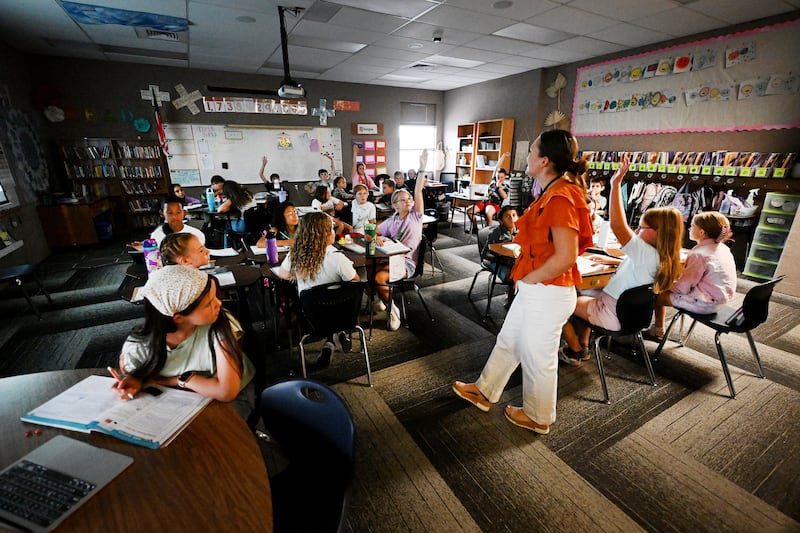
Recently, the Kem C. Gardner Policy Institute released a report showing that just over half of Utah’s third graders are considered proficient in reading. Although Utah is one of the top 10 states in the nation for reading achievement levels, according to the National Assessment of Educational Progress (NAEP), we can all agree that 50% is not good enough.
In Utah, we expect the public education system to empower students to engage in post-secondary opportunities, provide for themselves and their families, and pursue personal goals. Strong literacy is the cornerstone of all learning, in school and beyond.
Research underscores the importance of early literacy, indicating that strong early literacy supports future academic, economic and civic outcomes. We don’t just want to reach our statewide goal of 70% proficiency; we want to exceed it.
Utah’s efforts to improve early literacy
While there is still room for improvement, there are many steps that have been taken to make achieving our goal possible.
First, I would like to thank the Kem C. Gardner Policy Institute for its work in highlighting the need for better literacy outcomes. As a member of the Utah State Board of Education (USBE), I have helped the Board renew its commitment to improvements in literacy. This can be seen in the Board’s revised mission statement, “Academic and organizational excellence in Utah education for an elevated, educated citizenry.”
Second, I want to highlight the commendable work being done in literacy for families in Northern Utah.
At Adele C. Young Intermediate School, Lyndsie Daines, the school’s instructional literacy coach, isn’t waiting for legislation or policy changes. Lyndsie has implemented an intensive literacy program aimed at incoming sixth graders reading below grade level. At the end of her program, 90% of her students read at or above grade level. Her contributions are invaluable to the community, and her expertise is sought after by other schools, including adult education programs in Brigham City. Lyndsie Daines, thank you for proactively addressing literacy needs in your community. This is a great model for others moving forward.
The Cache County School District has also prioritized literacy in its elementary classrooms by training hundreds of paraeducators to support literacy efforts. They have also revised educator evaluations to emphasize effective instruction and classroom management.
In the last few years, higher education has dramatically improved its literacy training for preservice educators, which requires a literacy competency test to teach in Utah. Additionally, the USBE has provided extensive training for all elementary educators in the Science of Reading.
I am appreciative of the education leaders at all levels who have been actively driving literacy progress for Utah’s children. But we cannot become complacent.
As we move forward, our limited time and resources must be utilized with intentionality and purpose. We cannot expect schools to resolve every community issue without compromising our core goal: academic excellence.
It’s vital to scrutinize the role of technology in our classrooms to truly understand its impact on our children’s learning. Collaborating with families, teachers and education leaders is essential for fostering strong reading and writing skills in our students. Consequently, prioritizing high-quality curriculum materials and literature is imperative.
Nearly all children can learn to read with systematic instruction and timely support. It is our duty to provide that.