


Are we experiencing a religious revival? “No,” says political scientist and statistician Ryan Burge, writing for the Deseret News.
While it is true that the decline of churchgoing and the rise of the religiously unaffiliated has leveled off, Burge is right when he says we have not seen a “sustained, measurable rise in religious attendance.” And he is not alone in voicing skepticism about anecdotal stories of revival.
Daniel Cox of the American Enterprise Institute agrees that we are not at an inflection point of religious awakening. He cites flat or waning attendance rates for churches, especially the recent decline of female attendees, and continued disillusionment with religious institutions.
The data, in other words, is straightforward. “Recent polling shows no clear evidence of a religious revival among young adults,” reads a recent Pew headline. According to Pew’s report, today’s young adults demonstrate less religious interest and participation than older cohorts. A surge of young adults to churches is simply not statistically supported, leading Cox to call religious awakening an “illusion.”
But while statistical evidence has authority, it is not exhaustive. There is more to this story.
Vibes matter
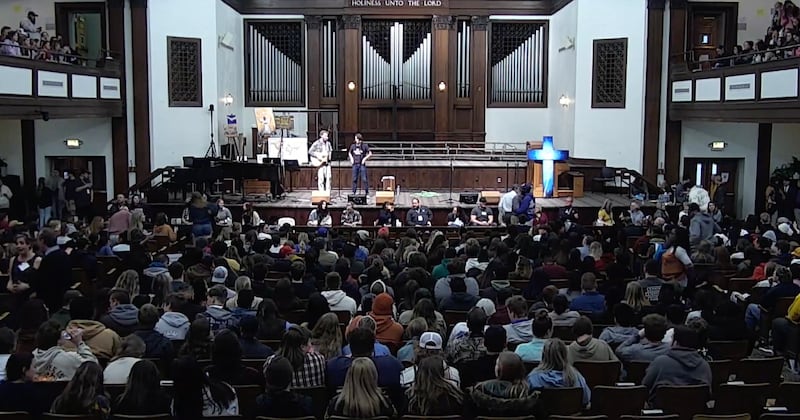
As someone who had a front row seat at Asbury University in 2023 for an unplanned, multi-week outpouring of 50,000 people seeking a spiritual encounter, I am especially sensitive to questions of spiritual awakening in our country. While I have never used the word “revival” to describe our present moment, I do not support a “nothing to see here” response to surveys and church attendance metrics.
Burge’s argument, he says, rests on concrete statistical methodology, “not vibes.” I get the point. Responsibly assembled data can transcend our biases and provide an unvarnished picture of reality. But just because statistical evidence is important doesn’t mean that vibes aren’t.
Economist Kyla Scanlon has made this point. Years ago, she coined the term "vibecession" to describe the dissonance between positive economic metrics and negative consumer sentiment. Common economic indicators like the S&P 500 or the unemployment rate, says Scanlon, cannot capture everyday experiences or internal sentiments like affordability concerns, financial stress and institutional trust.
Similarly, there are spiritual vibes that are real, felt and evident but map poorly, if at all, to a conventional metric like church attendance, particularly when you consider Gen Z’s well-documented skepticism of institutions. This might include reengagement with ultimate questions, shifting moral and spiritual imaginations, secular disillusionment or spiritual practices emerging outside inherited institutional forms. “We see both a significant move away from organized religion and, simultaneously, surprising pockets of spiritual seeking and even a resurgence in certain areas,” according to a recent report on Gen Z spirituality.
Barna Group CEO David Kinnaman says there is other evidence of a “renewed spiritual openness.”
For example, an additional 10 million Americans have identified as Bible readers according to a 2025 report by the American Bible Society, and the YouVersion Bible app recently exceeded 1 billion downloads. Over the past two years, the UniteUS movement has held multiple large-scale worship gatherings on college campuses in the U.S., with more planned for the future. Here, students are congregating for worship, altar calls and spontaneous baptisms. Also in recent years, Passion gatherings have filled stadiums with college-age students. (Whatever your religious affiliation, it is moving to watch 55,000 young adults sing “Agnus Dei" a cappella).
During the same period, we have seen thousands of baptisms across the United States. In September of 2025, for example, the “Baptize America” initiative had more than 650 churches participate and reported 30,000 baptisms.

And we continue to see broader trends of increasing belief in America. In a recent Barna survey, nearly two-thirds of adults declared a personal commitment to Christ that is meaningful to them today, much of which is occurring in young adults. “Since the pandemic … Millennials and Gen Z have shown significant increases in commitment to Jesus,” reads the report.
Whether in felt experience or observable data, there is evidence to suggest a spiritual shift occurring, particularly in young adults.
Spiritual fervor is not enough
But the story of revival is broader than our country’s collective spiritual temperature. Fervor, zeal, emotion — vibes — will flare out if not channeled into formative institutions that shape our character, foster growth and root us in the thoughts and practices necessary for spiritual maturation. This is a key New Testament theme. Letters from the apostle Paul often contrasted undeveloped spiritual zeal with enduring formation marked by community-facilitated discipline, obedience and long-suffering.
Such “maturity in Christ” (Colossians 1:28) is fostered and embodied in robust institutions, what author Yuval Levin describes as durable forms of common life: churches, ministries, schools and families. They are a key dimension in any story of revival.
Institutions are formational — an ecosystem of identity-shaping narratives, knowledge and habits. However, writes Levin, many of our contemporary institutions, including the church, have transformed from places of formation to platforms of performance.
And what happens when religious zeal is not disciplined and fostered in durable institutions? It goes somewhere else. Tara Burton’s book "Strange Rites" makes the point that the decline of institutional religion is not correlated with a rise of unbelief or religious disinterest. Rather, she argues, weak institutions give way to a highly personalized, intuitional religion conditioned by consumerism, politics, pop culture mythology or internet dynamics.
Where churches are strong, rooted, durable and demanding, they provide a conduit to receive and transform a spiritually porous generation. Young adults, for example, do not want undemanding Christianity or entertainment-driven, performative services; they want something authentic to anchor into amidst the dynamism of the moment. (The Eastern Orthodox Church provides an interesting case study.)
Beyond spiritual zeal, the story of revival will rise and fall proportionate to the strength of our institutions and their ability to channel that zeal into mature faith.

Depth is greater than density
Choosing to go to church regularly is what economists call a revealed preference, or “voting with your feet.”
But sheer numbers do not capture spiritual depth. We don’t need a statistical majority of Americans to identify as Christian to celebrate spiritual renewal in the country. The vitality of Christianity has never depended on volume so much as on the presence of robust communities capable of sustaining belief, practice and Christ-like virtues over time.
Mature faith shows up not only in attendance, but in endurance, moral seriousness, biblical faithfulness and the willingness to be formed rather than merely energized.
Posterity will assign the appropriate label to our moment, but prospects of revival will ultimately depend on our formation, not our fervor.
Kevin Brown is president of Asbury University in Wilmore, Kentucky.