




It’s not often that a hot-button political issue garners bipartisan support. But both Republicans and Democrats have played key roles in the ongoing policy battles related to protecting kids from social media and AI harms, without either side dominating.
That may be changing, however.
Consider former Chicago mayor Rahm Emanuel, a Democrat and former chief of staff for President Barack Obama. Emanuel is eyeing a run for president, and he is touring the nation to speak with voters. In Mississippi, he told audiences that he supports Australia’s social-media ban for kids under 16 and said the U.S. should follow suit. “The clock is ticking for America’s kids,” he wrote recently on X. “Protecting our kids from Big Tech algorithms will yield to long-term safety for our youth.”
Emanuel is right: social media and the purposefully addictive tech behind it are hurting kids. But as Jonathan Haidt points out, it’s not simply nefarious content that poses a risk; it’s the tech itself, which changes the way we view ourselves, each other and the purpose of life.
Dr. Victoria Dunckley coined the term Electronic Screen Syndrome to describe a growing problem among adolescents with excessive exposure to interactive screens. She says kids who spend too much time in the virtual world become pathologically “dysregulated” — they lose or never develop the ability to function in the normal, slower and less stimulating rhythms of real life. These screen-addled kids, according to Dunckley, are increasingly unable to modulate their mood, emotions and attention.
Scott Galloway, in his recent book “Notes on Being a Man”, found that the “addiction economy,” built on internet porn, gaming, gambling and social media, is hooking more and more young men, with predictable results. Male isolation, idleness and deaths of despair have surged in recent years.
Now, the rise of artificial intelligence is posing new threats. We’re seeing stories about kids developing emotional relationships with AI chatbots, sometimes resulting in tragedy after the bots encourage kids to harm themselves or others.
Emanuel isn’t the first to notice the problems. Plenty of Republican leaders have played leading roles in the fight against Big Tech. Utah’s Spencer Cox was the first U.S. governor to sign legislation regulating children’s access to social media. Ron DeSantis, the Republican from Florida, was the first U.S. governor to sign a bill banning cellphone use in public school classrooms.
Sen. Josh Hawley (R-MO) has aggressively advocated for tech regulation, including introducing a bill to ban AI chatbots from interacting with minors. Tennessee Sen. Marcia Blackburn is a leader in developing the Kids Online Safety Act (KOSA), which would force tech companies to make their products less dangerous for children. And, more recently, Sen. Lindsey Graham (R-SC) has introduced a bill to sunset Section 230 of the Communications Decency Act, a provision that has shielded social media companies from liability for harms to minors.
Additionally, Republican-led states, including Utah, Louisiana, Texas and Arkansas, have led the trend of passing age-verification laws for online pornography resulting in a landmark Supreme Court victory, Free Speech Coalition v. Paxton.
But a growing number of Democrats, including leaders in Washington, are also taking on the fight against Big Tech.
Connecticut Sen. Richard Blumenthal has long been a vocal supporter and sponsor of KOSA, and Minnesota Sen. Amy Klobuchar is well established as a fierce critic of Big Tech. Newer voices are also emerging, such as Massachusetts Rep. Jake Auchincloss. In a New York Times op-ed entitled “Digital Dopamine Is Consuming America. It’s Time to Fight for IRL,” he wrote that Big Tech “is routing young men to online sports betting, pornography and bot-infused social media platforms, like Meta, whose policies at one point deemed it ‘acceptable’ for bots ‘to engage a child in conversations that are romantic or sensual.’”
Auchincloss added, “Young men are the worse for it, in both work and love.” He is calling for a range of measures to protect kids.
Indeed, clear majorities of Republicans and Democrats across the nation have expressed concern about technology’s effects on children and shown a willingness to back legislation to advance “guardrails." One Fox News poll found that 64% of voters support banning social media for children under 16, including 73% of Republicans and 56% of Democrats.
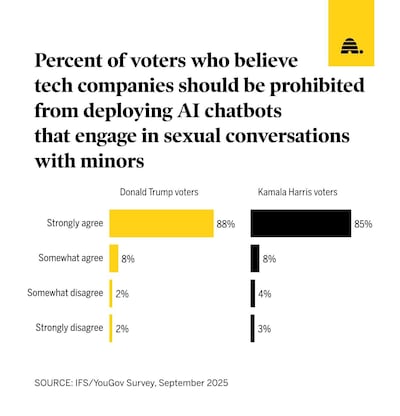
A September survey from the Institute for Family Studies found that Americans want Congress to prioritize protecting children from AI-related harms by a margin of 9 to 1. The same survey found that 88% of Donald Trump voters and 85% of Kamala Harris voters strongly agree that tech companies should be prohibited from providing access to chatbots that engage in sexual conversations with minors.
But popular support for stronger measures has run into problems — from Republicans. In 2024, GOP leaders in the House let KOSA die. Last month, the White House issued an executive order designed to limit state-based efforts to regulate AI.
This has frustrated state leaders at the forefront of the battle. Utah’s Cox put it this way to us: “Republican governors are leading the way in holding Big Tech accountable, but we can’t do it alone. Right now, states are carrying much of the responsibility to protect kids from the risks of social media and AI. We need stronger partnership and clearer support at the federal level so families aren’t left waiting while technology is accelerating.”
The reluctance of some DC Republicans to protect children and families from Big Tech is due in part to the party’s more libertarian wing, who are generally resistant to government regulation, as well as the involvement of tech bros in White House tech policy. Trump’s AI czar, David Sacks, hails from the Bay Area and is deeply invested in AI development — perhaps explaining why he helped author Trump’s executive order halting state AI regulations. He’s been aided by Sriram Krishnan, the senior policy advisor on artificial intelligence at the White House, who is a former partner at the Silicon Valley venture capital firm Andreessen Horowitz.
All this helps to explain why, despite a 99-1 defeat in the Senate earlier this year and significant opposition from voters, some GOP leaders have continued to push measures that would preempt state regulation on AI.
All this also means that tech-friendly Republicans in DC are in danger of sidelining the party when it comes to one of the biggest and most popular political fights related to American families. The first political party to champion reasonable regulation of Big Tech at the national level will claim a consequential win for families — and a political win for itself.
Maria Baer is a contributing writer at the Institute for Family Studies. Brad Wilcox is Distinguished University Professor of Sociology at the University of Virginia and senior fellow at the Institute for Family Studies.