

In January, Donald Trump announced the most extreme legal immigration policy in U.S. history. Strangely titled “Protecting the American People Against Invasion,” the policy not only bans citizens from 93 countries (including 70% of African countries) but also severely restricts the migration of spouses and minor children of American citizens from many of these same countries.
According to the Cato Institute, this ban, along with previously barred immigrant visas from 40 countries, “brings the number of banned nationalities up to 93, ... equaling nearly half of those who immigrated legally from abroad in 2024.”
For two and a half centuries, the United States has stood as a “shining city on a hill,” a beacon to the world, defined not only by its Constitution and its economic dynamism but also by its willingness to open its heart and its doors to those from across the world seeking a better life. The American story is, at its core, an immigrant story. From the earliest settlers to the millions who arrived through Ellis Island and since, the United States has been shaped, strengthened and continually renewed by those who came from beyond our borders.
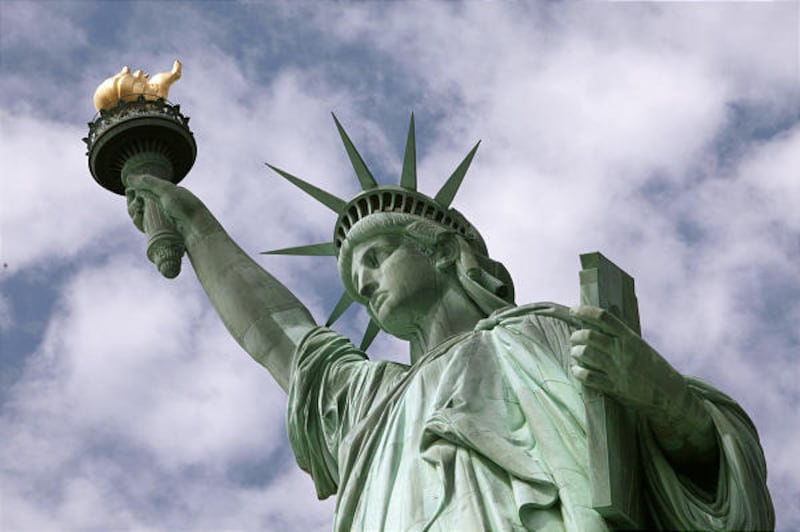
Few symbols capture this ethos more powerfully than Emma Lazarus’s poem engraved at the base of the Statue of Liberty, “The New Colossus,” whose words — “Give me your tired, your poor, your huddled masses yearning to breathe free” — have long served as a moral measurement of our generosity and compassion. They articulate a promise that the United States has aspired to uphold: that liberty is not a privilege reserved for the few but a refuge offered to the many.
That promise now seems uncertain.
Supporters of these new policies often frame them as necessary measures to protect national interests. But critics argue that they represent a narrowing of America’s identity — an inward turn that risks undermining the very qualities that have made the country exceptional. From the beginning, the United States has never been a nation defined by homogeneity. Its strength has come from its diversity, its openness and its willingness to embrace those who arrive with little more than hope.
A country that stops welcoming new immigrants risks stagnation — economically, culturally and demographically.
The irony, of course, is difficult to ignore. The architects of these restrictive policies are themselves descendants of immigrants — people whose families once crossed oceans and continents, fled danger and hardship, and sought refuge or opportunity on these shores. Their ancestors were not uniformly wealthy, educated or highly skilled. Many arrived penniless. Many spoke little English. Many were viewed with suspicion by those already here. Yet they were allowed to stay, to work, to build and ultimately to contribute to the nation’s growth and richness.
To close the door now is to forget that history — and to imperil our future because of the critical role immigration has played in America’s success. Immigrants have fueled innovation, filled essential and unwanted jobs, revitalized communities, and enriched the cultural fabric of the nation. They have served in the military, launched businesses, raised families and created some of our best literature, art and music while weaving themselves into the American tapestry. Restricting immigration on such a sweeping scale risks not only moral consequences but practical ones. A country that stops welcoming new immigrants risks stagnation — economically, culturally and demographically.
Moreover, the United States has long been a refuge for those fleeing violence, persecution or instability. When the wealthiest nation in history signals that its compassion has limits, the consequences ripple far beyond its borders. Other countries take note. Global leadership shifts. The moral authority the U.S. has claimed for generations becomes harder to assert.
Critics of the visa suspensions warn that the long-term effects could be profound. If the United States ceases to be a place where people from around the world can seek safety and opportunity, its future may look vastly different. The country’s population growth is certain to slow, its workforce to shrink, and its creative and innovative reputation to diminish, all leading to a waning of its global influence.
The United States now faces a choice. It can continue down a path of restriction, narrowing the definition of who belongs. Or it can reaffirm the values that have guided it for centuries — the values embodied in Lazarus’ poem and in the countless stories of those who came seeking freedom.
The “golden door” of Lazarus’ poem is not merely a metaphor. It has been an open portal of hope for over two centuries. To close it is to turn away from the very idea of America.