


Politicians are good at counting votes; less good at leading crusades. Advocates who want to see politicians lead, rather than reflect, cultural change, are often disappointed.
The drive to redefine marriage to include same-sex couples is a useful example; it wasn’t national politicians who helped change the polling. Only after a decade-plus push of cultural and social messaging to change attitudes, when a majority of Americans told pollsters they supported gay marriage, did President Barack Obama announce he had “evolved” on the issue.
Similarly, the movement that wants to protect unborn babies from abortion faces a similar challenge. To succeed, it has to win the culture, not just the next election. And it’s facing headwinds in the prevailing politics of the day.
In a post-Dobbs era, with states newly able to regulate abortion, the issue has lost the internal coherence that once made it a unifying message for the right. “End Roe” is a simpler, more powerful message than answering “…and then what?” Abortion opponents have generally lost at the ballot box, their political push complicated by the at-times frosty relationship with their long-time allies in the Republican Party.
The undercurrent of tension was notable at this year’s March for Life. Ahead of the event, long-time stalwarts like Kathryn Jean Lopez, Daniel Lipinski, Peter Laffin and Alexandra DeSanctis Marr —all sincere voices dedicated to ending abortion — pushed for a more confrontational approach to the Trump administration. Abby Johnson, a prominent abortion opponent, said her movement had been “betrayed.” Some were uncomfortable with the selection of Vice President JD Vance to speak to the March for Life, recalling his seeming support for the abortion-inducing drug mifepristone in 2024. Hecklers even interrupted his remarks.
There are indeed steps the Trump administration should take to better protect the unborn. But some of the righteous impatience of abortion opponents risks turning counterproductive.
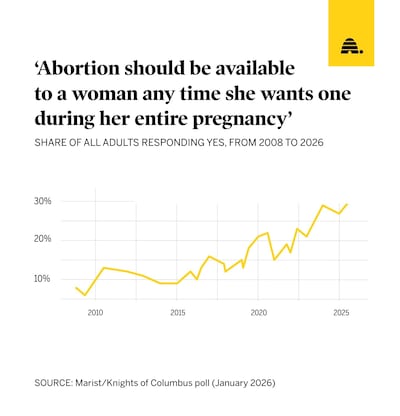
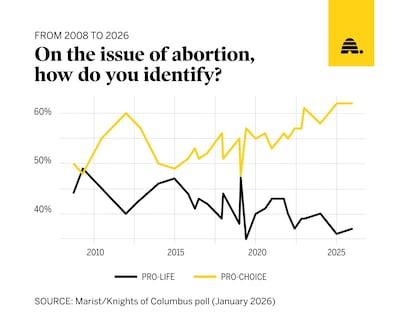
A new survey underscores the headwinds that pro-lifers face. The share of Americans who identify themselves as “pro-choice” stands at 62%. A full one-third of respondents say that abortion “should be available to a woman any time she wants one during her entire pregnancy.”
As recently as 2015, America could be said to be narrowly divided on abortion, with 49% of respondents describing themselves as “pro-choice” and 47% as “pro-life.” Since then, much has changed — Roe is gone, college-educated voters have swung left, and social media has been abuzz with misinformation about maternal mortality. The divide is now a chasm; “pro-choice” beats out “pro-life” by 25 percentage points, 62 to 37%.
With that reality in mind, even a meaningfully anti-abortion administration would face constraints. Some abortion opponents dream of national abortion limits or completely banning mifepristone. Politicians who commit to these kind of long-shot gambits may, paradoxically, make anti-abortion goals harder to achieve by raising the political salience of the abortion question.
Of course, acknowledging the limits of public opinion should not be an excuse for cowardice. Since Dobbs, abortion clinics have closed and red states have passed anti-abortion laws, yet the number of abortions is not down, largely due to the Biden administration’s Covid-era expansion of abortion pill access. Until 2021, you needed an in-person visit with a physician to obtain mifepristone; now, an online or telehealth visit suffices (with predictable consequences). This White House has been gleefully overturning other Biden-era regulations; often, rightly so. But its reluctance to reinstate pre-Covid guidance around the abortion pill smacks less of prudence than of an upcoming midterm election.
There is some good news for abortion opponents: the public is friendly to commonsense safeguards. Fifty-eight percent of men, and 61% of women agreed that an in-person visit should be required before obtaining abortion-inducing drugs. So abortion opponents should continue to turn up the heat on the administration on this specific request. The administration seemed sensitive to the pre-March for Life pressure, setting new limits on embryonic stem cell research, introducing a ban on federal funding for research on abortion-derived fetal remains, and somewhat backtracking on the president’s call for “flexibility” around taxpayer funding of abortion.
Some, seeking to up the pressure, have called for the firing of FDA Commissioner Marty Makary. But neither Makary, nor Health and Human Services Secretary Robert F. Kennedy Jr., nor the vice president, nor the rank-and-file conservatives who staff this administration, are ultimately deciding where to invest the administration’s political energy. It’s their boss in the West Wing, and his tight circle of top policy advisors, who are calling the shots, just as Trump nearly single-handedly rewrote the GOP platform to soften longstanding abortion language.
Misplacing their angst toward members of the administration will not be as effective as directly and candidly noting that Trump is, effectively, upholding the Biden administration’s abortion pill changes and calling on him to do the right thing.
Abortion opponents must also remember that their ultimate goal is not won on the cycle of mid-term elections. That is made more difficult when high-profile pro-life evangelists lose focus and weigh in on other contentious issues, including the recent shootings in Minneapolis. They should recall the progressive groups whose “mission creep” has watered down their own influence, as has happened to the Sierra Club, Planned Parenthood and the teachers’ unions that opted for “intersectionality” and became part of the progressive “omnicause.” Abortion opponents must avoid a similar temptation.
The goal of any social movement, particularly one that touches on deeply personal issues, is seeking converts, not heretics. It’s not just Vice President JD Vance who should be welcome at the March for Life, but politicians from either party willing to commit to investing in parents, reducing the need for abortion, and advancing laws that could protect more unborn children.
Any politician with sufficient longevity will always disappoint his or her allies, because their job is to weigh what the broader voting public will and will not accept. To place too much focus on fractures among the 37% of Americans who proudly describe themselves as “pro-life” is to risk losing sight of the ultimate goal — reaching and converting some share of the 6 in 10 Americans who don’t.