
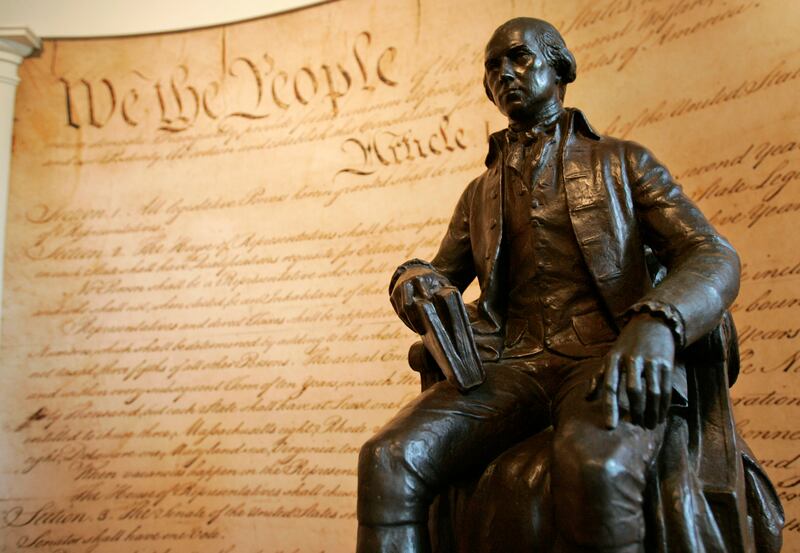

Does the Constitution still matter?
My law students — and many other law students across the country — wonder about this openly now. Not as an abstract theoretical question but as something urgent and unsettled.
The clear answer is yes, it still matters. But it matters in a way that is far more fragile and provisional than we often admit.
Constitutional protections do not automatically hover above events. They turn, again and again, on facts. And that dependence raises a harder question for our moment: What happens to constitutional rights when the facts themselves are endlessly disputed?
In constitutional law, especially under the First Amendment, everything depends on distinctions. Peaceful dissent versus regulable conduct. Speech versus action. Filming versus interference. Protest versus threat.
The legal code is full of lines like these — lines that are supposed to limit government power and protect dissent even when it is uncomfortable, disruptive or angry. The premise is that courts can identify what happened, sort expression from violence and then apply constitutional rules accordingly.
But that premise seems to be breaking down.
We live in a post-truth environment where evidence no longer settles disputes but becomes another battlefield itself. Every video is partial. Every encounter is narrated twice. Every death produces competing timelines, each asserted with absolute certainty. There is little space left for the possibility that our initial interpretation might be wrong. Narrative hardens instantly into convicted conclusion.
Consider how quickly constitutional status turns on characterization. A person standing silently with a sign is engaging in protected political speech. Step two feet closer to an officer and the same act may be labeled obstruction. A raised voice is protest until it becomes “disorderly conduct.” Holding up a phone is documentation until it is reframed as interference.
In each instance, the Constitution does not change. The story about what happened does.
The killing of Renee Good exposed this dynamic starkly. From the outset, there was no stable factual ground on which to stand — conflicting accounts of what led up to the confrontation spread almost immediately. Each version carried moral weight, but there was no agreed-upon reality that could anchor constitutional judgment. If everything is interpretation, then constitutional law becomes unmoored.
And then came the killing of Alex Pretti.
Whatever uncertainties remain, the Pretti shooting feels different — not because it lacks complexity but because the brutality is harder to abstract away. A man filming federal agents, later pinned to the ground, shot multiple times. The distance between dissent and lethal force collapses. The elasticity of “threat” stretches to the breaking point. What is laid bare is not just a disputed encounter but also a system in which the government’s interpretation of events carries decisive, often irreversible force.
This instability is not neutral. When facts are contested, the version offered by those with institutional authority tends to harden fastest. Police reports, official statements and government press releases often become the default frame before independent evidence can be assessed. By the time alternative accounts emerge, the constitutional analysis has already begun to tilt around the government’s narrative.
This is where post-truth becomes a constitutional problem. If our rights hinge on facts, and facts are endlessly malleable, then constitutional protection becomes conditional — and dependent on whatever interpretation a government authority happens to reach.
In this way, speech is protected until it is reclassified as interference. Filming is lawful until it is reframed as menace. Protest is permitted until it is redescribed as resistance. The line does not move because the law has changed. It moves because the accepted narrative has.
In theory, courts are meant to step in here. To slow things down. To test narratives against evidence. To insist that constitutional boundaries cannot be erased by fear or convenience. But courts arrive late, if they arrive at all. And constitutional remedies mean little when the harm is already done.
The tempo of modern life compounds the problem. Constitutional law assumes time for investigation, evidence gathering and adjudication. But public judgment now forms instantly. Videos go viral before context is known. Officials respond before facts settle. Force is justified in real time, while constitutional review happens months or years later, if it happens at all. Rights meant to constrain power in moments of crisis are instead evaluated only after the crisis has passed.
So when my students ask whether the Constitution still matters, what they are really asking is whether it still constrains power in real time, or only narrates its excesses after the fact. They’re wondering whether rights protect people when it is hardest to protect them, or only when doing so is easy and uncontroversial.
As I keep telling them, the answer is yes. The Constitution still matters in moments of real difficulty. But not automatically, and not on its own. The country’s founding document matters only if facts can still be stabilized long enough for law to do its work, and only if institutions are willing to resist the gravitational pull of expedient narratives — official stories that simplify or justify the use of power before the facts are fully known.
Stabilizing facts does not mean demanding perfect certainty. It means institutional patience, evidentiary rigor and a cultural willingness to resist instant moral closure. It requires treating truth as something to be discovered rather than declared. Without those habits, constitutional law loses the ground on which it stands.
The Constitution does not enforce itself. It relies on shared habits of care in describing events. It relies on our willingness to pause long enough to ask what happened before deciding what it means or how we feel about it. When that step is skipped, the Constitution does not disappear. It simply never turns on.