

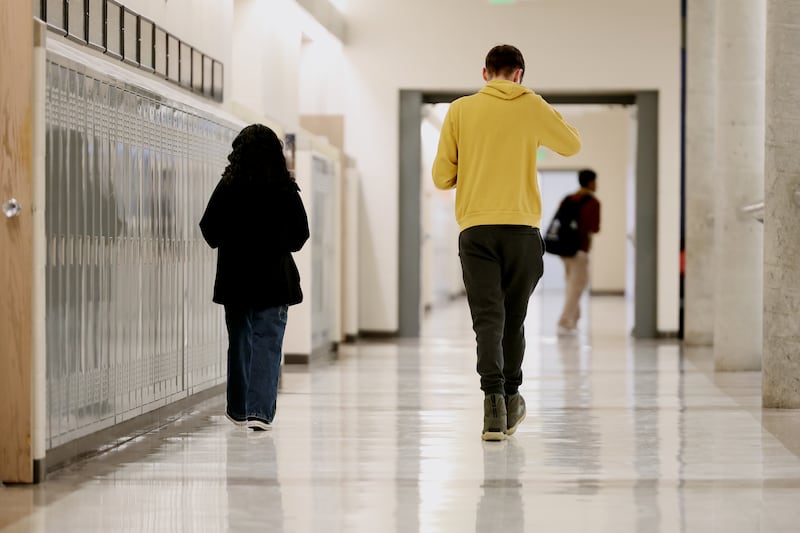
2025 was a hard year for many young people in Utah. Violence — both witnessed and experienced — has become a growing part of their daily reality. Parents feel it too. I hear more and more worry about school and community safety, yet I also hear a familiar refrain: “Utah is a safe place to raise families.”
But that raises a harder question: Do our kids actually feel safe here?
For years, I’ve studied the Centers for Disease Control and Prevention’s Youth Risk Behavior Survey (YRBS). And recently, an op‑ed in The Salt Lake Tribune — “As an assistant principal, I spoke up for more safety at this high school” — caught my attention. The author described a deep, persistent fear for her students and for herself. Many Utahns may be tempted to dismiss that fear as an outlier, but her experience aligns with what the data has been signaling for years.
Below are three of the most concerning findings from the CDC’s most recent data, from 2023:
Students carrying weapons on school property
The CDC defines this as bringing a gun, knife or club to school on at least one day in the 30 days before the survey. Utah’s numbers have been higher than the national average for most of the past decade.
In 2023, the likelihood that a student carried a weapon increased steadily from 9th (3.9%) to 10th (4.3%) to 11th (7.8%) and finally 12th grade (10.2%). The CDC only reported data for white and Hispanic/Latino students; among them, white students reported significantly higher rates (7.0% vs. 4.1%). While males reported the highest levels at 8.6%, female students’ rates were still troublingly high at 3.9% — far higher than most Utah parents would ever imagine.
To put that into perspective, Utah has roughly 185,000 high school students (about 46,250 of whom are 12th graders). If 10.2% of 12th graders carried a weapon to school in the past year, that represents about 4,700 students.
Students carrying a gun
The CDC also tracks gun carrying over a 12‑month period, excluding days when a gun was carried solely for hunting or target shooting. Nationally and statewide, gun carrying has declined slightly since 2017. Utah, however, has remained slightly above the U.S. average every year.
In 2023, males (4.3%) reported higher rates than females (2.8%), and the highest numbers appeared among 9th (4.2%) and 12th graders (4.3%). Again, the CDC only reported data for white and Hispanic/Latino students — and this time, Hispanic/Latino students (7.0%) reported significantly higher rates than white students (2.5%).
To put this into perspective again, Utah has approximately 92,500 high school girls. If 2.8% carried a gun at least once in the past year, that represents about 2,600 young women. For young men, the number is nearly 4,000.
High school students who experienced sexual violence by anyone
This measure includes “kissing, touching, or being forced to have sexual intercourse that they did not want to do, one or more times during the 12 months before the survey.” Although not limited to school settings, it remains central to understanding youth safety.
Utah’s rates have been significantly higher than the U.S. for years. In 2017, 17.6% of Utah high schoolers reported experiencing sexual violence (U.S. = 9.7%). In 2019, it was 14.3% (U.S. = 10.8%), and in 2021 it was 14.8% (U.S. = 11.0%).
The most recent data show 12.8% of Utah youth experienced sexual violence in 2023, compared with 11.4% nationally. In 2023, 17.7% of females and 8.5% of males were impacted. Hispanic/Latino youth (16.3%) were affected at higher rates than white youth (11.7%).
What does this mean? With roughly 92,500 high school girls in Utah, 17.7% translates to about 16,375 young women experiencing sexual violence in a single year. For young men, the number is nearly 7,900.
Of course, there are limitations to any data set, but the CDC attempts to get samples that represent the population. It is also important to note that these numbers likely underestimate the true scope, as many students choose not to report sensitive experiences.
Yes, Utah performs better than the nation on several YRBS indicators — such as the percentage of students who have driven a car while under the influence or ridden with a driver who had been drinking alcohol. Those strengths matter. But they do not erase the patterns of violence and risk that are emerging across our high schools.
For decades, my work with the Utah Women & Leadership Project has shown that many Utahns simply don’t know the data that could help us make better decisions for our children and our communities. We cannot solve these challenging problems unless we know where the problems lie. These three indicators alone should spark deeper conversations — around dinner tables, in classrooms and in legislative chambers.
These numbers should unsettle every one of us. Utah prides itself on being a safe place to raise families, but our youth are telling a different story. If we want to protect them, we must start by acknowledging the reality they are living in — and commit to changing it. Our kids here in Utah deserve nothing less.