
In late December, the ongoing collapse of the Iranian rial and subsequent inflation caused shopkeepers in Tehran to go on strike. The protests quickly spread throughout the entire country, morphing from employees refusing to work to widespread demonstrations against the regime. In response, President Trump said that if the Iranian government “violently kills protesters” that the U.S. would “come to their rescue.” Speaking directly to the dissidents, he went on to say, “help is on the way.”
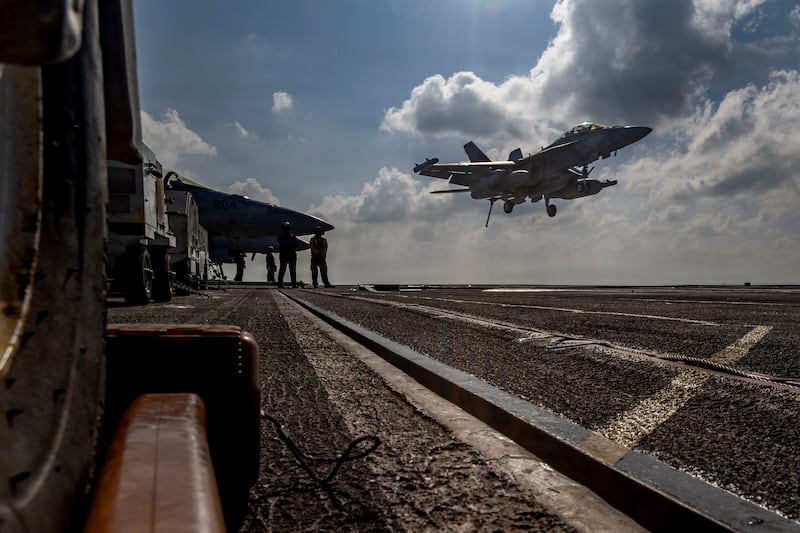
The president then ordered what he described as a “massive armada” of U.S. Navy ships to conduct an unscheduled deployment to the Persian Gulf. Led by the nuclear-powered aircraft carrier USS Abraham Lincoln, the carrier strike group packs a heavy punch, including stealth aircraft and hundreds of long-range precision-guided munitions. As the flotilla approached the Persian Gulf, President Trump said that the U.S. was “locked and loaded” and ready to go.
Predictably, the president’s rhetoric and actions did not deter the regime’s response, as the Islamic Revolutionary Guards Corps (IRGC) continued to violently suppress the demonstrations. In six weeks, more than 30,000 Iranian citizens have been murdered, with more detained. The brutal overreaction is a tragic continuation of an ongoing tyranny. Since the Iranian Revolution in 1979, both Ayatollah Khomeini and his successor as Supreme Leader, Ayatollah Khamenei, have directed an ongoing campaign of vicious reprisals against Iranian citizens who question the legitimacy or even the policies of the mad mullahs of Tehran. In total, hundreds of thousands of Iranians have been executed and millions have been imprisoned or forced into exile.
While the vast majority of American citizens sympathize with the plight of the Iranian people, their misfortune at the hands of the Iranian government does not threaten the national security of the United States, which begs the question: What does President Trump mean when he says that Ayatollah Khamenei “should be very worried?” As usual, there is no point in trying to discern Trump’s intent; the only connective tissue between his thought processes, public utterances and incoherent policy decisions is his disdain for any restrictions on him, including those imposed by the Constitution.
Having recently spent the better part of two decades mired in major wars in Afghanistan and Iraq, as well as smaller conflicts in Syria and Libya, all of which resulted in thousands of dead American service members and a multi-trillion-dollar bill to current and future taxpayers, the American people deserve to know what Trump plans to do in Iran. Fire a few cruise missiles and leave? Or does he intend to follow through with his promise to the Iranian dissidents that he is going to help them, and if so, how?
A better question might be, what does Congress intend to do to fulfill its constitutional responsibility as a co-equal branch of government? If recent history is any guide, we can expect the Republican majority in Congress to continue what it has been doing during Trump’s second term — nothing at all. The Constitution prescribes no policy outcomes; in contrast, it is highly prescriptive about the policy process, especially when it comes to armed conflict. The legislative branch alone has the authority to declare war and the responsibility to pay for it.
The Founding Fathers could not have foreseen the world we live in now, where some national security decisions must be made by the chief executive on a short timeline. It is impossible for the president, functioning as commander in chief, to coordinate every aspect of those responsibilities with Congress or seek approval for every necessary action. Fortunately, the courts, Congress and the American people recognize this, and there is a broad, bipartisan consensus that under certain circumstances, the president has the authority and obligation to act without coordinating with Congress.
That consensus does not apply here. Nothing about the tragic situation in Iran requires an American military response — certainly not in the absence of thorough congressional review. There is no upside, and significant downside, to American military action in response to an internal conflict inside Iran, which is why Congress should immediately hold public hearings and demand that the Trump administration clarify its intent, rather than continuing to enable his dysfunctional policies.