
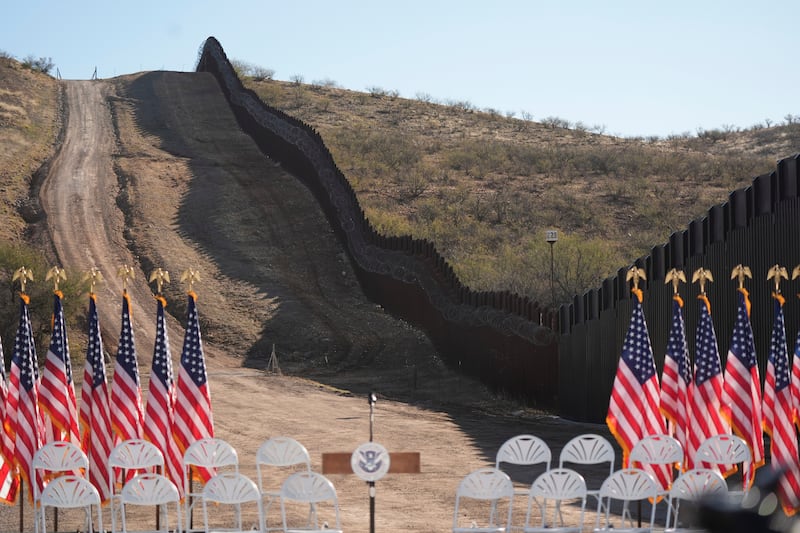

In the aftermath of the deaths of anti-ICE protesters Renee Good and Alex Pretti, the latter of which was ruled a homicide by county officials, President Donald Trump announced earlier this month that he would no longer send federal U.S. Immigration and Customs Enforcement agents into cities or states unless the governors or mayors “ask” and “say please.”
This reversal was stunning. One of, if not the major issue that led to Trump’s victory over former Vice President Kamala Harris was former President Joe Biden’s mishandling of the border situation, leading to a massive uptick in illegal border crossings, estimated at nearly 8 million. Nearly two-thirds of Americans disapproved of Biden’s handling of the issue.
Yet, this reversal was also predictable. Trump’s policies are now almost exactly as unpopular as Biden’s. A recent poll found that nearly two-thirds of Americans believe U.S. Immigration and Customs Enforcement has gone too far. Even Sen. Bill Cassidy, R-LA, a red-state senator who is up for reelection, called ICE’S recent actions “disturbing.”
Trump was hired to secure the border, not to send poorly trained agents to round up people with funny accents while shooting inevitable protesters on thin pretexts. Any adviser who told the White House this tactic would be popular, even among their own voters, should have had their head examined. Biden’s advisers deserve the same.
For a decade or more, Americans have been presented with two (roughly) equally unpalatable, alternatives: a largely uncontrolled flow of immigrants entering the country illegally that rises and falls on various economic and political factors, or mass deportation of immigrants who don’t make much trouble, not all of whom are here illegally.
This sharp binary has been forced on Americans because both sides believed that they could gain political advantages over their opponents with the issue. This is now demonstrably false. It ended in disaster for both sides.
The contours of a compromise, however, have been sitting on a shelf for decades. All we need to do is dust it off.
Or, as George W. Bush might say, “Miss me yet?”
Bush’s immigration proposal, first pitched in principle during the 2000 campaign, and really pursued in earnest in 2007, massively increased border security and holding employers accountable for hiring undocumented workers, but also sought to create a guest worker program and allowed for those who had lived here otherwise lawfully to get right with the law by, among other things, paying back taxes and learning English.
Bush’s proposal ultimately failed in the Senate because pandering politicians on both sides of the aisle let politics get in the way. The late Sen. Ted Kennedy, D-Mass., a supporter of Bush’s bill said, upon the bill’s defeat, “The situation is going to get worse and worse and worse.”
Bush had similar sentiments, declaring the status quo “unacceptable.” Both were right. President Barack Obama pushed for a somewhat similar policy six years later, and it passed the Senate, but died in the House.
Looking to Bush’s attempted compromise isn’t nostalgia for a bygone era, but an acknowledgment that both Biden’s and Trump’s unfortunate examples have proven that the American public will neither support de facto open-borders, nor mass deportations, and there are zero medium- or long-term benefits for either political party for the pendulum swinging toward extremism on immigration.
Indeed, what has either side gotten for their intransigence? Almost 20 years after the collapse of the 2007 compromise, the right got millions of more immigrants living in the U.S. illegally, and collapsing political fortunes. The left got no path to legalization or citizenship, endless litigation over the legally dubious Deferred Action for Childhood Arrivals program implemented without Congress under Obama, and the kinds of mistreatments of detainees we’ve seen for months (not to mention their 2024 loss to Donald Trump).
What the left needs to understand, contra the Democratic Socialists of America’s stance, is that Americans are not wrong to want control of their borders, nor does America have unlimited patience for having millions of unvetted immigrants come here without sufficient reason.
This influx of unaccounted immigrants not only offends American sensibilities as a violation of the rules, but also allows for terrorists, drug traffickers, and other criminals to take advantage of the situation. It offends American sensibilities for immigrants that entered the country illegally that are guilty of serious crimes, including homicide, to be released back into the public — and for good reason.
While it is true that a small cadre of activists have convinced too many in the elite left otherwise, they’ve been chastened by recent elections. And I doubt we’ll see a Biden-era border policy again anytime soon.
Meanwhile, the right needs to understand that it is a myth that you can have control of illegal immigration without an economically realistic influx of legal immigrants. Furthermore, it is neither realistic, nor desirable, to deport otherwise lawful and productive immigrants, for reasons foreign and domestic.
There is also a certain segment of the right that considers anything short of a militarized border and deportation of every immigrant living in the country illegally as destructive to the rule of law. They call everything short of this “amnesty,” and claim any form of amnesty causes the law to be undermined.
But this doesn’t hold up to scrutiny. First, America has had multiple amnesties for a variety of offenses, from Vietnam draft dodgers to immigration. There’s certainly no verifiable uptick in lawlessness because of these actions. Indeed Ronald Reagan’s famed 1986 amnesty for about 3 million immigrants led to a downtick in crime.
It’s a common refrain from many conservatives that Reagan was misled by Democrats about enforcement when he signed the 1986 amnesty. That’s simply untrue. He knew what he was doing.
As Reagan said in a debate with Walter Mondale, “I believe in the idea of amnesty for those who have put down roots and lived here, even though sometime back they may have entered illegally.” He may have hoped that signing the bill would stem the tide of illegal immigration more than it did, but he knew well that the bill he signed lacked the stricter employer sanctions that some immigration hard-liners had wanted (Bush’s proposal had stronger penalties and enforcement methods).
He signed it anyway.
Reagan understood the practical consequences of our large border between the U.S. and Mexico, and the massive economic disparity between the U.S. and Central America more broadly (the per capita GDP of the U.S. is roughly six times that of Mexico). Specifically, he knew how this meant that black markets were inevitable without a sufficient flow of legal migration. Indeed, during the 1980 campaign, Reagan and George H.W. Bush both gushed over the possibility of a closer relationship with Mexico that could allow for a more free flow of labor, ending the underground economy. They were both right.
The views of the old guard may be seen as passé, but that doesn’t make them wrong. The utter failure, economically, socially and politically, of both the Trump and Biden approaches to the issue, is painfully clear. Everyone knows what the contours of a compromise looks like. Sometimes, you need to look backward to go forward.