


Finally, Utah politicians are beginning to speak out about prediction markets and the faux gambling companies that hide under the umbrella of a system built to enable commodities trading.
These, if not stopped soon, will turn Utah into a place where anti-gambling laws become less than mere suggestions and where the social ills tied to gambling have free rein.
But it could go further than that. They could invite interference that has national or even international ramifications.
On Tuesday, Mike Selig, who chairs the Commodity Futures Trading Commission, posted a video on X that defended prediction markets as useful for hedging risk and for acting as a “check” on the news media, presumably by providing better predictive data on upcoming elections than opinion polls.
Utah Gov. Spencer Cox responded with force, saying he doesn’t remember the Commodity Futures Trading Commission “having authority over the ‘derivative market’ of LeBron James’ rebounds.”
Of course not. Those who wrote laws nearly 100 years ago that marked the distinct differences between trading and the type of gambling that once had the mayor of New York City, Fiorello La Guardia, swinging a sledgehammer at illegal slot machines would be shocked by what’s going on.
“These prediction markets you are breathlessly defending are gambling — pure and simple,” the governor posted. “They are destroying the lives of families and countless Americans, especially young men. They have no place in Utah.”
In an email response to questions from Ethan Bauer at Deseret Magazine, Utah Sen. Mike Lee said, “Prediction markets are clearly a form of gambling, simply with an inventive mechanism to work around gambling laws like Utah’s.”
Gambling by any other name ...
If it waddles like a duck, swims like a duck and quacks like a duck … well, it ought to be easy for even a nearsighted Elmer Fudd to see that the “inventive mechanism” of commodities markets doesn’t change the fact that a Utahn using an app to bet on a Jazz game is, in fact, gambling.
And as a number of experts are now pointing out, there is no magic to the odds that predictive trading apps like Kalshi or Polymarket provide.
“Kalshi and Polymarket contend that by letting the world know what the ‘crowd’ thinks will happen, their sites provide valuable information that is more accurate than polls or prognostications,” Benjamin Schiffrin, director of securities policy for Better Markets, wrote recently. “The problem is that, absent inside information, the users on these sites are no more likely to know whether a candidate will win an election or a team will win a game than anyone else.”
Evidence shows that prediction markets are not always accurate predictors, he said.
That, according to Matthew Wein, can be a big problem.
Wein edits the Secure Stakes newsletter, is the CEO of the Wein Strategy Lab and was a policy adviser at the Department of Homeland Security. He argues that commodity markets are sometimes thin and “dominated by a relatively small pool of sophisticated bettors, enthusiasts, and speculators.”
Easy manipulations?
These people could easily manipulate markets. He uses the example of a bet on whether a movie will gross more than $100 million during its opening weekend.
“A studio could rationally allocate a portion of its marketing budget to buy the ‘yes’ side to move the price upward and then cite that movement to entertainment reporters as evidence of strong anticipated performance.”
It’s one thing to consider a movie, but quite another “when the topics at stake intersect with homeland security, national security, or cybersecurity,” he wrote.
American sports are already reeling from several recent gambling scandals, including the alleged throwing of college basketball games. Wein argues that companies that allow betting on virtually any event, election or game could eventually destroy trust in many institutions. Foreign governments, he wrote, already have shown their willingness to exploit stolen data “to shape narratives for strategic effect.”
Super Bowl bets
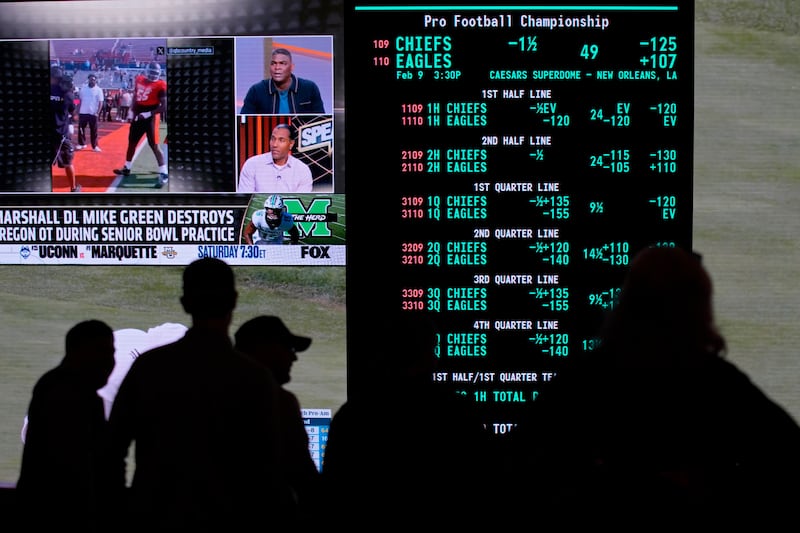
But, of course, everyone right now is focused on sports gambling. NPR reported that Kalshi and Polymarket generated almost $5 billion in Super Bowl wagers leading up to the game. Presumably, that includes wagers from Utahns.
Prediction markets are regulated by the Commodity Futures Trading Commission, not by the state laws that have developed around legal betting markets.
Tough statements by Utah politicians are helpful, but it may be hard to counter President Donald Trump’s firm support for prediction markets in any legislative fight against states’ rights.
Utah’s hope for maintaining control over its anti-gambling stance may ultimately rest with the Supreme Court.