

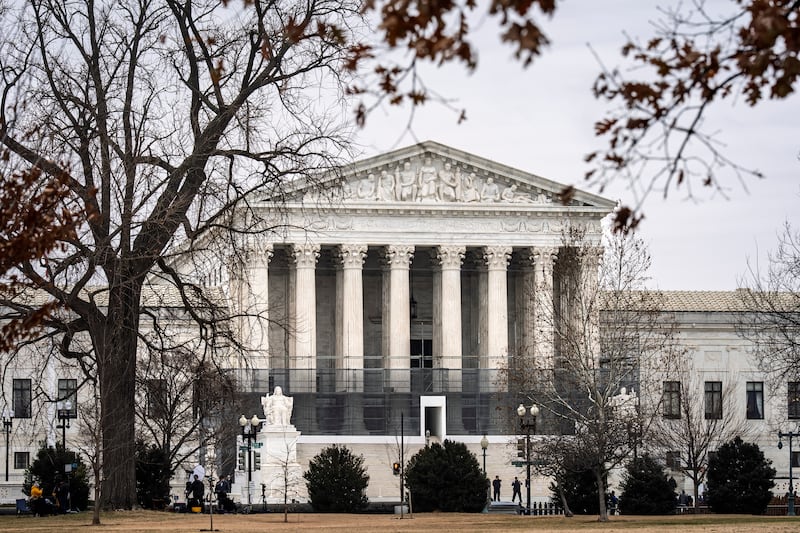
The U.S. Supreme Court’s decision on tariffs, released Friday morning, puts the issue back where it always has belonged — in Congress.
For decades now, Congress has steadily ceded much of its power to the executive branch. Americans today are politically polarized over important issues such as immigration reform, energy policies, education, environmental law and other important issues of the day, including tariffs. The legislative branch, which is charged with writing laws, ought to be undergoing the difficult tasks of debate and compromise necessary to solve these as the people’s elected representatives.
That process tends to have a mollifying effect on public discourse. It would empower, not divide, people.
Instead, some lawmakers grandstand and politicize, leaving the executive branch to solve issues through executive orders that the judicial branch often strikes down as overreach.
What the Constitution says
On tariffs, the nation’s founders were clear. As the court’s majority decision in the tariffs case reminded the nation, Article I, Section 8 of the Constitution says, “The Congress shall have power to lay and collect taxes, duties, imposts and excises...”
“The framers,” Friday’s majority opinion, authored by Chief Justice John Roberts, said, “recognized the unique importance of this taxing power — a power which very clearly includes the power to impose tariffs.”
In a news conference following the decision, President Donald Trump said he intends to continue levying tariffs using other laws as justification.
Other avenues for tariffs
Those other avenues, specifically sections 122 and 301 of the Trade Act of 1974, have procedural guardrails. Section 122 allows tariffs of up to 15%, but only for a duration of 150 days, and only in instances where “large and serious” trade imbalances exist. Section 301 requires lengthy investigations to justify accusations of unfair trade practices, which may not suit the president’s purposes.
Also, Trump may choose to invoke Section 338 of the Tariff Act of 1930. Short and vague, it allows up to 50% tariffs on imports the president feels discriminate against the United States as compared with other nations. As a recent essay published by the Cato Institute says, it has never been invoked. It would also require action from the U.S. International Trade Commission, although the commission’s role is not spelled out.
Trump, at the news conference, announced a broad 10% levy under Section 122.
All of this ignores the founders’ intent.
Congress steps aside
As Clark Packard, a research fellow in the Herbert A. Stiefel Center for Trade Policy Studies, wrote for Cato, “Congress spent decades handing off its constitutional trade authority to the executive branch, and these delegations remain largely intact.
“Until lawmakers reclaim some of that authority and add serious procedural safeguards, the risk of arbitrary tariffs will continue.”
He is right. The safest path for the president would be to persuade Congress to impose the tariffs he seeks. Better yet, Congress could insert itself into the process, reclaiming the powers the founders gave it.
It tried to do that earlier this month when the House voted 219 to 211 to reverse tariffs on Canada. However, the Senate is not expected to take up the matter.
In Friday’s ruling, the six justices in the majority cited Federalist No. 48, written by James Madison. Congress alone, it says, has “access to the pockets of the people.”
Friday’s court decision was narrowly tailored to tariffs justified by the International Emergency Economic Powers Act of 1977. As the Washington Post noted, other tariffs that were aimed specifically at certain sectors of goods, such as steel, aluminum and automobiles, will remain.
The court also was quiet about whether the money raised by the now disallowed tariffs should be refunded, and if so, who should receive refunds.
With the administration firm about continuing to apply tariffs using other legal justifications, it seems clear that more lawsuits may be coming unless Congress asserts itself.