

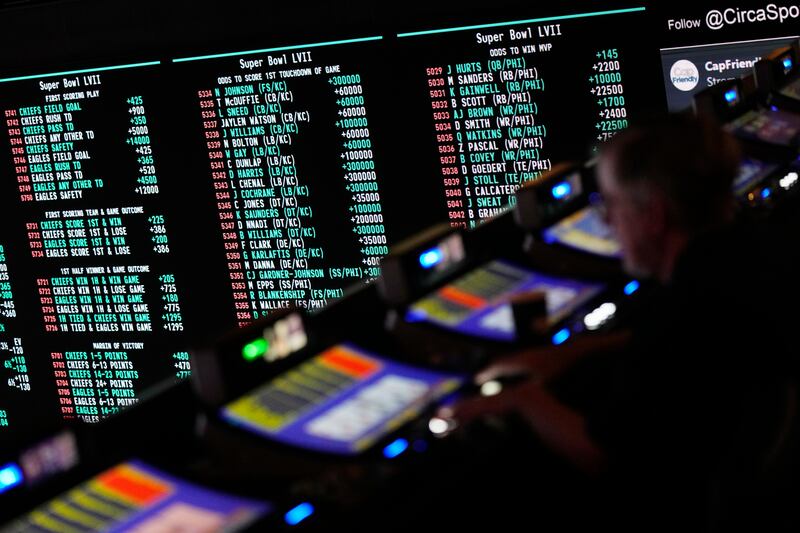
For more than a century, gambling required effort. You had to drive to Las Vegas and walk through a column of smoke into a noisy casino. That friction alone created a barrier that prevented many from falling into addiction.
Today, that casino — in the form of online gambling apps — lives in our pockets. Or worse, our teens’ pockets. The barriers are gone, but the risks and harms are more prevalent than ever.
Players still lose money to the predatory lure of these apps, but now they also lose so much more than their cash. They also lose time and their focus, and they even end up surrendering peace of mind. Fractured marriages, maxed-out credit cards and lost student loan money often follow in their wake, as do chronic stress from the financial chaos and an ever-present anxiety driven by dopamine hits from increasingly reckless bets. The toll is devastating.
What starts as a simple tap quietly takes over a person’s life, trapping them until their world shrinks down to the next gamble. Its grip tightens with every tap.
It sounds almost dystopian. But it’s happening in real time, and it’s happening much closer than you may realize.
Recently, we have seen the newest iteration of gambling: the so-called “prediction markets.” These apps allow users to trade on outcomes ranging from who will win the Oscars to who will win a presidential election. One app even recently invited users to wager on when Jesus would return.
Promoters, most prominently Kalshi, insist this is not gambling at all but merely “trading on futures.”
So, with just a few taps on an app that tries to resemble a financial trading platform, you can wager on real-world events, like who will win the Super Bowl or if the Fed will raise interest rates. Although traditional sports betting apps are illegal under Utah law, these platforms argue that they merely allow users to hedge their risk. But what is the real risk to hedge when you are simply predicting whether LeBron James will score more or less than another player? It’s simply a bet, dressed up in different clothing.
So, let’s be clear about the distinction we’re being asked to accept.
It was illegal in Utah to bet — in any manner — on whether the Seahawks will win the Super Bowl. But some apps claimed it was perfectly legal to “trade” on a financial contract tied to a future outcome in which the Seahawks would win the Super Bowl.
This scenario is not hypothetical. On the morning of the Super Bowl, my college-aged son, here in Utah, received a targeted ad that read, “You can legally make money from football in all 50 states on Kalshi.” And then, with what felt like a carefully crafted wink, it added that in Utah, “you can legally trade on football outcomes.”
Betting. Wagering. Trading on futures. A wolf in sheep’s clothing is still a wolf.
As Utah’s attorney general, I view this as a distinction without a difference.
We now better understand how these apps work. Like social media apps before them and nicotine even earlier, they are designed to hook users by delivering a dopamine hit. Neuroscience shows us that the brain responds most strongly to variable rewards: the occasional win, the near miss, the unpredictable payout. “I was so close. Maybe just one more try.”
That is the very architecture of addiction — and it is particularly corrosive to the still-developing teenage brain. In that teenager’s pocket. All the time.
We are just beginning to understand the psychological toll of addictive social media algorithms. Now imagine adding financial risk to that same design. Not just anxiety or depression, but rent money. Tuition. Student loans.
That is why I joined Connecticut Attorney General William Tong, a Democrat, in urging Congress to address offshore gambling operations that disregard state law and target young Americans. There is a reason that nearly every attorney general in the country joined us in this effort.
Utah lawmakers are also stepping up. Rep.Joseph Elison has sponsored HB243 to address “proposition bets” — another form of wagering dressed up in softer language.
I was recently asked whether I plan to do anything about the rapid rise of prediction market apps that are now operating in Utah.
My response? You can bet on it.