

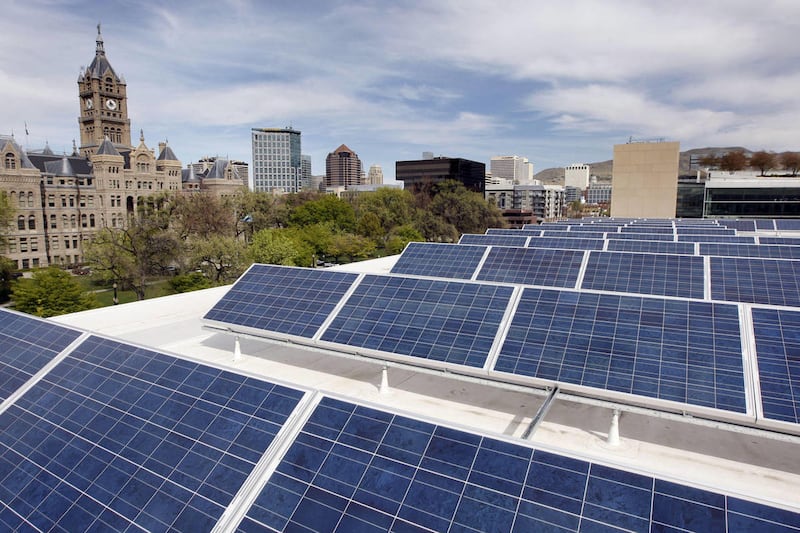
When people think about the economic engines of Utah’s future, they tend to picture Silicon Slopes, the booming Wasatch Front or the tech companies setting up shop along the I-15 corridor. And those are all important. But there’s another economic success story unfolding across the state — one that’s happening in the wide-open spaces of Beaver, Emery, Iron and Millard counties, where utility-scale renewable energy projects are quietly generating billions of dollars in investment and thousands of jobs.
A new study from the Crossroads Economics Center at Weber State University, commissioned by The Western Way, puts hard numbers on what many in rural Utah already know: Renewable energy development is one of the most significant economic forces in our state’s rural communities. And as policymakers debate the future of energy in Utah and across the West, these are the facts that should be driving the conversation.
Here’s the headline: Over the period from 2007 through 2028, 41 utility-scale renewable energy projects across Utah — solar, wind and geothermal — represent $8.4 billion in construction and investment activity. That’s not a projection or a wish. That’s real money flowing into real communities, paying real workers and generating real tax revenue.
The construction of these projects alone has supported more than 34,600 job-years of employment statewide, including roughly 19,300 job-years of direct onsite construction labor. When you factor in the supply-chain and household-spending effects — the electricians buying groceries, the equipment suppliers hiring staff — the economic ripple extends far beyond the project sites themselves. Total construction-period economic output tops $5.2 billion, with $3.1 billion in value added to Utah’s economy.
And the benefits don’t stop when the last panel is installed. On an annual basis, ongoing operations at these facilities support approximately 1,570 jobs, $244.6 million in economic output and $113.7 million in wages, salaries and benefits. These are stable, recurring contributions to the economy — not one-time windfalls.
For rural counties, the fiscal impact is especially meaningful. The facilities in this study generate an estimated $33 million per year in property tax revenue, funding schools, fire departments and other essential services in communities that have historically relied on a narrow economic base. Add in approximately $4 million per year in land lease payments to rural landowners, and you start to see how renewable energy development is diversifying and strengthening rural economies from Beaver County to Box Elder.
I want to be clear: This isn’t about picking winners or choosing sides in the energy debate. As a fiscal conservative and former state legislator, I believe energy decisions should be driven by economics and local conditions — not ideology. Utah doesn’t have a mandatory renewable portfolio standard. What we have is a state where the economics of solar, wind and geothermal energy simply work, particularly in rural areas with abundant land, strong resources and access to transmission infrastructure.
Since 2015, approximately 94% of new electric generating capacity added in Utah has been solar. That’s not because of a government mandate. It’s because the market is speaking, and solar is competitive. Meanwhile, geothermal energy — which uses the same drilling technologies that made America an oil and gas superpower — is poised for a major expansion, with large projects planned in Beaver County that could substantially increase Utah’s baseload renewable generation later this decade.
The study also documents a growing role for battery energy storage, with 1,170 megawatts of installed and planned storage capacity supporting grid reliability and helping to manage intermittency. Storage construction alone is estimated to support roughly 6,300 additional job-years and $865 million in economic output. This is the “all of the above” approach in action — different technologies working together to keep the lights on and keep costs down.
Gov. Cox’s Operation Gigawatt recognizes that Utah needs to double its energy production over the next decade to meet surging demand from population growth, data centers, manufacturing and more. Renewable energy — alongside natural gas, nuclear, geothermal and other sources — is a critical part of meeting that goal. And as this study makes clear, building out our renewable capacity isn’t just good energy policy. It’s good economic policy, especially for the rural communities that are hosting these projects.
Utah’s approach to energy has always been grounded in pragmatism and results. We don’t have the luxury of treating energy as a political football when families need affordable power and rural communities need good-paying jobs. The data in this study should give every policymaker, county commissioner and community leader the confidence to keep saying yes to responsible energy development — because the economic case is overwhelming.
The energy business has never been a zero-sum game, and in my view it never will be. Utah is proving that every single day.