

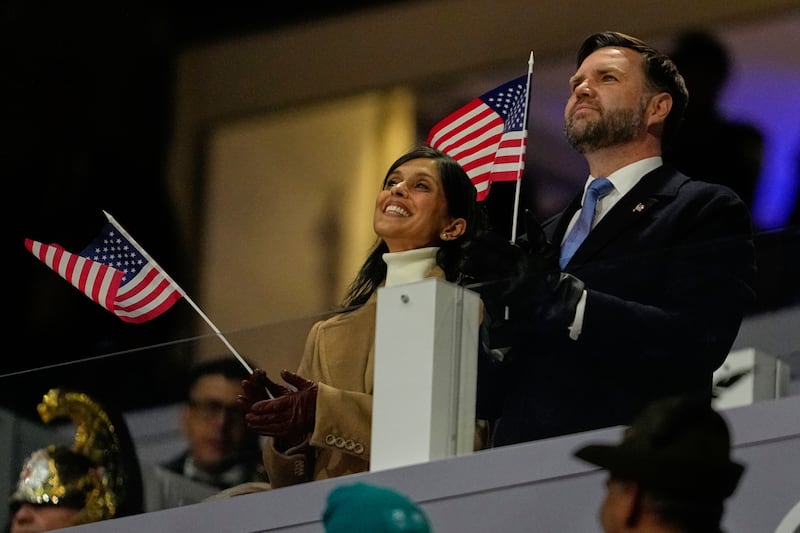
When Vice President JD Vance was booed at the Winter Olympics opening ceremony in Milan, the moment was more than a fleeting embarrassment. It was a signal. On one of the world’s largest stages, an American leader drew open hostility from an international crowd.
For many Americans, that hostility was softened — literally.
The boos were allegedly dampened on the American broadcast but plainly audible on international feeds. Commentary moved on quickly. Within hours, the episode was reframed at home as partisan spin or dismissed as trivial.
But the most revealing part wasn’t the booing itself. It was the gap between how the world responded and how we did. The anger abroad was clear. Our instinct was to look away.
Americans do not fully grasp how negatively we are perceived abroad — or how quickly that perception is hardening.
The reaction in Milan was not a sudden shift. It reflected a long-developing erosion of trust. I first encountered that reality years ago.
While studying foreign affairs at a university in England alongside classmates from Europe, Africa, the Middle East and Asia, I noticed that responses to my arguments were often dismissive before substantive. Professors referred to my comments as “the American perspective,” setting them apart rather than engaging their merits.
This was before Donald Trump ever took office. The skepticism wasn’t about one personality. It reflected a deeper view that America asserted more than it listened, invoked international norms selectively and assumed leadership was automatic. Many of those classmates now serve in foreign ministries, multinational firms, and international institutions. The attitudes formed in seminar rooms have matured into policy instincts.
More recently, I sat down with a high-ranking foreign diplomat. His assessment was blunt and operational, not partisan. Allies are uncertain about American continuity. American diplomats struggle to give clear long-term assurances and are often absent in their duties. As a result, U.S. officials are left out of important conversations.
Goodwill, once earned, does not renew itself. It must be reinforced by consistent conduct.
I think this is a shocking reality for many Americans because they are still living in a post-war bubble. After World War II, the United States paired hard power with normative leadership. Through the Marshall Plan, it helped rebuild Europe. It anchored NATO and a rules-based financial and trade system. The result was a postwar economic boom that benefited Americans directly. The dollar became the global reserve currency. American companies thrived in a predictable system shaped by American leadership. No nation has ever earned more soft power.
That soft power translated into prosperity.
I saw the lingering effects of that era while living in Gela, Sicily, one of the primary Allied landing sites in Italy. Older residents who remembered the war would smile when they learned I was American and ask for a “tootsie,” recalling the candy U.S. soldiers handed out. They spoke of liberation and hope. Younger residents saw something different — Americans as insular and naive about the world beyond our borders. The message was clear: Goodwill, once earned, does not renew itself. It must be reinforced by consistent conduct.
Today, the consequences of reputational decline are tangible.
Across allied nations, confidence in U.S. leadership has swung dramatically over the past decade. European leaders increasingly speak of “strategic autonomy,” and they are investing accordingly.
A Utah-based advanced manufacturing firm recently described how reputational and political risk are forcing it to shift portions of production overseas. Its foreign customers now ask explicit questions: What happens if export controls change mid-contract? If tariffs return? If a future administration reverses today’s commitments?
These are real Utah jobs being moved — not because the company wants to leave, but because its customers are recalculating exposure. When predictability declines, customers diversify. Contracts move. Manufacturing follows. In some markets, “Made in America” is no longer an automatic advantage. It is a variable to hedge against.
This is not abstract diplomacy. It is payroll.
Soft power is not about popularity; it is about leverage. When the United States raises concerns about territorial aggression or unfair trade, its ability to rally coalitions depends on credibility. If partners believe commitments may expire every four years — or be discarded when politically convenient — they will hesitate to align or stake political capital on American initiatives.
Relationships — whether between nations or between people — depend on honesty. When commitments are abandoned and every interaction becomes transactional, trust collapses. In our personal lives, when we don’t deal honestly, those relationships fracture. In foreign policy, the consequences are measured in lost contracts, weakened alliances and diminished influence.
The most troubling part is not that these things are happening. It is that many Americans do not realize how serious the damage has become — or how quickly the world is adapting to a future that depends less on us. If we continue treating alliances as disposable, agreements as temporary and credibility as optional, that future will arrive faster than we think.
I am proud to be an American. But if we want to regain our standing, we must first be honest about where it has fallen — and why.