

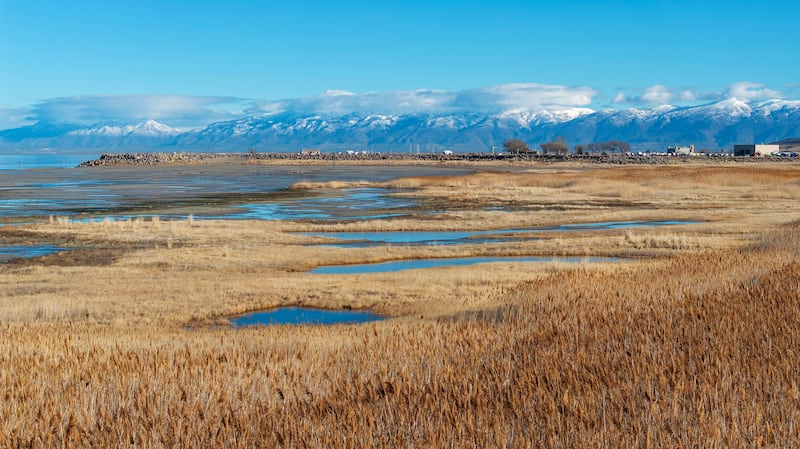
America’s inland sea has been shrinking for decades because of water overuse and drought. House Concurrent Resolution 9 makes us believe that 2026 will be the year we turn things around.
On Saturday, Feb. 21, President Donald Trump met with Utah Gov. Spencer Cox to discuss the pressing challenges facing the Great Salt Lake.
Once spanning more than 2,000 square miles, the lake has shrunk by more than half. Toxic dust from the lakebed is now blowing into homes and agricultural fields of the 2.5 million people living along the Wasatch Front and even reaching into Idaho and Wyoming. Saving the lake is not simply an environmental and public health concern. This is a question of economic security and protecting the assets that power Utah’s prosperity.

The Great Salt Lake fuels national security and manufacturing industries, supports the global food supply, protects vast public and private infrastructure, and anchors Utah’s jobs and tax base. Evaporation from the lake creates nearly half of the region’s precipitation—so when the lake shrinks, we lose not just shoreline, but the snowpack and rain that replenish our reservoirs, sustain agriculture, and secure Utah’s long-term water future. The 10 million migratory birds that depend on America’s lake travel to every state in the country and every country in the Western Hemisphere.
President Trump immediately understood the urgency of this challenge and pledged to help the State of Utah. Within hours, the President posted on Truth Social and said “This is an Environmental hazard that must be worked on, IMMEDIATELY” and then ended with a call to action: “MAKE ‘THE LAKE’ GREAT AGAIN!”
As Utahns celebrated the national attention, the Utah Legislature got to work. Senator Sandall and Representative Elison proposed a concurrent resolution calling on the states of our region and the national government to work together to pull off this world-first saline lake rescue.
This is what leadership looks like. This is how government should work — each of us doing what we can to make our communities stronger, healthier and cleaner.

As the resolution rightly points out, restoring the Great Salt Lake is possible, but it will require resources beyond what Utah can reasonably provide alone. The cost of helping farmers, cities, and industry conserve enough water to save the lake could be between $2 billion to $10 billion. While significant, this level of investment is on par with the cost of infrastructure projects — like building a freeway or an airport — that are regularly supported by the federal government.
Ultimately, protecting our home shouldn’t be viewed as a cost; it is an investment in the future and a reflection of who we are. That pioneering spirit of faith and hard work is what makes our region great.
As community leaders and everyday citizens, we together commit to make the Great Salt Lake great again. Add your voice of support and commitment to this letter here.