

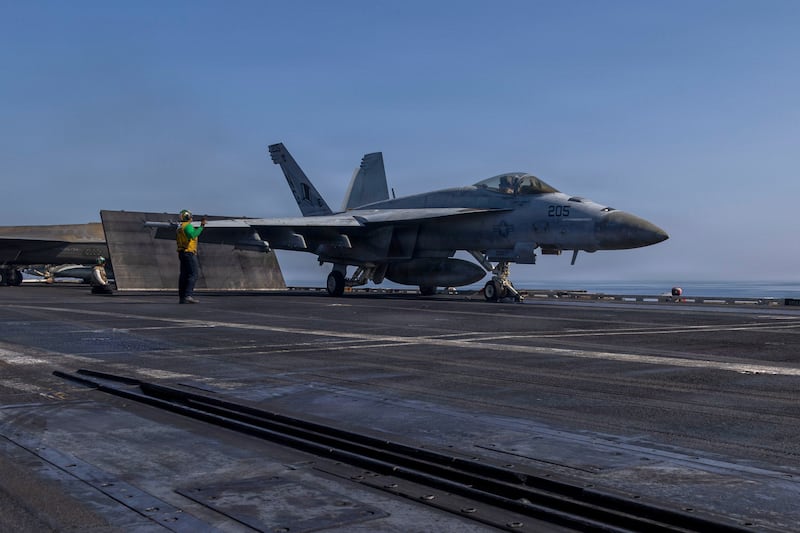
The United States military performed brilliantly in the assault on Iranian leadership and assets Saturday, much as it did in the capture of Nicolás Maduro in Venezuela in early January. Its ability to pinpoint the exact location of Ayatollah Ali Khamenei and perform a surgical strike ought to make any tyrant think twice.
What will follow — the transformation of Iran from the top down — must be equally well planned and executed.
War is a deadly and tragic business. Innocent people get hurt or die. Several U.S. service members already have died. Good planning and clear objectives can minimize casualties, especially when the tool being used is a precise and well-trained military force.
We are reminded of the Powell Doctrine, developed by Gen. Colin Powell during the first Gulf War. It holds that the government should treat force as a last resort after every other option is exhausted. If war is necessary, it should be entered into with a clear objective, a clear exit strategy and public support. Then it should be deployed with overwhelming and decisive force, using all resources available.
Only President Donald Trump and his close aides know if every other nonlethal option was exhausted, although one could easily argue that Iran has had plenty of chances over many decades to renounce its sponsorship of terrorism and to abandon its nuclear weapons ambitions.
That said, the world is a better place without Iran’s decadeslong ruling regime, which spread terror and death through nefarious proxies in the Middle East and beyond. As Israel’s ambassador to the U.N., Danny Danon, said, “When a regime chants ‘death to Israel,’ ‘death to America,’ we take it seriously.”
From the days 47 years ago when radical students took 52 American embassy workers hostage and held them for 444 days, Iran has shown not only a brazen and outspoken hatred for Western democracies but a willingness to act on those feelings.
Fox News quoted former Reagan Justice Department chief of staff Mark Levin saying Iran has targeted Americans, either directly or indirectly, at least 44 times, killing more than 1,000 U.S. citizens.
Iran’s leaders have been relentless in their pursuit of nuclear weapons and were defiant in negotiations to end their nuclear program until the end.
The president laid out his reasons and objectives for the war on Monday. These, as the Deseret News reported, “included eliminating Iran’s leadership, destroying the country’s nuclear program, and targeting the country’s navy.”
Was there an imminent national security risk? Trump said Iran already possessed missiles capable of hitting Europe as well as American military bases. He said the country soon would have had the ability to strike the United States on its own soil.
In addition, the aforementioned record of attacks on Americans and American interests were evidence of a continual existential risk, both to the United States and Israel. Add to that what were likely thousands of people killed by the Iranian government during recent protests against the regime. Doctors and nurses described this to The New York Times as a massacre.
The president also told various sources Monday that he isn’t ruling out the possibility of sending ground soldiers into Iran. “I don’t have the yips with respect to boots on the ground,” he told the New York Post. What remains unclear is the nation’s exit strategy.
True regime change, including the eradication of a defiant old guard and the establishment of democratic processes, likely will take boots on the ground, a lengthy campaign and a patient resolve by the American people as casualties rise.
It also will take a buy-in from Congress. Trump is not the first president to act militarily without formal congressional approval, but as the campaign proceeds, it’s important for the world to know he is not acting without the support of the people’s representatives.
The success of this campaign could radically change the Middle East for the better while eliminating a large threat to the Western world.
But a lengthy campaign would test the nation’s patience and could come with political ramifications.
The beginning was successful. Long-term success will be much harder to achieve.