

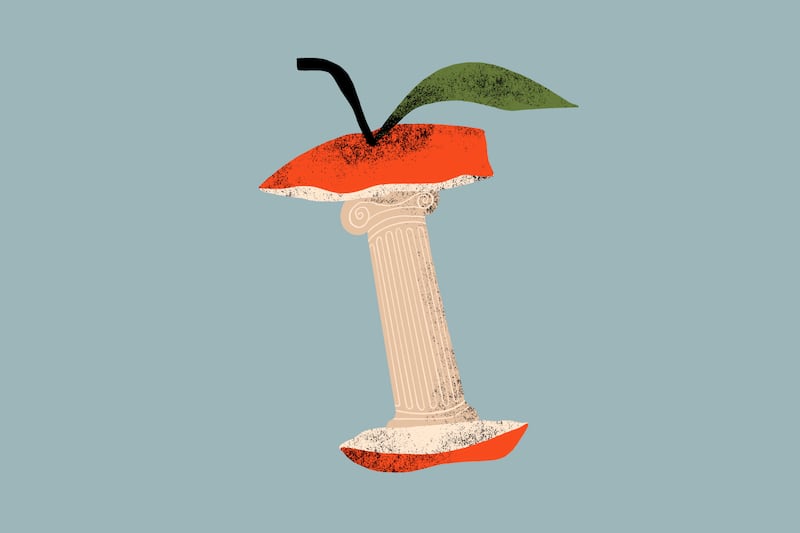
I work with thousands of college students, who enter the educational journey with good intentions but face a broken system. I see a lot of young Americans walking onto campus every year with a strange burden: They’re told college is where they “find themselves,” but they’re also told, indirectly, that they’d better monetize whatever they find. No wonder so many graduates end up studying one thing and doing another. The modern system is built to produce information but not personal transformation.
The New York Fed’s tracker shows the underemployment rate for recent college graduates hit 42.5% in late 2025, meaning millions are working in jobs that don’t require a degree, at least not yet. And the debt story is no longer a footnote but the main story, as the household debt report puts student loan balances at $1.66 trillion.
When college is treated as a transaction, students respond like rational economists. They optimize for the grade, the credential, the internship logo. But somewhere in that optimization, we lose the older idea of education — that it is supposed to shape a human being.
Most Americans still speak, at least privately, in spiritual language about work. We use words like “calling,” “purpose” and “stewardship.” We say things like “Whatever you do, do it with your whole heart." You don’t have to be religious to recognize the truth underneath it. In my years of work in health care and caregiving for the aging population, I strongly believe that doing the work in front of you with excellence, and doing it for something beyond yourself, is one of the most reliable paths to a meaningful life.
And excellence in the material realm really can also be a spiritual act, if you understand “spiritual” the way many Americans do: not as an abstraction, but as the daily practice of becoming someone trustworthy. Patience when you’re tired. Self-control when you’re provoked. Forgiveness when you’ve been wronged. Truthfulness when a shortcut is available. These are everyday virtues that many aim to embody.
The tragedy is that our campuses often talk about values while structuring student life to avoid the very experiences that form them. I think that character is not learned by reading about courage; it is learned by having to show up when it would be easier not to. It is learned in service, in responsibility and in being needed.
I’ve seen this up close through CareYaya, the nationwide caregiving platform I run, where thousands of college students support older adults with care at home, many who of whom are dealing with dementia or physical decline. A pre-med student can memorize every biological pathway and still be unprepared for the moment an anxious older adult asks, “Am I going to be OK?” Those are the moments that teach presence — how to listen without rushing, how to tell the truth with kindness, how to carry someone else’s fear without making it about your own discomfort. And as the surgeon general has warned, social disconnection is a public health issue with real consequences.
My observation isn’t only about health care, but health care makes the stakes really visible. The Association of American Medical Colleges projects a physician shortage of 13,500 to 86,000 by 2036. And the Bureau of Labor Statistics projects about 765,800 openings each year for home health and personal care aides. Family caregiving — still the backbone of American elder care — is big enough to be its own shadow workforce, as the National Academies detailed in its landmark report. If we want the next generation of clinicians, leaders and citizens to meet reality, we need an education system that puts reality back into the curriculum.
The good news is we don’t have to guess what works. Research on service-learning consistently finds benefits for students across outcomes like civic engagement, social skills and academic learning. In other words: When students are asked to serve, they don’t just become nicer; they become better.
So here is my concrete proposal for a new America: Every college student should complete a structured “service semester” (or equivalent) tied to their field and to community need — schools, clinics, elder care, disability support, tutoring, public health, local government. Not random volunteering, but actual supervised apprenticeship that builds virtue. Give students academic credit for learning how to be useful, accountable and steady.
If we did that, I think something subtle would change. Students would still learn information. They’d still specialize. But they would graduate having practiced the moral muscles that adulthood demands. And they’d understand, in their bones, the lesson our culture keeps forgetting: The pursuit of excellence isn’t separate from the pursuit of meaning. For many people, it’s the same road, just walked with a better reason.