

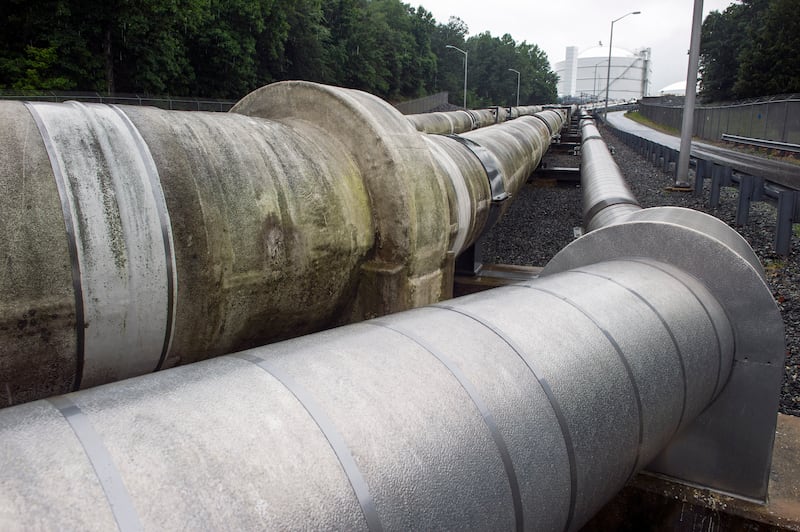
Following the Iranian strike on the world’s largest liquefied natural gas (LNG) terminal in Qatar, the United States has a golden opportunity to seize on our vast natural resources and become the world’s leading natural gas producer. Due to market innovation and investments, our country has transformed from a net energy importer into the world’s largest LNG exporter in over a decade.
With an energy abundance mindset, America is maximizing production while being mindful of the environment. But, to fully capture America’s LNG advantage, we need a global market for gas — one that expands supplies from stable regions of the world.
Bolstering LNG supply globally has manifold benefits — even for the U.S. A robust international LNG market creates more demand and liquidity, which in turn incentivizes producers to invest, drill and build infrastructure at home. In 2024, global LNG trade reached a record 411 million tons — connecting 22 exporting nations with 48 importing nations.
This surging worldwide demand sends a clear signal: If American energy producers have access to broad international markets, they’re incentivized to invest more in domestic natural gas development, thereby benefiting everyone with greater supply. As American LNG exports have increased, domestic production has equally climbed to all-time highs, while domestic natural gas prices have stayed low and affordable, especially compared to elsewhere in the world.
When Qatar closed its massive LNG terminal, natural gas prices in import-dependent Europe spiked 40%. Here in the United States, prices have barely budged, thanks to our energy abundance policies.

Alternatively, a shrinking global market would send chilling signals to investors and reduce supply, creating more price volatility. Opponents of U.S. LNG exports erroneously claim that exporting natural gas will drive up prices at home. But they have it backward. Restricting markets for U.S. gas would have negative downstream effects, like choking investments in new American supply and infrastructure — leading to energy that’s more expensive and volatile to geopolitical events.
A U.S. Department of Energy study showed that domestic gas prices depend far more on the scale of our resources and extraction technology than on our LNG export policy. Similar research shows that even with a dramatic expansion in future exports, household gas costs will largely remain unaffected.
A growing, international LNG marketplace will also reinforce U.S. leadership in global trade and international relations.
Last month marked four years since Russia illegally invaded Ukraine and weaponized oil and gas, a stark reminder of the consequences of how adversarial suppliers can use energy as a weapon. Lithuania, my ancestral homeland, accepted the first American shipment of LNG from Sabine Pass, Louisiana, a decade ago — charting their path to energy independence. But U.S. LNG not only helped to displace Russian gas in the European Union in the wake of the crisis but also crushed any hope of its return. The United States now supplies 60% of the bloc’s LNG imports. The EU’s recent ban on Russian gas imports would not be possible without U.S. LNG.
Indeed, energy leadership isn’t just about molecules and demand; it’s a strategic tool in global affairs. By growing the global LNG market, our nation can maintain its position as the indispensable energy supplier and enhance our leverage on the world stage, especially through the White House’s National Energy Dominance Council.
An inescapable fact is the United States has the cheapest, most efficiently produced natural gas supply in the world. This gives our LNG a stronger selling point than competitors, as countries seek cleaner, reliable and affordable energy sources to meet their demand.
No other major supplier can match what is right beneath our feet in places like the Permian Basin and the Marcellus Shale. Therefore, as LNG markets expand, so too will the U.S. opportunity to reap the benefits of a system that rewards low-cost and efficient producers.
At its core, LNG exports are not just about energy. They are about America’s strength at home and abroad, hence why the Trump administration has so aptly dubbed them “freedom molecules.”
America’s LNG future should be embraced with confidence. A growing global LNG market will only solidify America’s energy advantage and its role as a global peacemaker.