

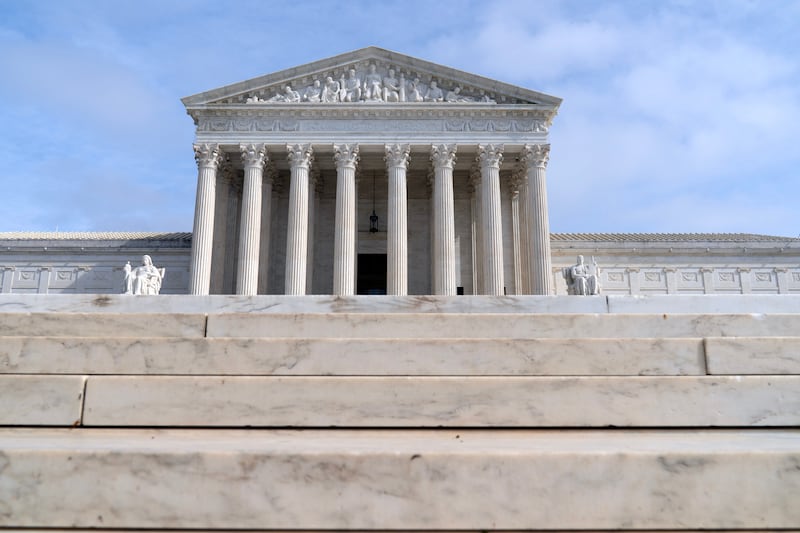
In its 6-3 ruling on Feb. 20, the Supreme Court rightly struck down most of the president’s sweeping global tariffs and reaffirmed the power of Congress over taxes and tariffs — a power lawmakers had chosen not to exercise. This restoration of constitutional order echoes the separation of powers doctrine of legendary John Marshall, the Court’s longest-serving chief justice.
Two centuries ago, Marshall wrote that “the legislature makes, the executive executes, and the judiciary construes the law.” Congress, he declared, must keep to itself “powers which are strictly and exclusively legislative.” Congress cannot relinquish its responsibilities for creating executive departments and agencies, authorizing and regulating these activities, overseeing their work, reviewing their performance, and holding them accountable.
Despite Marshall’s admonition, over time, Congress has delegated portions of its legislative power to the president, executive agencies and independent regulatory commissions. On the eve of the 250th anniversary of our nation’s founding, James Madison’s advocacy in Federalist No. 47 for the separation of powers and checks and balances seems ever closer to a fading memory.
For years, regardless of which party has held a congressional majority or the White House, Congress has increasingly failed to check presidential overreach, and the relevance of Congress has diminished in the public eye. Often, instead of engaging in meaningful debate, taking decisive action or reaching compromises that could have resulted in important long-lasting policy, Congress has focused on White House priorities rather than broader national interests, concerns and sentiments.
Over the past year, a largely passive Congress has watched as the executive branch unilaterally dismantled federal agencies, ignored spending laws and imposed sweeping tariffs. This overreach included retaliatory acts against opponents, deploying federal forces into cities, radical environmental rollbacks, spreading electoral misinformation, slashing research funding and plunging international relations into uncertainty.
Amid this silence, according to The Washington Post, Congress “set a modern record for lowest legislative output in the first year of a new presidency.” That figure contrasted sharply with the 229 executive orders issued, the most signed by any U.S. president in the first year of a presidential term since Franklin D. Roosevelt issued 568 executive orders in 1933.
Instead of seeking to find common ground, Capitol Hill has mostly been interested in enacting legislation that is a reflection of a single viewpoint — the president’s — while ignoring the broad spectrum of public opinion on issues. The unwillingness to find common ground is highlighted by the 43-day stalemate on Capitol Hill in late 2025 that set a record for the longest government shutdown in U.S. history. That deadlock caused major airport disruptions and upended food assistance for families. While the Congressional Budget Office expects that “most of the decline in real GDP will be recovered eventually,” it estimated “that between $7 billion and $14 billion will not be.”
If that was not disruptive enough, once again, just three months later, Congress decided to recess at the outset of yet another partial government shutdown when another impasse was reached. The current political environment on Capitol Hill, former members argue, rewards partisan vitriol because it generates “more media coverage and fundraising dollars.” Studies by the Association of Former Members of Congress confirm the increasing exodus of lawmakers is being driven by rising safety threats, legislative gridlock and a dysfunctional work environment. They also “decried what they viewed as Congress abdicating its responsibilities to the executive branch” and failing to develop the cross-aisle relationships necessary for meaningful bipartisanship.
To heal the toxic polarization tearing our nation apart, our lawmakers must embrace bipartisanship and good-faith listening.
Predictably, a Pew Research Center study in September 2023 found that voter sentiment is defined by deep frustration, with 86% of Americans viewing “political parties as more interested in fighting each other than in solving problems.” This has fueled widespread voter exhaustion, disengagement from partisan politics and a widely held belief that special interests have too much influence.
Concern over the influence of special interests is well founded. In 2024, federal lobby spending surged to $4.44 billion, powered by 13,000 registered lobbyists in Washington, who vastly outnumber the 535 members of Congress. This massive influence machine “highlights the extent of corporate influence in the law-making process.” As one observer noted, “Special interests do not need to convince normal people to pass their laws, they only need to convince elected representatives.” The financial scale of this influence is mirrored in the approximately $3.8 billion raised and $3.7 billion spent by House and Senate candidates in the 2023-2024 election cycle.
In “History Matters,” a posthumous collection of Pulitzer Prize-winning historian David McCullough’s writings and speeches, he tells us, “History shows us how to behave,” and reinforces our shared values. “History is — or should be — the bedrock of patriotism, not the chest pounding kind of patriotism but the real thing, love of country.”
To heal the toxic polarization tearing our nation apart, our lawmakers must embrace bipartisanship and good-faith listening. The future of Congress as a functional, coequal branch of government is in jeopardy. Our responsibility this November is to look for congressional candidates committed to bridge building, collaboration and restoring the constitutional balance defined by John Marshall.