

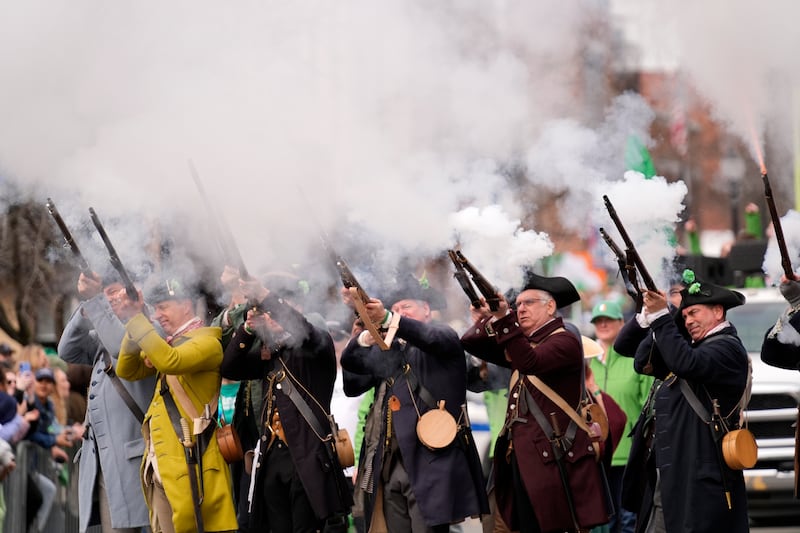
Each year on March 17, Boston marks Evacuation Day, celebrating the moment in 1776 — 250 years ago today — when British forces abandoned the city and withdrew to Canada. Their departure culminated a struggle that began the previous spring and was marked by Henry Knox’s “Noble Train of Artillery,” rapid American-built fortifications on the surrounding heights and a violent “hurrycane” that disrupted British plans.
In 1775, thousands of militiamen from Massachusetts and nearby colonies responded to the hostilities at Lexington and Concord, gathering around Boston to contain the British. A confrontation erupted — the Battle of Bunker Hill — where British regulars seized the ground but suffered more than a thousand casualties.
British general Henry Clinton called it “a dear-bought victory,” warning that another such triumph could ruin them. The battle showed that colonial militia could stand against professional troops. Crushing the rebellion would not be easy.
George Washington knew his army outside Boston was outgunned and outmanned. To change those odds, he relied on young Boston bookseller Henry Knox, who had caught Washington’s attention after helping construct fortifications at Roxbury. Knox had no formal military training; he taught himself artillery by studying military manuals he sold in his shop. In late 1775, Washington sent him hundreds of miles north to retrieve heavy cannon captured earlier in the war at Fort Ticonderoga.
Knox made the trip, retrieving 59 pieces of artillery — field guns, mortars and howitzers — weighing roughly 60 tons, along with barrels of precious gunflints. Preparing the guns for transport alone took 10 days. The return journey proved even more daunting — hauling the massive weapons on sleds pulled by oxen and horses across forests, mountains and frozen rivers in the dead of winter.
While crossing the frozen Hudson River near Albany, a cannon plunged through the ice and had to be recovered with local help. Despite the freezing cold and treacherous terrain, Knox’s team covered 300 miles in just 38 days. By late January 1776, the “Noble Train of Artillery” reached the outskirts of Boston. It was an extraordinary logistical achievement that would soon help force the British to abandon the city.
On March 4, 1776, American forces moved quietly to fortify Dorchester Heights, overlooking Boston Harbor. While the men worked through the night hauling cannon and building fortifications, Washington ordered artillery to fire from other positions to distract the British, who returned the barrage without realizing what was unfolding above them.
In the morning, British commander William Howe saw the newly fortified heights brimming with cannon and reportedly exclaimed, “The rebels have done more in one night than my whole army could have done in months!”
Howe quickly prepared an attack, loading seven regiments onto transports with plans to launch a nighttime assault on the heights. But before the attack began, a violent storm swept in from the sea. One American soldier called it a “hurrycane.” It brought snow, rain and rough waters, making a landing impossible. This, coupled with the fog that shielded the American retreat at the Battle of Long Island months later, might suggest that the weather sided with the Americans.
With the well-placed guns now threatening his fleet and making an attack untenable, Howe soon abandoned Boston altogether. On March 17, some 9,000 British regulars, along with about 1,200 dependents and more than 1,000 Loyalists, sailed north to Halifax in Canada.
For many Americans, victory seemed at hand, but Washington recognized that their “Glorious Cause” was far from won and soon predicted that the British would next set their sights on New York City.
Daniel McCurtin, an Irish-born Continental Army soldier stationed in New York, wrote in June 1776 of the arrival of the British fleet in the harbor: “I spied, as I peeped out the Bay, something resembling a wood of pine trees trimmed. In about 10 minutes, the whole bay was full of shipping as ever it could be. I thought all of London was afloat.”
Some 400 ships, including 73 warships carrying 32,000 troops, including Hessian mercenaries, had arrived in New York Harbor. What had begun as a British evacuation from Boston had now become the full-scale invasion of New York.
Evacuation Day for New York — and the United States — would not come for another seven years.