



A version of this article was first published in the Right to the Point newsletter. Sign up to receive the newsletter in your inbox every Wednesday morning with additional content.
Attorney, talk-show host and CNN commentator Michael Smerconish has found success in the political middle, promoting his show as a place for “independent minds.” Of course, as an article in Columbia Journalism Review noted in 2018, staking out a centrist position means he has enemies on both sides of the aisle.
It also means you never know where the Smerconish audience will stand on any given topic. And his audience surprised him this week with their answers to a poll question: Is the U.S. winning the war with Iran?
Nearly three-quarters (72.6%) said no, a result that Smerconish said was a “head-scratcher.” He thought that the question “warranted a more even divide,” a reasonable expectation given Iran’s substantial losses, both in leadership and in assets, and the U.S. control of Iran’s airspace.
Smerconish posed a similar question to his audience on March 11: “If the war in Iran were to end today, would the U.S. have been victorious?” Then, an even greater number of respondents, 82.6%, said no.
To be clear, it’s an informal and unscientific poll, subject to manipulation if, say, Pete Hegseth were to send a link to 10,000 of his closest friends. And ultimately the poll raises more questions than it answers, to include what exactly constitutes “winning,” something the Trump administration has yet to define.
Moreover, determining who is winning or losing in a conflict is hard enough for a president and his Cabinet, let alone those of us trying to figure things out from a vantage point where we are constantly bombarded with reports that may or may not be true. (See The New York Times’ analysis of AI-generated images, and false rumors that spread about deaths and bombings.)
Most polls simply gauge support for the military strikes.
But the question of whether people think the U.S. is winning is an interesting one, and exposure to media coverage likely influences how they answer the question. Which leads us to Matthew Hennessey’s recent piece for The Wall Street Journal, in which he detailed “the media-made fog of failure in Iran.”
“The media is clearly rooting for an American military loss in Iran,” Hennessey wrote. “Read, watch, listen. Every major outlet, with one obvious exception, is hammering the same message about the war: It’s going poorly, it’s getting worse and it never should have started in the first place.”
He recounts some of the recent coverage, all focused on the negative: “We’re running out of missiles. Planes are falling from the sky. We’re targeting children. Steak and lobster tails.”
Of course, there are plenty of people on social media promoting a much different narrative, one in which America and Israel are winning.
Glenn Beck said Tuesday that what Israel and the U.S. are doing in Iran could turn out to be either World War III or the greatest thing the U.S. has done in the Middle East. We just don’t know yet.
That’s likely what a lot of Americans think, but “Honestly, I have no idea, just hoping for the best” wasn’t a choice we were offered on the Smerconish poll.
The NYT covers the Oscars
How many journalists does it take for The New York Times to cover the Academy Awards?
The answer: A lot more than you’d think.
Behold Sarah Bahr’s tweet:
To which a reasonable person might answer: SIXTY?
That number even gave pause to media analyst Margaret Sullivan, who observed in her “American Crisis” newsletter: “That’s bigger than a lot of entire regional newsrooms these days.”
A closer inspection of Bahr’s article showed that 60 is a bit overblown, as that comprises the number of people, editors included, contributing to the newspaper’s coverage, which included a live blog. As for the journalists working on the ground in Los Angeles, it was about a dozen.
That’s still a lot, but a fraction of the Times’ total newsroom, which, according to Sullivan, numbers about 2,300. And The New York Times, like The Los Angeles Times, has more reason to sink resources into the Oscars than, say, The Washington Post.
Still, the annual hoopla over the Oscars does seem another marker of disconnect between the elites and everybody else. Viewership has declined over much of the past few decades, and some who watch are doing so only to make fun of them, says Sasha Stone, founder of the Hollywood-adjacent website Awards Daily.
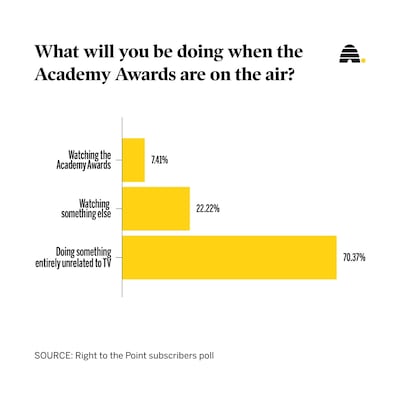
As for the Right to the Point community, most of us had better things to do than watch, with more than 70% saying in our entirely unscientific poll of subscribers last week that we wouldn’t even be watching TV while the Oscars were on.
Arthur Brooks on finding purpose in life
Happiness expert Arthur Brooks (who is delivering the commencement speech at the University of Utah next month) releases a new book at the end of this month. It’s called “The Meaning of Your Life” and it’s being called “the definitive account of how the modern world makes meaning so hard to find — and a plan to discover your life’s deepest purpose.”
People who preorder the book are being offered entrance into a “VIP room” at the virtual book launch March 27 and a private Q&A session with Brooks and other high-profile participants in the launch, including Rainn Wilson, Chip Conley, Hoda Kotb, Maria Shriver, Andrew Yang and Dan Buettner.
Alas, no mention of Oprah Winfrey (with whom Brooks co-wrote 2023 “Build the Life You Want”), but we’re promised surprise guests, so you never know. Here’s a link to learn more.
Tweet of the Week
Recommended Reading
Naomi Schaefer Riley is not a fan of America’s drug policies, which, however well meaning, are having unintended consequences.
She writes: “Our concern about parents’ feelings outweigh our concerns about risks to children. When we look back on this drug epidemic 50 years from now, there will be plenty of blame to go around. Our regrets will not bring back these thousands of souls.”
America’s failed drug policies are hurting our kids
Sutherland Institute scholar Samuel J. Abrams recently took his son to visit his hometown of Philadelphia, and in addition to the usual tourist sights, they made an impromptu, and moving, stop at a local synagogue.
“Cities like Philadelphia remind us that traditions survive only when someone decides they are worth carrying forward. Sometimes that work moves from parent to child. And sometimes, unexpectedly, the child is the one who calls the parent back to it.”
What an unplanned stop in Philadelphia taught my son
Jacob Hess breaks down a new analysis from Ryan Burge that is good news for people who belong to a church and go regularly: they’re less likely to have an anxiety disorder or other mental health condition.
“None of this suggests that faith eliminates mental health struggles, of course, since many believers across traditions experience serious challenges. But across decades of research, a certain pattern has been unmistakable.”
Regular church attendance associated with lower likelihood of mental health diagnoses
End Notes
Subscribers to SiriusXM who listen to any of the conservative-leaning stations know that it’s not just show hosts who develop a cult following, but also some of the people who voice advertisements.
Some are extraordinarily effective.
For example, even though I am not in the market for life insurance, I listen intently every time Mike Slater earnestly tells me I’m going to die and I need Ethos to protect my family.
And don’t get me started on Chuck “I’m not an attorney” McDowell, the raspy voice of Wesley Financial who wants to get me out of a time share I don’t even have. If there is an “it factor” in radio advertising, these guys have it.
Imagine my surprise when, while channel surfing SiriusXM this week, I came across Mike Slater talking about politics; turns out, he’s not in the life-insurance business, but the host of Breitbart News Daily.
I was even more surprised to look him up on social media and see a photo of Donald Trump and Mitt Romney presiding over his X account. Why? No particular reason that I can discern. If you have inside knowledge, please share.
Finally, if you missed it last week, here’s a conversation I had with Princeton University scholar Bernard Haykel, an expert on the Middle East, about where the military action in Iran is headed.
Here’s what a Princeton Middle East expert says is the likeliest outcome in Iran