

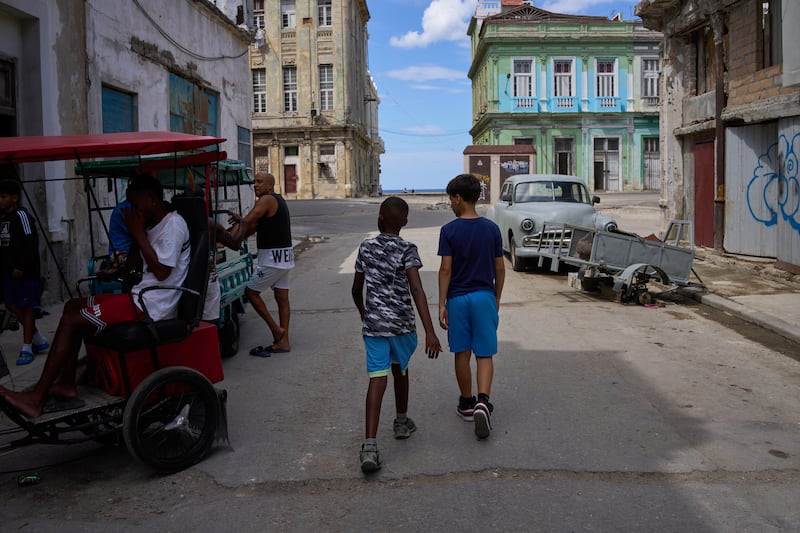

From my rented room in Old Havana, my guide led me in the direction he’d explicitly told me not to wander when I first arrived. Don’t worry, he said. El Guajirito is only a few blocks away. Besides, you know your way around now.
We passed wandering dogs and street-corner loiterers. Salsa music played somewhere. It seemed to play everywhere, with different tunes carrying across Old Havana’s pleasant ocean breeze. I could hear people murmuring but couldn’t see them.
When we arrived at El Guajirito, I first saw nothing. Just another magnificent run-down building of the sort common in Havana, with elaborate arches and stones and cracks in the stones. But inside, it opened up into a regal marble staircase, lit by chandelier, leading to a restaurant and a stage.
I’d mostly tried to avoid these sorts of places on my week-long stay in Cuba, but for a night, I wanted to see Cuba through a vacationer’s eyes rather than my default suspicious glare. I wanted to see the part of Cuba that people visit to see, and that today’s Cubans almost never see. Cuba as it was, rather than as it is.
El Guajirito was perfect because, if you knew what to look for, it blended worlds old and new. It was the sort of place that offered kickbacks to guides who brought in travelers — a common arrangement there — because this was the Cuba the government wanted people to take home. The men wore guayaberas. The tables and chairs were antique, real wood. The menu was the only QR-code menu I saw in Cuba. It included, for goodness sake, filet mignon.
After dinner, an ensemble of crooners and divas serenaded the audience of Americans, Italians and Russians with traditional Cuban hits. In terms of execution, it was lovely. Even familiar. It was the sort of stuff I grew up hearing all the time as a kid in Miami. The crowd ate it up. They clapped along. Meanwhile I squirmed in my chair. I looked at them and wondered what was wrong with me.
Soon everyone joined in a conga line that stretched across the stage. I sat motionless. I wasn’t supposed to be here, I thought. When it was over, folks chanted O-tra vez! O-tra vez! “Again! Again!” I left before the chants had died down, back into the supposedly dangerous neighborhood I’d come from, this time without a guide. Despite few cars on the road, I caught a big whiff of exhaust. Then I walked the two blocks back to my rented room. Easy. My guide was right. I did know my way around. Yet I felt lost. I didn’t know what was real and what my family and friends, my guide, American media and the Cuban government wanted me to think was real.
Four years later, with Cuba teetering on the brink of collapse, that hasn’t changed.
Right, wrong and missing the point
My mom fled Cuba in 1965 along with the rest of her family, with a change of clothes and a Mariquita Pérez doll. She was 6. She settled in Miami. She never returned. In February of 2022, I was the first member of our immediate family to go back — a journey 56 years in the making.
I visited the home where she once lived, and I found my great grandfather’s initials still etched into a glass frame above the front door. I thumbed through a photo album the current occupants had held onto, depicting my mom in a Halloween costume. It had been there all those years, just waiting to be found. I sweat through my shirt at El Guajirito.
I’d come to write about religious freedom and ancestral legacies for Deseret. As a kid in Miami, many if not most of my friends shared similar stories: Their parents or grandparents had likewise left Cuba to escape the grip of Communism, or dictatorship, or both. It informed our existence: Cuba loomed over everything, as fundamental as it was forbidden. Over the decades, Cuba the memory had become divorced from Cuba the place. Now, all that could be on the cusp of changing.
President Donald Trump and Secretary of State Marco Rubio have the Communist government in their crosshairs — or so it seems, and so they say. But as with Venezuela, as with Iran, their ultimate designs for Cuba remain unclear.
The most recent reporting by the New York Times suggests President Miguel Diaz-Canel will be removed from power; that political prisoners will be released; that economic constraints will loosen. However, the existing government structure does not seem likely to change. The Communist party will still rule. The Castro family will still rule. Maybe that, too, will change. Something, it seems, is going to change in a major way. But change is a neutral force. Change can make things better or worse.
In Cuba’s case, it’s hard to imagine the situation getting much worse. Decades of a U.S.-enforced trade embargo, plus rampant government greed and mismanagement, have crumbled the nation’s economic foundations. Cuba exclusively blames the embargo; American leadership has largely blames government ineptitude. Both groups are right and wrong, and both of them miss the point.
Cuba’s economic woes are a secondary concern. Its more fundamental issue is its state of dictatorship. Since the revolution, it has had three leaders, two of them named Castro. Diaz-Canel is their hand-picked heir in a lineage that actually extends beyond the revolution. What became a brutal dictatorship was, at first, a response to dictatorship.
Fulgencio Batista was Cuba’s democratically elected president from 1940 to 1944. He ran for re-election in 1952. Facing certain defeat, he led a military coup and preempted the coming election. Havana became a playground for organized crime and U.S. industry alike, all while Batista squashed dissent and grew wealthy. One U.S. official called Batista’s corruption, brutality and indifference “an open invitation to revolution.”
Fidel Castro proved that assessment correct when he landed a yacht carrying 81 fellow revolutionaries in November 1956. His fighters took Havana on January 1, 1959, and the Cuban revolution was fulfilled. It wasn’t clear then what that meant. Would Castro restore the constitution Batista had violated? Would he be something new? More of the same?
The answer to the latter two was yes. He turned Cuba into a Communist state and a close ally of the Soviet Union. Whether he did so out of genuine ideological conviction or lust for power is still debated, but the consequences were immediate. Change had come. Dictatorship remained. And many Cubans, my family included, wanted to get away.
The U.S. was, for a long time, happy to accept them and thereby score an easy image victory in the Cold War. All the while, it tried to choke out the government with the trade embargo. All the while, Castro purged dissent, punished political prisoners and unleashed waves of exile. He lost military respect abroad, but at home, he created a situation where nobody dared speak out. When I visited in 2022, I met with a priest at an old church in Havana. He told me the truth about his view of the government. But obviously, he told me, I couldn’t print that, because then the government would then cease the renovations to his parish.
I also visited the Cuban National Aquarium, where the tanks were not exactly empty but far from full. My guide joked that people had to eat the fish. It did have an exhibit featuring two sea lions and a seal. I’m not a marine biologist, but it looked to me like the two species did not belong together. The sea lions were always active, always swimming. The seal sat on the bottom of the pool. Every once in a while it would surface to breathe, then sink right back down, motionless. I couldn’t tell whether the sea lions wanted to keep it that way, or just didn’t notice the seal was down there.
‘None of this real’
After my night at El Guajirito, my rented room felt like a space capsule. It was located on the second floor of an apartment building in Old Havana, where the other tenants were everyday Cubans. A small dog seemed to live in the dark staircase. The inside of my studio was painted bright orange, with art on the walls and a flat-screen TV. It had hot water and air conditioning, all made possible by American investment, then listed on Airbnb. That night I opened the door to the balcony, letting in the salty ocean breeze and the many strands of salsa music still playing across the city. Then I picked up a pen.
“None of this is real,” I wrote in the room’s guest book. I meant that the room was an illusion that took the person staying there away from the reality surrounding it. It let me escape to what felt to me like a normal, familiar standard of living, while the tenant in the next apartment could not. I hope that what’s coming, whatever form it takes, will rectify that imbalance. I fear it will only deepen it.
“If negotiations continue on the current trajectory, the regime would ultimately be the same one that, in the summer of 2021, brutalized and detained thousands of protesters for calling for freedom of speech,” Maria de los Angeles Torres, a political scientist and Cuba expert, wrote in the New York Times on Wednesday. “This is not a government that should be trusted with Cuba’s future, much less empowered by the Trump administration.” She contends that economic reform and a cosmetic leadership change would be a betrayal to those who’ve suffered under the Cuban dictatorship, and I’d like to think she’s right.
But trading political freedom for economic possibilities is seductive. Especially when it comes with a visible leadership change, even if that change really amounts to very little. Especially for Cubans who’ve had so little for so long. It feels like victory.
It feels like my orange Airbnb, and like El Guajirito: Something meant to feel real that is not. Whatever this is, Torres contends, it isn’t the change Cubans have been fighting for. Yet many Cubans in my life disagree. They’re ready for whatever change Trump brings to the island. I feel lost between them, just like I felt lost at El Guajirito. Cuba surely needs hope, needs change. Only time will reveal what is actually real, and what is an illusion.