

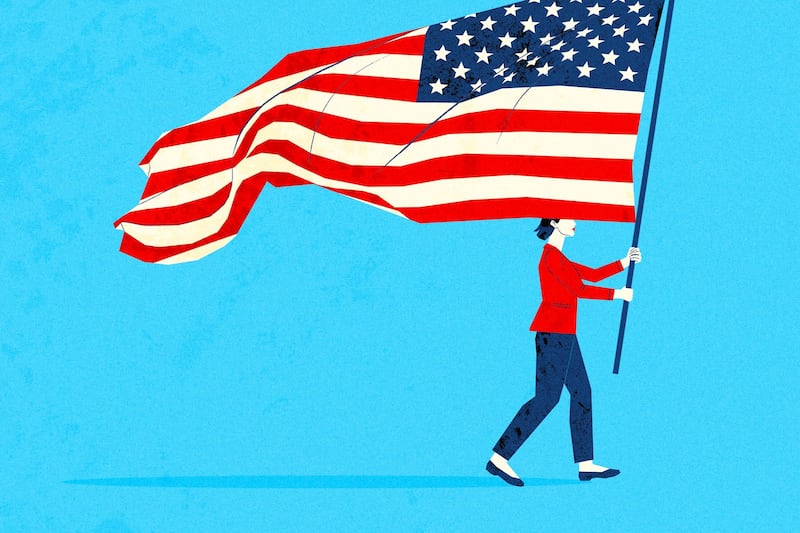
Revolutions rarely keep themselves to their original objectives. The American Revolution was no exception.
The goal of this self-proclaimed separation was to liberate the 13 original colonies from British rule. It succeeded, of course. The American Revolution also unintentionally put the nation on a path to a second revolution: the liberation of women from the tyranny of men.
Consider the Declaration of Independence. It was no doubt written by men, about men and for men. Yet it contained within it a revolutionary idea so powerful that it launched the democratic era and the liberation of women along with it.
The same ideals that dismantled property requirements for voting — destroying the slave system and eventually expanding suffrage to all men — would also chart the path toward political equality for women. After all, if “all men are created equal” and “endowed ... with certain inalienable rights,” including the right to consent to government, then that same logic must apply to women.
Seventy years after the immortal words “We hold these truths to be self-evident …” were put to paper, women gathered in Seneca Falls, New York, to claim those principles for themselves in the Declaration of Sentiments.
Borrowing the logic, style and formatting of its parent document, the Declaration of Sentiments declared the independence of women from male domination and presented a list of grievances as justification. Clearly, the American Revolution was the metaphorical womb from which the women’s revolution emerged.
Beyond providing the vital philosophical language of equality, the American Revolution also drew women into political life in unprecedented ways.
After the passage of the despised Stamp Act in 1765, the colonies agreed to a boycott of all British-made goods until the tax was repealed. As major purchasers in colonial America, women were thus vital to any economic boycott campaign against the British.
According to Carol Berkin’s groundbreaking work "Revolutionary Mothers," “the first political act of American women was to say ‘No.’” This involved a great deal of political organizing among women.
For example, in 1774, 51 women in North Carolina constituted themselves as the Ladies’ Patriotic Guild and signed an agreement to boycott all British-made goods and products. Women were awakening not just to their influence in the economy but also to their essential political ties to one another.
The Continental Army was perpetually underfunded. Fundraising for its soldiers likewise drew women into the political sphere. Sarah Franklin Bache, daughter of Benjamin Franklin, and Esther DeBerdt Reed decided to do something about it by organizing the Ladies’ Association. The effort would ultimately bring in more than $300,000 (in paper currency) for the troops. Women, Reed argued, had the capacity for courage, patriotism and moderation — all virtues of citizens in a free republic. The American Revolution was their chance to prove it.
Once Americans declared that all people possess natural rights and that legitimate government rests on consent, women would inevitably — and rightly — claim those principles as their own.
Beyond boycotts and fundraising, some women wrote plays, poems and essays in favor of independence. Per the social conventions of the era, some women often wrote under pseudonyms or the names of their husbands. Others, like Mercy Otis Warren, eventually undertook the radical act of writing and engaging politically under their own names.
Of course, some women even fought in the war itself. Deborah Sampson of Massachusetts disguised herself as a man to serve in the Continental Army from May 1782 to October 1783. Upon discovery, she was honorably discharged and later received a pension for her military service. She was also the first woman to go on a national lecture tour in the new country, which would have been an unthinkable public engagement for a woman prior to the American Revolution.
While the American Revolution did liberate the colonies from British rule, it also unleashed a genie in the form of principle that would not be put back into the bottle. Once Americans declared that all people possess natural rights and that legitimate government rests on consent, women would inevitably — and rightly — claim those principles as their own.
In that sense, the women’s movement did not begin in Seneca Falls in 1848; it was born in 1776.
This bit of history is courtesy of the CCS. Learn more about how we are marking the Declaration of Independence’s 250th anniversary.