


A version of this article was first published in the Right to the Point newsletter. Sign up to receive the newsletter in your inbox every Wednesday morning with additional content.
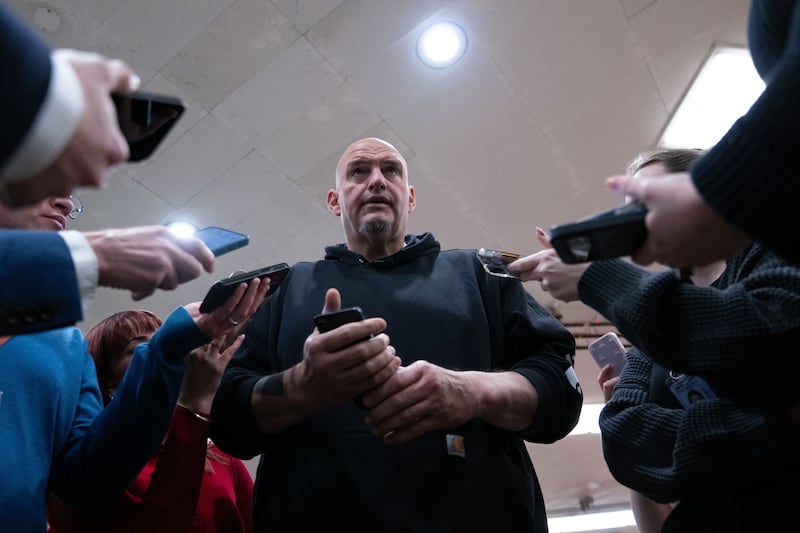
When John Fetterman was first elected to represent Pennsylvania in the U.S. Senate, he was not treated kindly by conservative media. See, for example, Laura Ingraham’s “Mr. Fetterman Goes to Washington” segment in November of 2022 in which the 6-foot-8 Fetterman was called “a massive marionette” and likened to the animated character Shrek.
Considered a progressive, Fetterman had been a Democratic mayor and later the commonwealth’s lieutenant governor, where, according to his website, he “transformed the position into a bully pulpit, advocating for marijuana legalization, economic justice, equal protection for the LGBTQ+ community, and criminal justice reform.” But the vitriol went beyond policy differences, and continued after he was treated for depression not long after taking office.
Then there was the matter of his wardrobe, which rankled people who believed that wearing hoodies and shorts to work convey disrespect — especially when that workplace is the U.S. Senate.
But a curious thing has happened over the past three years: Fetterman’s stock has fallen sharply with Democrats and risen with Republicans, prompting CNN analyst Harry Enten to say “he’s down there with the Titanic” in his own party. In one recent survey, 73% of Republicans said they approved of Fetterman’s performance, compared to 22% of Democrats.
And Fetterman has become a favorite of Fox News hosts like Jesse Watters and Sean Hannity, who had a lengthy conversation with him on his new podcast, admitting that, at one point, he realized, “I had you all wrong. Everything I thought about you, and I really believed it, was wrong.”
It’s not that Fetterman has suddenly embraced positions of the right, although he has been vocal about his support for Israel and the military action in Iran. Rather, it’s that Fetterman has demonstrated a degree of civility and common sense that has been uncommon in the current political climate, even shaking President Donald Trump’s hand at the State of the Union address and expressing admiration for the job that Secretary of State Marco Rubio is doing.
And Fetterman has also demonstrated that he’s willing to change his mind on some things — he wore shorts, sneakers and a hoodie to Trump’s inauguration in 2025 but donned a suit for the State of the Union in 2026, saying it was out of respect for the event.
Similarly, he said he shook Trump’s hand because he will always shake a president’s hand, and said he was disappointed in some of his fellow Democrats’ behavior that night, saying afterwards, “I don’t care if it’s a Republican or Democrat, it’s a president. Just don’t do that. Respect the office.”
All of the conservative love has forced Fetterman to face a question he really seems to dislike: whether he will leave the Democratic Party. He insists that he has voted with the Democratic Party 90% of the time and that his positions do not align with the GOP, even though social media is rife with Republicans applauding his various statements.
He recently told CNN’s Kasie Hunt, “I might clap for some (Republican) things that I agree with, but you know, when you represent Pennsylvania ... hey, we’d all love a blue state, then you could really talk to one side, but for me, it’s a special responsibility, if you represent Pennsylvania, that we have to find a way forward.”
There’s that common sense again, the kind that gets politicians in trouble. (Just ask Mitt Romney.)
Meanwhile, in another strange turn of events, the longform podcast has turned into a platform for civil conversation between ideological opposites, from Gavin Newsom’s conversation with the late Charlie Kirk, to Hannity’s talk with Fetterman. It’s good to see it, particularly as the podcaster wars rage on.
A nation collectively winces (again)
It was hard to find anyone defending the president’s social media post responding to the death of Robert Mueller; those who did simply pointed out that Mueller’s lengthy investigation of alleged Russian interference in the 2016 election was difficult for Trump, who wrote on social media, “Good, I’m glad he’s dead. He can no longer hurt innocent people.”
It was reminiscent of the president’s remarks when Rob Reiner died last year, remarks that made both Republicans and Democrats wince. The less said, the better, in cases like these. But as Matthew Hennessey wrote for The Wall Street Journal, “Mr. Trump is like the honey badger. He don’t care.”
In contrast, former President George W. Bush, whose favorables grow stronger every year, released a statement of sympathy for the Mueller family, highlighting Robert Mueller’s military honors and his work at the FBI after 9/11, which has been obscured by what came after that.
Mueller’s complicated legacy is marred by what social scientists call “the recency effect” — our tendency to recall, and to give more weight to, the most recent thing we’ve heard.
Writing for The Free Press, Eli Lake acknowledged the sins on both sides. “Mueller’s family didn’t deserve the president’s grave dancing. None of Trump’s many enemies do. But Trump also didn’t deserve Russiagate,” Lake wrote.
In the wake of all this, two other people of note died this past week: Leonid Radvinsky, the owner of OnlyFans, the global website that is a major producer of pornography; and Kermit Gosnell, a Philadelphia abortion provider who went to jail for killing fully developed babies.
I looked around, wondering if there would be people also saying, “Good, I’m glad he’s dead” of those men. There are surely people thinking it.
In a monologue on Radvinsky’s death, Albert Mohler Jr., president of The Southern Theological Baptist Seminary, said, “It’s a sad day,” noting that Radvinsky had died of cancer at age 43, but primarily talked about the corrosive effects of pornography, a word that stems from the Greek porneia, which means wrongful desire.
There were, however, some punches, including an X post from conservative commentator Tim Pool, who said Radvinsky was a “vile evil man and one of the most prolific sex traffickers in human history. I have no sympathy for him or anyone who worked with him.”
Regarding Kermit Gosnell, who died in prison at age 85, I was impressed by the response of abortion opponent Lila Rose, who wrote on X that the doctor ended the lives of thousands of babies, “many who were born alive.”
But she went on to write, “He wasn’t created to do evil — he was created for good. Pray he repented on his death bed and may he rest in peace.”
That was definitely not representative of the response on social media, but it is a dignified way to respond to the death of Gosnell.
Of further note: Even the medical news site MedPage Today described Gosnell as a “baby-killing doctor” when reporting his death in its daily newsletter, indicative of how reprehensible his crimes were.
Tweet of the Week
To be fair, I only found this post funny because I didn’t have to fly this week. If I’d been among the exhausted travelers in line ... not so much.
Recommended Reading
Jason F. Wright was recently invited to church by an acquaintance, and even though he didn’t take the man up on his offer, the exchange made him think.
“At some point in the 2,000 years since the Master Inviter showed the way, many of us decided we should only invite someone to church when the timing is flawless. We wait until the person has openly expressed interest, until the conversation feels perfectly aligned, until the potluck or talent show or children’s program is just right. And then, when the Spirit has practically delivered a notarized letter, we extend the invitation. What if that hesitation says more about our fear than about someone else’s readiness?”
Don’t overthink it. Invite people to church, whatever your faith may be
Drew DeMeglio poses a question that is particularly relevant as oil prices remain high: Is the summer vacation now out of reach for the middle class?
“The modest annual vacation that was once a calling card of the American middle class is becoming less attainable. Travel prices have increased 20% since 2019. Ticket prices for Disney theme parks, a middle-class staple, continue to rise. In 2024, the year before the historic drop in visitors to Las Vegas, the city emerged as one of the most expensive in the United States. The middle class is not simply losing the ability to go on vacation — they’re being priced out.”
The end of the middle-class vacation?
Judge Thomas B. Griffith believes that the U.S. Constitution is “hanging by a thread,” but not for the reasons you might think.
“Large majorities of Republicans think that Democrats are immoral and evil. Large majorities of Democrats think the same about Republicans. A recent Pew survey found that the United States is the only nation in the world where a majority of its people believe that most of their fellow citizens are bad people. ... The Constitution cannot survive this animosity.”
“Is the Republic in the midst of a constitutional crisis?”
End Notes
Last week, we talked about commentator Michael Smerconish’s question to his audience, “Is the U.S. winning the war in Iran?” (the noes had it, 72.61% to 27.39% yes), and then I posed the question here.
The Right to the Point family is more optimistic and also more willing to admit that it’s too soon to know.
Here’s our breakdown:

To vote in future polls, subscribe to “Right to the Point,” a newsletter you’ll get free in your inbox on Wednesdays.