

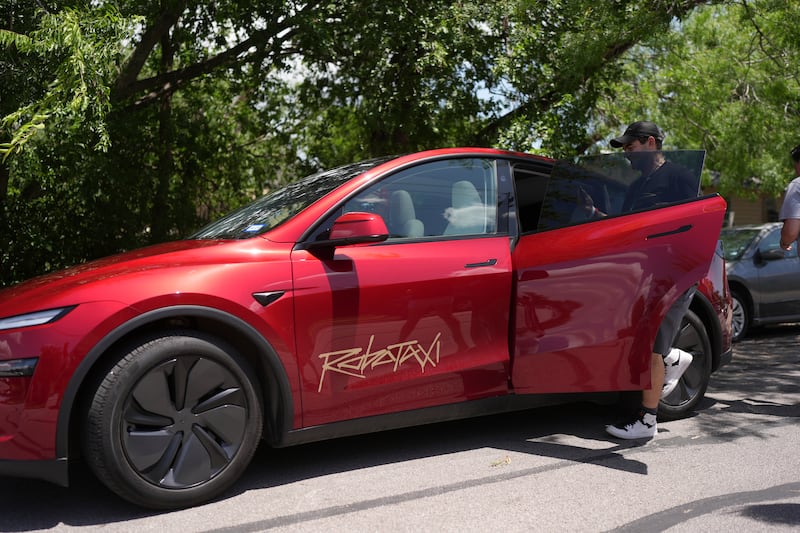

A few weeks ago in Wuhan, China — a city that boasts thousands of supposedly driverless taxis — a whole bunch of them came to a stop on roadways, reportedly because of a “system malfunction,” as Technology Magazine reported it.
These were taxis operated by a company called Apollo Go. While passengers could open their doors, many considered that ill advised, as they were stopped on high-speed highways. However, they could do nothing to get the cars moving again.
The publication said one customer was stuck on an overpass for 90 minutes, trying over and over to reach customer service. Instead, the customer’s order was canceled.
Worst nightmare
For years, my worst nightmare has been to be careening toward a cliff in an autonomous vehicle that has been hacked by a sinister ne’er-do-well. It’s kind of a modern twist on the 1920s film meme of being tied to a railroad track with a locomotive bearing down. But now I have to worry about being stalled on a freeway with a malfunction while traffic zips by, trying to avoid me.
To say nothing of the idea that air taxis may fill the skies by the time the Olympics return to Utah in 2034.
The future may be exciting, but I think I’ll keep chancing life in my 20-year-old six-speed manual transmission Volvo, thank you.
Meanwhile, in California, about 3,000 people have joined a class-action lawsuit against Tesla. The New York Post reported that the lead plaintiff bought a car in 2017 and paid thousands extra for a lifetime of self-driving software updates. Today, his car still isn’t completely autonomous, and his hardware may not be capable of handling it if the technology was available.
The plaintiff alleges Tesla is marketing vehicles as fully autonomous when they are not.
What happened to 2020 predictions?
All of which has me once again wondering, it’s 2026 — where is my fully self-driving car?
I first asked that question in a column in 2020. If you were to travel back to the mid-teens, you would see that 2020 was central to the predictions of many about a driverless world. In 2015, Business Insider published a piece headlined, “10 million self-driving cars will be on the road by 2020.”
“Self-driving cars are no longer a futuristic idea,” it began, noting that many manufacturers were about to introduce features allowing a car “some ability to drive itself.”
“Some,” it turns out, is a big word.
That same year, The Guardian quoted BMW’s Michael Aeberhard as saying, “We think sometime after 2020 we will be ready for the first highly automated function, which means that the driver will be actually able to do something other than monitor the system — read emails, call somebody, check the news, whatever.”
To be clear, I sometimes see people on Utah’s I-15 doing one or more of those things, but not in self-driving cars.
Well, 2020 blew by in a pandemic-smudged blur. Now, it’s six years later and the best expert guesses I can find predict fully self-driving cars won’t be available until around 2035, but even that isn’t certain.
The elusive Level 5
Experts measure autonomous driving on six levels, from zero to five, with Level 5 being completely self-driving, meaning it has no steering wheel or pedals and no need for monitoring by a human.
A blog this month by patent attorney Bao Tran, published by patentpc.com, says, “The closest we have today is Level 2+ and Level 3 autonomy, where cars can drive themselves under certain conditions but still require human intervention.”
That is true despite all the hype and innuendo by some of the 40-plus companies that are working on the technology. He said Tesla, Waymo, Cruise and Baidu Apollo are leading the way toward the Level 5 “holy grail.” Those who are operating taxi services are gaining valuable on-the-ground experience, but often at the expense of customers, such as the man in Arizona who wanted to go to the airport but ended up driving in circles.
Level 5 would require a vehicle to respond to an endless array of circumstances, including weather, road signs covered in graffiti, construction projects, traffic police using hand gestures, subtle nods from drivers yielding the right-of-way at a four-way stop or unusual merge patterns at freeway interchanges.
This doesn’t mean we won’t get there. I just hope that happens before I need a car to get me to and from my doctor appointments after I retire, without leaving me stranded on an overpass.