

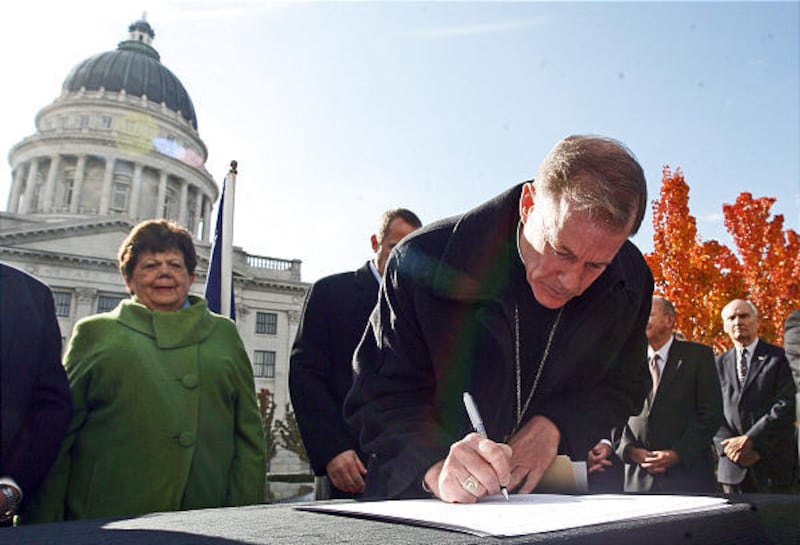
Fifteen years ago, Utah did something rare in American politics.
In the middle of a rising national storm over immigration, leaders across faith, business and government came together and chose a different path. The Utah Compact offered a simple but powerful framework: uphold the rule of law, keep families together, respect human dignity and recognize the economic reality of immigration.
It was thoughtful. It was balanced. And it worked.
Supported by leaders of The Church of Jesus Christ of Latter-day Saints and reaffirmed again in 2019, the Utah Compact became a model for a more humane, rational approach — what many called “the Utah way.”
But much has changed since then.
Across the country, immigration enforcement has intensified. In Minneapolis, two citizens were killed during federal operations. Entire communities are retreating into fear — children missing school, families avoiding church, neighbors disappearing overnight.
This is not theoretical to me.
My wife and I helped lead Hispanic congregations in Arizona for years. We knew these families personally. Then, during the height of enforcement policies, they vanished — fathers deported, mothers packing in the night, children left confused and afraid.
I later served three terms in the Arizona state Senate, where we made a deliberate choice: Stop the cycle of punitive, fear-driven, state-based immigration laws. For nearly a decade, we held that line.
Because we learned something important.
You can enforce the law without creating fear.
You can secure borders without breaking communities.
Today, the national conversation has shifted again. Border security — long debated — is now essentially done. But that success has revealed the next challenge hiding in plain sight:
There are an estimated 10 to 12 million immigrants living in the country illegally already here. Most are not criminals. They are working, raising families, paying taxes, attending church and quietly contributing to the only country many of their children have ever known.
We cannot deport our way out of that reality.
And we should not ignore it either.
This is where Utah can lead again.
It is time for a Utah Compact 2.0 — not a rejection of the original principles, but an evolution of them.
The original compact correctly emphasized federal responsibility, law enforcement priorities, family unity, economic strength and human dignity. Those principles still hold. But today’s moment requires one more step: resolution.
A modern compact should call for a pragmatic legal framework for those already here — one that reinforces the rule of law while resolving a reality we can no longer ignore.
This is not amnesty. It is accountability paired with order.
Congress could establish a conditional, renewable legal status for long-term, noncriminal residents who are already contributing to our economy and communities. Eligibility should be clear and strict:
- Background checks and disqualification for serious criminal activity
- Proof of work history and tax compliance, or structured repayment plans
- Registration with federal authorities within a defined window
- No access to federal benefits beyond what is earned through work
- No automatic path to citizenship — this is legal presence, not naturalization
Participation would be earned, not granted. Those who do not come forward or who violate the terms would remain subject to enforcement.
Equally important, this approach must be paired with credible enforcement going forward. A functioning system requires both a lawful way in and consistent consequences for those who ignore it. Otherwise, we simply repeat the cycle.
Such a framework would do three things at once.
First, it would restore respect for the law by replacing today’s gray market with a clear, enforceable structure.
Second, it would protect American workers and businesses by leveling the playing field — ending the quiet incentives that reward under-the-table employment and exploitation.
Third, it would strengthen families and communities by allowing people who are already here, known and contributing, to live and work without constant fear — while still holding them to defined legal standards.
This is not about erasing the past. It is about governing the present responsibly.
From a faith perspective, the case is even clearer.
Latter-day Saint doctrine emphasizes both accountability and compassion. We believe in laws — but also in agency, redemption, addressing laws that haven’t worked and the centrality of the family.
We are taught to “love our neighbor,” not as an abstract idea, but as a lived responsibility. In this case, our neighbors are not strangers. They are co-workers, fellow church members and friends.
The original Utah Compact reminded us that immigration policy is not just about borders. It is about people.
That truth has not changed.
What has changed is the urgency.
We now face a defining choice: continue cycling between enforcement and neglect, or finally build a durable, humane solution for those already here.
Utah has done this before.
At a time when other states pursued division, Utah chose clarity, compassion and leadership. It showed that conservative principles and humane policy are not opposites — they are complements.
That example still matters.
And it is needed again.
A Utah Compact 2.0 would not solve every aspect of immigration policy. But it would do something equally important: It would restore balance, reaffirm our values and offer a path forward that is both lawful and humane.
In a divided nation, that kind of leadership is rare.
In Utah, it has precedent.
And now, it has purpose again.