


In 2004, Wangari Maathai became the first African woman and first environmental activist to receive the Nobel Peace Prize. Her work empowering women and planting trees with the Green Belt Movement propelled her to becoming a leader in upholding democracy in Kenya.
Years ago, a student gave me a children’s book version of her story entitled “Wangari’s Trees of Peace.” As I flipped through the book’s pages recently, one image stood out to me. It depicts (age appropriately) a police officer beating Maathai while she was peacefully protesting.
It struck me: Making peace is not always a peaceful process.
People we often think of as models of peacemakers have had similar experiences to Maathai. Mohandas Gandhi was beaten and derided on multiple occasions and eventually assassinated. The Rev. Martin Luther King Jr. was called a troublemaker, surveilled by the FBI and also assassinated.
Many South Africans fighting apartheid (including Nelson Mandela) were branded terrorists. Their examples indicate that making true peace requires long, hard work and bold action to confront the enemies of peace.
I say “true peace” because, as one of my students put it, keeping the peace is not the same as making peace. Preventing outright conflict may actually undermine true peace if repression, division and suffering are left simmering under the surface.
In my recent class on South African liberation movements, we came to the conclusion that true reconciliation had to include facing the full truth with accountability and a mutual commitment to creating a new and just relationship (as Mpho Tutu van Furth articulated).
Their examples indicate that making true peace requires long, hard work and bold action to confront the enemies of peace.
Needless to say, confronting the truth of wrongs committed is not a pleasant process. Yet, it is the only way forward to true and lasting peace. As my friend Kimberly Applewhite, a psychologist working in the Salt Lake City area, once said, the discomfort of correction is not the same as the discomfort of contention.
In the words of the Kairos Document, issued in 1985 by South African Christian leaders against apartheid, “Any form of peace or reconciliation that allows the sin of injustice and oppression to continue is a false peace and counterfeit reconciliation.”
At that time, resistance to apartheid had reached a fever pitch both within South Africa and internationally. The document was a new, bold step for 150 church leaders, motivated by witnessing continued violent oppression by the apartheid state.
These leaders subsequently came together to demand the dismantling of apartheid. They stated, “It would be quite wrong to try to preserve ‘peace’ and ‘unity’ at all costs, even at the cost of truth and justice and, worse still, at the cost of thousands of young lives. As disciples of Jesus we should rather promote truth and justice and life at all costs, even at the cost of creating conflict, disunity and dissension along the way.”
They looked to Jesus, who overturned the merchant tables in the temple and challenged the Sadducees and Pharisees, as an example.
This kind of righteous confrontation is what U.S. civil rights leader and former Rep. John Lewis called “good trouble, necessary trouble” — getting in the way, speaking up, even challenging the law in order to bring about justice.
I want to be clear that in highlighting how people have taken bold, even confrontational actions to establish peace, I am not advocating for war or violence. Although self-defense can be justified, Archbishop Desmond Tutu, who chaired South Africa’s Truth and Reconciliation Commission, told how violence can be tragically misdirected and damage both the victims and the perpetrators. After listening to testimonies of gross human rights violations committed to uphold apartheid, Tutu declared, “The end does not justify the means.”
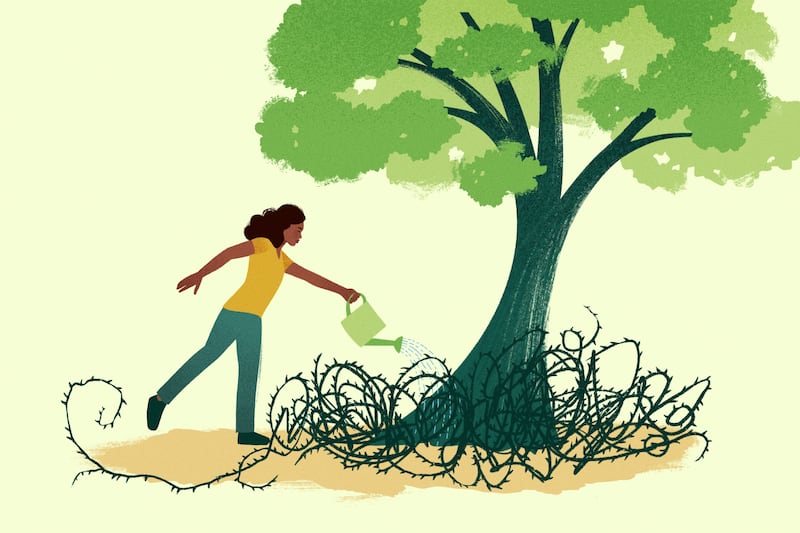
The manner in which we confront injustice matters. Maathai and others understood that to achieve peace, they needed to prepare the ground for peace, even in the way they fought for it. In other words, they worked to create conditions that would nurture peace by showing their opponents there was a place for them in a more just future.
Lewis perhaps put it best when he wrote, “If you want to create an open society, your means of doing so must be consistent with the society you want to create.”
How do we make sure our peacemaking methods will contribute to a peaceful society? For many of these leaders, love was a guiding force. We need both a love that Austin Channing Brown says is “troubled by injustice” and a love that yields an “accepting and open heart,” as Lewis added, that “holds no malice toward the inflictors” of suffering.
For believers, this means recognizing that even our enemies are children of God. South African activist Malusi Mpumlwana demonstrated this love while being tortured in prison. He recalled thinking, “By the way, these are God’s children and yet they are behaving like animals. They need us to help them recover the humanity they have lost.”
It is this kind of love, coupled with truth and a commitment to a just future, that can guide us through successful peacemaking, even if it may not always feel like a peaceful process.