



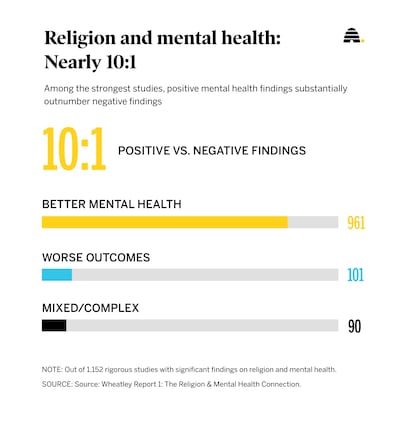
Our team of scholars at BYU and Duke has just finished a comprehensive review of Oxford University Press’s Handbook of Religion and Health, a 1,100-page volume that catalogs the findings of the most rigorous studies to date, as selected by a broader research team from Duke and Harvard. From these 1,152 studies, we tallied which findings were positive, negative, mixed or null.
The picture that emerges is hard to ignore.
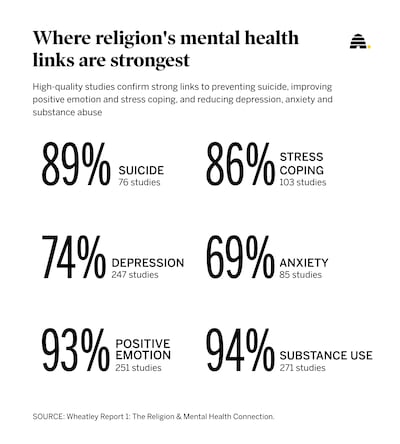
In these most robust U.S. and international studies, beneficial associations between religion and mental health outpace harmful ones by roughly 10 to 1. Among these studies, large majorities found positive relationships between religion and several areas of mental health, including improving suicide prevention, stress coping and positive emotion, and reducing depression, anxiety and substance use.
The pattern is especially strong for positive emotion (26:1) and coping with stress (12:1), but the positive connections do not end there. Notably, of the 271 highest-quality studies from the Oxford Handbook on religion and substance abuse, 256 found religious involvement linked to lower addiction rates compared with just six negative studies, a 43-to-1 advantage.
And the places where the evidence is strongest of a mental health benefit from religion are precisely the places we are hurting most — in Utah and across the nation.
For preventing suicide, the strongest studies find that religion helps 11 times more often than it appears to hinder. That includes a landmark study of nearly 90,000 women that found frequent attenders of religious services were five times less likely to die by suicide than women who never attended. Harvard’s Tyler VanderWeele and colleagues have estimated that falling religious attendance accounts for roughly 40% of the rise in U.S. suicide rates over the past two decades.
As reflected here, the places where the evidence is strongest for a mental health benefit from religion are precisely the places we are hurting most.
Faith stabilizes youth
These connections show up early on at the family level. Religious participation is correlated with stronger marriages, lower divorce rates, more engaged parenting, and norms that pull adolescents away from substances and self-harm.
Adolescent suicide has roughly doubled nationwide over the past two decades and now stands as the second leading cause of death for young people in America. In the Mountain West, including Utah, the trend has climbed even steeper.
Against that backdrop, the protective effect of stable, faith-rooted homes is one of the most replicated findings in the literature. This works because active religious congregations deliver several things at once that no clinic can replicate at scale: weekly face-to-face contact across generations, opportunities to serve people outside one’s household, frameworks of meaning that hold under economic strain or sudden grief, and explicit teachings that affirm the dignity and worth of human life.
Other institutions can only offer an aspect or two of that potent package. No other institution but faith communities offers all of that to as many people free of charge to the state.
This is not simply solved by “creating community” more generally. A Pew Research Center study found that actively religious adults are consistently more likely than their unaffiliated or inactively religious peers to describe themselves as “very happy,” but the same lift did not show up for those who joined sports clubs, charities or political parties.
Bottom line: Whatever religion is providing, secular forms of belonging do not replicate it.
Faith in Utah
Utah is not starting from scratch. The Church of Jesus Christ of Latter-day Saints runs an Addiction Recovery Program that holds roughly 2,800 meetings every week across 30 countries and 17 languages — a peer-led, faith-framed adaptation of the same 12-step model that the 2020 Cochrane review found to be still more effective than other established treatments at producing continuous abstinence. Hundreds of those groups meet in Utah weekly. The meetings are free, confidential, open to those of any (or no) faith and led by people who have walked through addiction themselves. Other Utah faith communities — Catholic, evangelical, Jewish and Muslim — run parallel ministries.
Inside Utah’s prisons, religion is doing work most Utahns never see. The Utah Department of Corrections relies on roughly 1,500 religious volunteers serving its facilities, the highest number of any state prison system in the country. Latter-day Saints lead that work alongside ministries from Jehovah’s Witnesses, Catholics and more than two dozen other traditions. During the pandemic, when outside volunteers were locked out of the prison, peer-led religious activity inside continued at up to 30 hours a week. For those reentering society from prison, these religious volunteers formed steady relationships standing between them and another arrest.
Stepping back from faith when we need it the most
Each of us has watched, from our own area of expertise, what happens as religion recedes from the institutions that once partnered with it:
- In criminal justice, we have seen faith removed as a key to rehabilitation and restorative justice, replaced by secular programs. However well-designed, these alternatives have lost the moral and spiritual transformation around which the earliest American rehabilitation framework was built.
- In mental health, we have inherited a clinical tradition that long pathologized religion as a neurosis.
- In workplaces, we have seen religious expression discouraged and employees grow reluctant to bring their faith into professional life.
- In family life, we have seen the weekly rhythms of communal worship fade for many in a generation, taking with them the dense network of relationships that once held people through crisis.
At the same time, we have watched depression, addiction and isolation rise sharply across all ages. We have seen desperation among men reach crisis levels, leading far too many to suicide and others to incarceration. We have seen unaddressed mental health problems drain human connection, family stability and quiet happiness within homes all around us.
These concerning trends are linked to many other social realities. But we believe it’s time to acknowledge more broadly the public health consequences of stepping back from faith.
None of this means religion is a cure-all. Even in the most rigorous studies cataloged in the Oxford Handbook of Religion and Health, the evidence is genuinely mixed for schizophrenia and bipolar disorder, where clinical psychiatric care is essential and irreplaceable. We should also be especially cognizant of the alarming rates of depression and suicidality among LGBTQ+ youth.
But here again, religion can help. According to recent research, sexual minority Latter-day Saint teens were much less likely to report suicidal ideation than nonheterosexual teens with other or no faith traditions. That finding does not erase the difficult experiences some people have had within religious settings. But it does show that the answer is not to reactively separate vulnerable youth from religion altogether.
People need more faith-health partnerships, not fewer — chaplains, clinicians, volunteers and faith communities — so patients can choose for themselves what steps they need to improve their lives.
Some ways to elevate the positive role of faith in mental health
So what would it look like to take this evidence on the mental health benefits of religion seriously at a national and local level? At minimum:
- Clinicians can ask patients about their faith community involvement — not to evangelize, but because the scientific data on religion’s protective effects are so scientifically clear and compelling.
- Health systems can build more voluntary referral pathways from primary care, behavioral health and addiction recovery to congregations the patient chooses, across all faith traditions, with a respectful exit for anyone who declines.
- Public agencies can regard the Church of Jesus Christ’s Addiction Recovery Program; 12-step ministries; and parallel Catholic, evangelical, Jewish and Muslim recovery efforts as serious partners in prevention.
- Prevention partnerships could flourish among public institutions, including schools, jails, hospitals and crisis services. These initiatives lie explicitly within First Amendment limits as a complement to public services, not a substitute. Utah, with stronger and richer religious infrastructure than almost anywhere in the country, has every reason to scale a similar approach.
- We can also do more to defend the societal conditions that make all of this possible — especially genuine space for free expression. The cataloged benefits of religion depend on people being free to practice their faith openly, across traditions and without coercion.
In many ways, Utah is further along than the rest of the country in recognizing what a partnership with religion can do. The close-knit social fabric and relatively high neighborhood trust that other states are trying to rebuild already exist here in large measure. What we have not yet done is treat the fabric of religious communities as the public health asset the evidence shows it to be — and build the durable bridges between clinical care, schools and faith communities that such recognition would require.
At a moment when loneliness, addiction and despair are rising across the nation, we cannot afford to ignore the evidence-based solutions already standing in our neighborhoods.