




It’s all men’s fault.
It’s a popular catchphrase in liberal circles generally, but especially in conversations about marriage. Whenever we at the Institute for Family Studies or the Wheatley Institute publish new research about falling marriage rates (or declining dating trends), progressive thinkers seem to instinctively rush to the defense of women, as if we’re casting all blame on them.
From Matt Yglesias at Slow Boring arguing “the weak link in convincing more people to settle down earlier is, in fact, men” to Anna Sussman lamenting “the state of men today” in The New York Times to The Atlantic’s Olga Khazan opining on X that “I truly think the decline in marriage is really a problem of men failing to launch,” the idea that America’s retreat from marriage is all about male malaise, especially among working-class guys, is clearly popular on the left.
The Times even illustrated the message with an image showing a giant woman being pursued by a crowd of midget men.
Believe me, we get it. We have heard from plenty of liberal and conservative young women that too many men aren’t measuring up. But pinning all the blame on working-class men leaves elite liberals free to avoid facing their own responsibility for the present cultural moment they’ve helped shape.
Consider, for example, the gutting of the Boy Scouts, one of the few institutions in America dedicated to turning boys into virtuous young men. After being pressed by left-leaning elites for decades to go coed, the organization said in 2017 that it would begin admitting girls. It filed for bankruptcy three years later.
Since the 1960s, masculinity itself has been viewed with increased skepticism, maligned in the mainstream media and the ivory tower, while in the real world, its virtues — including strength, initiative and chivalry — were still expected and demanded in the workplace and yes, even in dating. All this brings to mind C.S. Lewis’s observation that “we make men without chests and expect from them virtue and enterprise.”
Men and women build culture together, and the liberal thinkers and writers who place the blame for falling marriage rates squarely at the feet of today’s men ought to reckon with the norms and trends — many of which they’ve expressly had a hand in — that have brought us to this moment where too many men don’t seem marriageable. (It’s worth noting that many young men tend to agree with this assessment: our recent study found that nearly half — 46% — of young American men ages 18-23 say they think of themselves as “a failure.”)
It is true that many more men are “failing to launch” today than in prior generations. Women now outnumber men in higher education by a ratio of almost 3 to 2. Fewer young men are working, and a rising number are stoned on the sofa. Fully 1 in 5 are living with their parents. For a young woman hoping to marry, these trends shrink the pool of available and attractive partners.
And yet progressive educators, politicians and journalists have presided over the collapse of boys’ performance in schools, a left-wing monoculture on college campuses that discourages young men from engaging in the classroom, a COVID-19 response that robbed boys of countless opportunities to develop their social skills, and the push for the legalization of marijuana. They have also done their level best to demean and devalue masculinity. So, yes, some of our young men ought to be doing better, but our culture also ought to create better norms and institutions so that more young men can thrive.
Take today’s social norms around sex. It’s fascinating to note, for example, that many of the women Anna Louie Sussman references in her New York Times piece about the dearth of marriageable men are mothers, all lamenting not having found a spouse. Yet there is no examination of why women are agreeing to sex with men who are so utterly — by their own expressed standards — not marriage material.
The answer is norms. Marrying young — in your 20s — is no longer aspirational, let alone normal. Waiting until marriage for sex is stranger still. In many circles, particularly among the progressive elite, a more traditional sexual ethic is actively mocked.
So while it may be true that many young women still say they hope to marry and become mothers, they don’t want to marry young and few forgo sex until after marriage. Yet those two habits, were they once again normalized on a cultural scale, would not only increase women’s odds of marrying but would almost certainly improve the quality of their dating pool. Men are more likely to commit and embrace mature adulthood when that is what society expects them to do.
We can lament that truth — men should grow up and commit anyway — but we must reckon with it. Men are much less likely to level up and embrace committed love when they have ready access to low-cost or no-cost sex, including internet pornography, as Mark Regnerus argued in his book “Cheap Sex.” Psychologists Roy Baumeister and Kathleen Vohs described it this way:
“Nowadays young men can skip the wearying detour of getting education and career prospects to qualify for sex. Nor does he have to get married and accept all those costs, including promising to share his lifetime earnings and forego other women forever. ... Sex has become free and easy.”
The social science bears it out. Thirty years ago, Nobel laureate George Akerlof studied the sexual and marriage habits of young men and women in the wake of the sexual revolution. He concluded that as out-of-wedlock births rose in that era (despite predictions that they’d fall), so-called “shotgun weddings” almost completely disappeared. In the name of sexual “liberation” (for men and women alike), we destigmatized nonmarital childbearing and deadbeat fatherhood — and, predictably, ended up with far more deadbeat dads and children born outside of wedlock. It turns out “sexual activity without commitment was increasingly expected in premarital relationships,” Akerlof wrote.
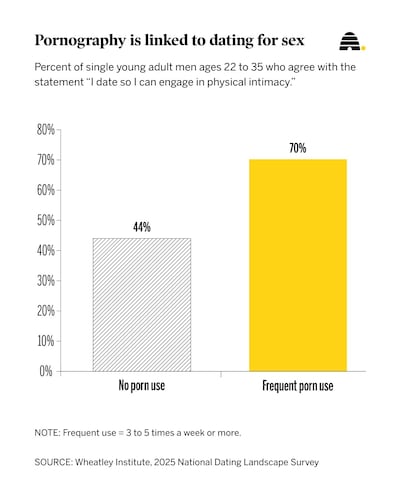
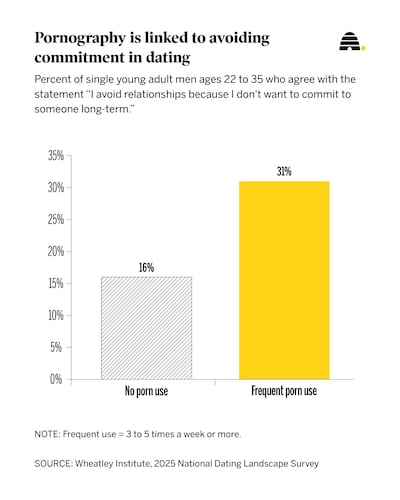
Today, we see that another form of cheap sex, internet pornography, also seems to be undermining committed love, as well as marriage. Young men (22-35) who are frequent porn users are about twice as likely to say that they avoid committing in dating relationships and 7 in 10 agree that they date in order to have sex, according to the National Dating Landscape Survey. Another study found that “heavy Internet usage generally, and use of pornography specifically” was tied to lower odds of marriage.
We have given men abundant access to precisely this kind of cheap virtual and real sex. We also have — both explicitly in pop culture, and implicitly in our laws and customs — told women that expecting commitment from men before having sex is “needy” and anti-feminist, and that to co-accept responsibility for sexual decisions is victimization. And then we’ve continued to expect commitment and maturation from men. It’s a strange world that asks men to grow up and embrace commitment while telling them sex requires no commitment at all, let alone marriage.
This inconsistency has created a tornado of cascading social ills, including generations of single mothers, kids without a dad at home and too many men who can’t seem to find a reason to grow up. As Akerlof himself noted, men are more likely to “settle down when they get married: if they fail to get married, they fail to settle down.”
The breakdown of norms, ideals and institutions — including sexual ones — that usher boys into manhood has created a large minority of young men who seem unworthy of, or uninterested in, real love, not to mention marriage. But if love and marriage is the pathway to the good life (spoiler: it is for most of us) then it’s in everyone’s interest — men and women alike — to create a healthier culture. We need a less cynical view of dating and marriage, including young marriage, among women. We should stop allowing vice (drug use, online gambling, overreliance on government assistance) to proliferate. And by creating new social sexual norms, or returning to old ones, we should encourage men to step up, communicating that we expect more from them than easy sex and suppressed masculinity.
We should expect men to embrace real love and marriage — and equip them to be worthy of both as good men. Then there would be no need for the male blame game.