

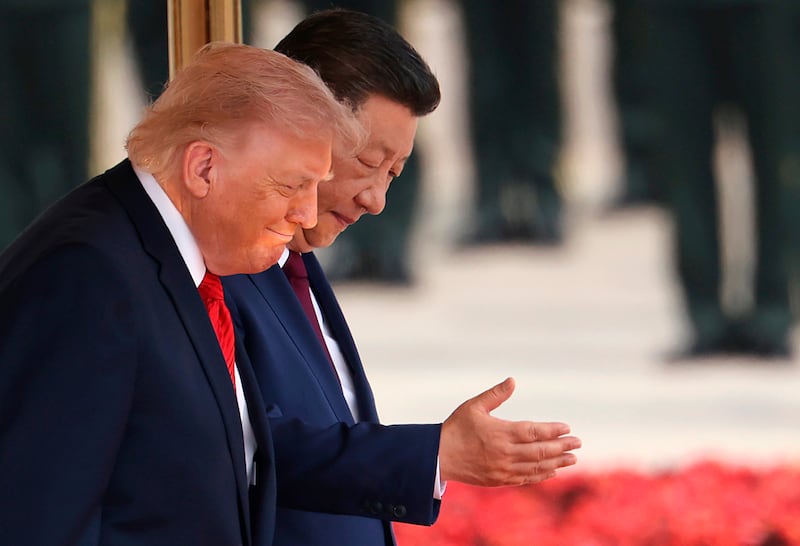

President Donald Trump is returning home from China after 43 hours of pomp and ceremony, a lengthy meeting with President Xi Jinping and high-level U.S. and Chinese officials, and a private lunch and tea with Xi at his personal residence within the Forbidden City compound.
Trump was effusive in his praise of Xi, including his trademark appellation that Xi looks like he “is from central casting.” Trump also expressed awe at how beautiful and impressive Beijing is as China’s historic capital.
Xi was much more circumspect in his language, focusing his remarks on U.S.-China relations and calling for a relationship of “constructive strategic stability.”
As the summit concluded, both Xi and Trump praised the meetings for improving and stabilizing bilateral relations. But there were few specific commitments and agreements.
Trump said that they had “settled a lot of different problems that other people wouldn’t have been able to settle.” China’s Foreign Ministry issued a statement saying that the two leaders “agreed on a new vision of a constructive China-U.S. relationship of strategic stability, and reached important common understandings on keeping economic and trade ties stable” while also “properly addressing each other’s concerns, and enhancing communication and coordination on international and regional issues.”
The real deliverables from this summit will only become known over the coming weeks and months.
Regarding trade
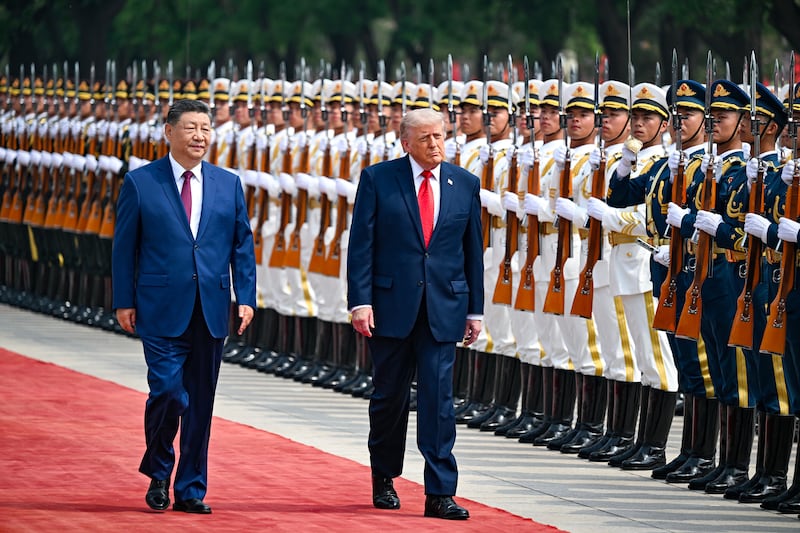
The main trade issues for the U.S. were “Boeings, beef and beans.” A few things stood out in that regard:
- China said that “the economic and trade teams of the two countries reached an overall balanced and positive result, which is good news for the people of the two countries and the world.”
- Trump claimed that China agreed to buy 200 Boeing aircraft. China last agreed to a major purchase of Boeing aircraft during Trump’s first visit to China in 2017.
- Jamieson Greer, the president’s trade representative, said the U.S. expects China to commit to purchase billions of dollars of U.S. agricultural products. To get trade negotiations off on the right foot, as the summit began, China committed to allow the import of American beef to China.
But these agreements are not set in stone. In an interview with Sean Hannity of Fox News, Trump was less than completely confident about the Boeing aircraft agreement, saying, “I think it was a commitment.”
In the past, China made these kinds of commitments, but it never worked out — gaining a reputation in the foreign policy world for doing so.
Nonetheless, these steps do seem positive in the sense that they show China’s willingness to reengage with the U.S. on specific trade issues.
Regarding sharing technology
Going forward, Secretary of the Treasury Scott Bessent said the two sides discussed setting up a board of trade to negotiate bilateral trade issues and a board of investment to discuss Chinese investments in the “nonstrategic nonsensitive area.”
The secretary would not confirm reports of an agreement to allow 10 Chinese companies to purchase advanced Nvidia chips that are critical to developing advanced artificial intelligence (AI).
These matters are highly sensitive, especially given past concerns of Trump being willing to give away technology to China in exchange for other things he wanted. In this case, the incentives were again evident: We wanted them to buy some of our agriculture, and they wanted to buy some of our tech.
Bessent did say that China and the U.S. will cooperate to keep AI out of the hands of non-state actors with malign intentions. But we don’t know what will happen.
Regarding peace in the Middle East
Regarding the war in Iran, China was even-handed. The Chinese Foreign Ministry did not publicly announce any U.S.-China agreement, if there was one. The Foreign Ministry stated, “China’s position on the Iran situation is clear. There is no point in continuing this conflict which should not have happened in the first place. To find an early way to resolve the situation is in the interest of not only the U.S. and Iran, but also regional countries and the rest of the world. China always believes that dialogue and negotiation is the right way forward, and the use of force is a dead end.”
Both sides, the statement continued, should “engage in dialogue and consultation, and reach a settlement on the Iranian nuclear issue and other issues that accommodates the concerns of all parties. It is important to reopen the shipping lanes as soon as possible to respond to the call of the international community and jointly keep the global supply chains stable and unimpeded. China will work with the international community to provide stronger support for peace talks and play a constructive role in achieving lasting peace in the Middle East.”
The White House readout of the Xi-Trump meeting stated that “the two sides agreed that the Strait of Hormuz must remain open to support the free flow of energy” and Xi “also made clear China’s opposition to the militarization of the Strait and any effort to charge a toll for its use, and he expressed interest in purchasing more American oil to reduce China’s dependence on the Strait in the future.”
“Both countries agree that Iran can never have a nuclear weapon,” the White House statement added.
Trump talks about this as a new agreement from China. But in my view, this is nothing new. This has been China’s policy for months — a reiteration of statements they’ve made about the war ever since it started. It appears the U.S. didn’t get China to make any kind of agreement to put pressure on Iran.
Regarding Taiwan
Xi established China’s red line on Taiwan at the outset of the closed-door meeting, stressing that the Taiwan issue is the most critical issue in the U.S.-China relationship. He stated, “If it is handled properly, the bilateral relationship will enjoy overall stability. Otherwise, the two countries will have clashes and even conflicts, putting the entire relationship in great jeopardy.”
The Foreign Ministry spokesperson said, “China’s opposition to U.S. arms sales to China’s Taiwan region is consistent and clear. Safeguarding peace and stability across the Taiwan Strait is the biggest common denominator between China and the U.S. The U.S. side must exercise extra caution in handling the Taiwan question.”
The White House readout made no mention of Taiwan, but Secretary of State Marco Rubio confirmed Xi’s statement, saying, “The Chinese always raise it on their side, we always make clear our position, and we move on to the other topics.”
The secretary confirmed that there was no change in U.S. Taiwan policy. At the same time, the spokesperson for the Taiwan government issued a statement that the U.S. has “repeatedly reiterated its firm and clear position of support for Taiwan.” The statement added, “China’s military threat is the sole source of insecurity in the Taiwan Strait and the broader Indo-Pacific region. Continuous enhancement of defense and effective joint deterrence are the most critical factors to ensuring regional security. The government views all actions that contribute to regional stability and the management of potential risks from authoritarian expansion positively.”
Although this reflects largely a reiteration of positions, the Rubio statement was really important — Trump made no concessions and there was no change in stated U.S. policy.
Any surprises?
I was surprised that there didn’t appear to be discussions of nuclear weapons between countries — or of some statements from Japan’s prime minister that have alarmed China.
Yet there was apparently no room for more. Trump wanted to make a trade deal, China wanted to make a statement on Taiwan and the Iran war pushed itself into the discussion. Other issues got pushed off the table.
During the summit, Xi Jinping recast the U.S.-China relationship, placing China on equal footing with the United States. Xi stated that “changes in the past century are accelerating, and the international situation is chaotic and intertwined. Can we work together to address global challenges and inject more stability into the world? I am willing to work with President Trump to lead and steer the big ship of China-U.S. relations, so that 2026 will become a historic and landmark year for China-U.S. relations to carry forward the past and open up the future.”
But Xi also expressed an ominous concern: “As the once-in-a-century transformation accelerates and the international landscape undergoes change and turmoil, the world has reached a new crossroads. Can China and the United States overcome the ‘Thucydides Trap’ and establish a new paradigm for relations between great powers?”
Here, the China president was referencing the ancient Greek historian Thucydides, who observed that when an established world power feels threatened by a rising one, this has historically resulted in war. Even so, Xi wants Americans to view China’s rise as peaceful and not threatening to the United States.
My take: China is not out to topple the United States — they have benefited a great deal from the world order. They want to maintain that and be recognized as a leader in that world order.
They’re effectively telling us, “Don’t see us as a threat. We don’t want to threaten you — we want our fair piece of the pie. Let’s not fall into this trap where great powers come to blows.”