

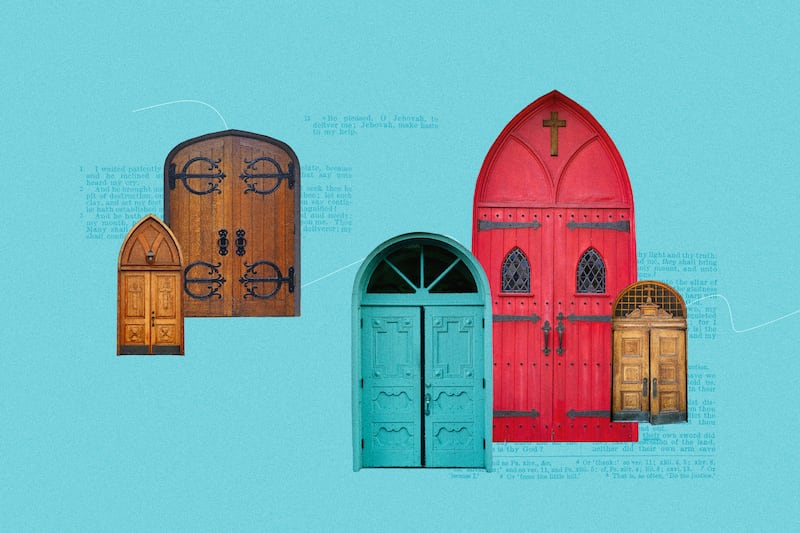

When I was 13, a school friend invited me to attend church with his family. I didn’t hesitate. I said no.
I pictured an old Baptist church in downtown Charlottesville, Virginia, near my dad’s office — one I had walked past many times. But I had no idea what happened inside. More than that, I had no memory — none — of ever having stepped inside another house of faith. Without questioning it, I had decided I wasn’t supposed to.
At a time when Americans increasingly sort themselves into like-minded circles — politically, culturally and even religiously — opportunities to step meaningfully into someone else’s space are becoming rare.
Which is why I’ve come to believe we need more of them. Invitations to speak in Methodist, Episcopal, Lutheran, Baptist and nondenominational congregations have taught me something I didn’t expect about faith — and something more of us should actively pursue.
We need more interfaith experiences.
These invitations have come largely because of my work as a writer and speaker. Over time, that work has opened doors I once assumed would always be closed. As a member of The Church of Jesus Christ of Latter-day Saints, it is unusual to be asked to stand at another church’s pulpit on a Sunday morning, sometimes even serving as a guest speaker.
I don’t take those invitations lightly. Each one represents a profound act of trust. When a congregation hands you their pulpit — or even their microphone — they are trusting you with their people and their worship.
I feel the weight of that responsibility every time.
I also don’t feel the need to soften what I believe. I speak openly about my faith in Jesus Christ and my convictions as a Latter-day Saint, while trying never to distract from the Spirit of the meeting or disrespect the traditions of those who have invited me. There is a way to be clear without being overbearing.
It’s a balance I didn’t always understand — as my boyhood rejection of a chance to worship illustrates.
That moment stayed with me.
Years later, I’ve found myself doing something the 13-year-old version of me never would have imagined: walking through doors like that and, at times, standing at the front of the room. Even now, there’s occasionally a flicker of hesitation as I approach the entrance.
But I step through anyway — and without exception, I’m met with a handshake, a smile and someone asking where I’m from. Someone presses a program into my hand. Another person quietly makes sure I know where to sit.
Within minutes, I’m no longer a visitor. I’m a guest. Sometimes, I’m even family.
Often, after the final prayer, something else happens that has impressed me: people linger. They talk. They check on each other. They introduce you to someone you “just have to meet.” There’s an unhurried sense of fellowship that extends the worship beyond the closing hymn.
It seems like a small thing.
But it isn’t. And that welcome has taught me some truths.
First, Christians recognize each other faster than we sometimes think. When people learn I’m a Latter-day Saint, the conversation rarely stays on labels. It moves toward what we share: faith in Jesus Christ, the power of prayer and the belief that God is still working in our lives. While public conversations emphasize differences, inside church buildings, the similarities tend to surface first.
Second, hospitality is a universal language of faith. It shows up in small ways — in the person who saves you a seat, a quiet introduction, a whispered “we’re glad you’re here.” Across traditions, that instinct to welcome a stranger is alive and well. More than that, it is personal. Again and again, I’ve been treated as family — simply another person who showed up to worship God.
Third, the music has surprised me. Sometimes it’s a hymn I know; other times it’s new. I’ve come to value both. There’s something powerful about hearing familiar words in a different setting — and something just as meaningful about discovering new ones that carry the same message: Praise God, trust Christ and keep the faith.
Fourth, people everywhere are hungry for hope. After nearly every chance to speak, someone approaches quietly with a story — a struggling child, a strained marriage, a private question about faith or a burden they’ve been carrying alone. The circumstances vary, but the hope does not. People want to know that God sees them.
Finally, explaining your faith to people outside your own tradition has a way of strengthening it. Speaking in these settings has required me to articulate my beliefs more clearly than I sometimes do among fellow Latter-day Saints. When you step outside your own tradition, you quickly discover what matters most.
Taken together, these experiences have led me to a simple conclusion: Faith often travels farther through kindness than through agreement. That doesn’t mean differences don’t matter. But relationships built on respect and shared belief in Jesus Christ can open doors that arguments never will.
In a season of division — when it’s easy to misunderstand people we’ve never actually met — those kinds of experiences matter. They remind us that belief is not only something we defend; it is something we live alongside people who see the world a little differently.
I’m not suggesting that everyone needs to stand behind another congregation’s pulpit. But there is value in stepping, even occasionally, into someone else’s place of worship — or welcoming them into ours. Interfaith understanding is built through experience.
I sometimes think about that 13-year-old boy in Charlottesville — the one who had walked past that church so many times but never imagined going inside.
He would be surprised to see where I’ve stood since then. But what would surprise him even more is what I’ve found inside: people who love Jesus Christ. People trying to live a little better. People hoping God will meet them where they are.
In other words, people who are a lot like the people I worship with week after week.
The buildings may look different from the outside. But inside, the hope sounds remarkably the same.
And we would be better for hearing it — together.