

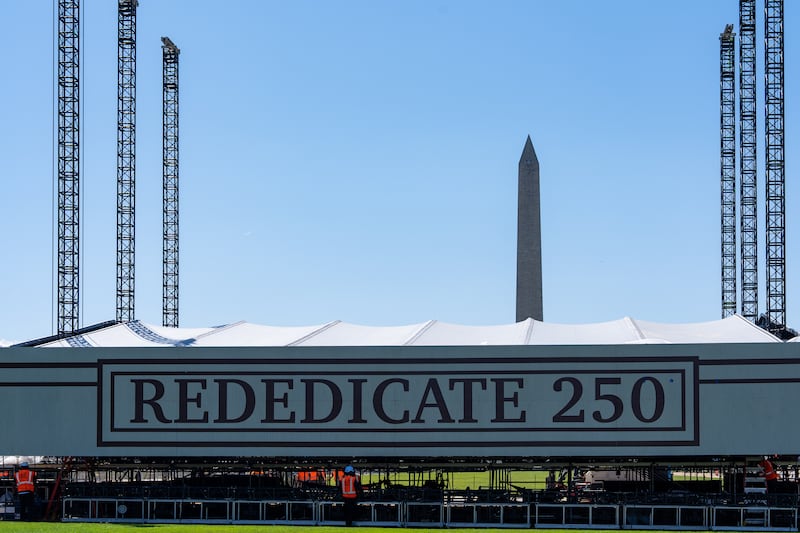

On Sunday, organizers of “Rededicate 250” will gather on the National Mall for a day of prayer, worship and what they describe as a “rededication” of the United States as “One Nation under God.” Timed just ahead of the nation’s 250th birthday, the event features House Speaker Mike Johnson, Secretary of Defense Pete Hegseth and other senior officials, along with prominent evangelical leaders, two Catholic bishops and a leading Orthodox rabbi.
Organized through a public-private partnership with the White House, this event revives a constitutional question Americans have never fully resolved: When does public religious expression become governmental establishment of religion?
For some, the answer is straightforward. The National Mall is a traditional public forum where private groups regularly hold religious and ideological events. Religious Americans have the same right as anyone else to assemble, pray and celebrate their vision of the nation’s history.
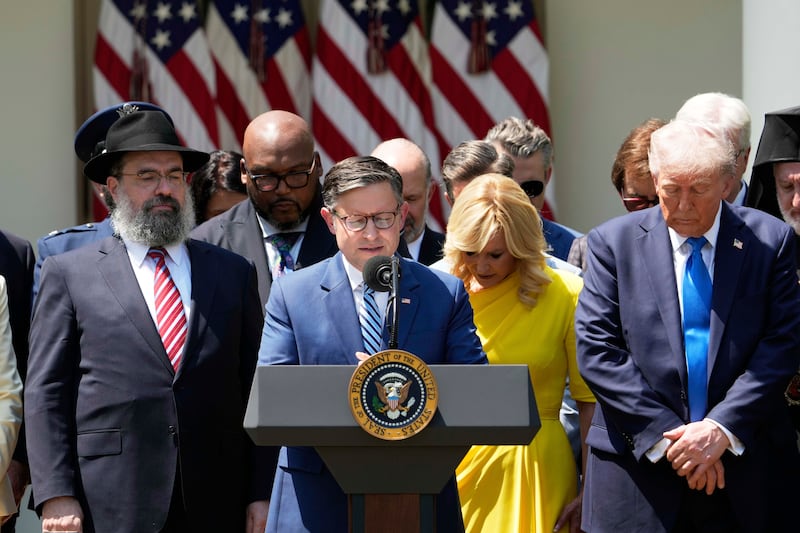
For others, the event feels different, not because it is religious but because of how it is framed: presented as a national act of religious recommitment, organized in partnership with the White House and with high-ranking officials appearing under their official titles.
At what point, critics ask, does patriotic religiosity become government endorsement?
What the Constitution requires
The Constitution offers no simple answer, but it does provide a framework.
The First Amendment contains two religion clauses that exist in tension:
- The Free Exercise Clause protects Americans’ right to practice religion publicly and robustly.
- The Establishment Clause forbids the government from establishing religion or coercing religious observance.
Between these two declarations, a diverse practice of faith across the nation has flourished, spanning two centuries. The challenge has always been defining where private expression ends and unconstitutional governmental action begins.
For much of the 20th century, the Supreme Court approached this boundary with some suspicion. School-sponsored prayer was struck down on the ground that schoolchildren are uniquely vulnerable to official religious pressure. By the 1980s, the court had developed an “endorsement test,” which asked whether government action conveyed an impermissible endorsement of religion to a reasonable observer.
The Supreme Court’s modern jurisprudence has moved in a different direction, away from concern about government endorsement and toward a focus on past precedents for protecting government-linked religious expression, as long as no one is forced to participate.
At what point, critics ask, does patriotic religiosity become government endorsement?
The key case for events like Rededicate 250 is Town of Greece v. Galloway. Citizens there challenged a town’s practice of opening meetings with explicitly Christian prayers, many invoking Jesus Christ by name. They argued that the practice excluded non-Christians and effectively aligned the town with one faith.
The Supreme Court disagreed. Writing for the court, Justice Anthony Kennedy emphasized the nation’s long tradition of legislative prayer dating back to the founding. So long as the government does not coerce participation, discriminate among faiths or use prayer as a tool of proselytization, ceremonial religious expression generally falls within the nation’s constitutional traditions.
That approach has strengthened in recent years. In Kennedy v. Bremerton School District, the court held that a high school football coach’s visible postgame prayers were protected private religious expression. Establishment Clause analysis, the court said, must be guided by “historical practices and understandings,” not by abstract concerns about perceived endorsement.
Under this framework, Rededicate 250 would likely be upheld. The National Mall is a paradigmatic public forum. Participation is voluntary. No one is compelled to attend, pray or affirm any creed. The government is not imposing religious observance in the way the Establishment Clause most clearly forbids.
History points in the same direction. As Michael McConnell has shown, a government-established religion to the founding generation was defined not by religious rhetoric or public ceremony but by its legal control over faith: things like controlling doctrine and clergy, compelling attendance, providing public financial support and limiting political participation to members of the established church.
Rededicate 250 has none of these features.
What legal doctrine cannot settle
Even so, doctrinal permissibility is not the same as constitutional reassurance.
What makes Rededicate 250 more fraught is the fusion of three elements: explicitly Christian worship, national symbolism and the participation of high-ranking leaders in their official capacities, in an event organized through a partnership with the White House. Such an event does not merely place religion alongside public life. It intertwines religious commitment with national identity.
That distinction matters, even if it does not map neatly onto modern legal doctrine. The Establishment Clause was not designed to purge religion from the public square, but to prevent the state from identifying itself too closely with a particular faith. That starts to feel like what’s happening here, especially because the framers worried not only about formal establishment but also about what happens when religious and civic identity become tightly linked.
When senior officials participate in overtly sectarian national ceremonies, organized in part through the executive branch, does the government signal that some religious identities are more fully “American” than others?
The concern is not coercion in the narrow sense. No one at Rededicate 250 will be punished for refusing to participate, and no legal rights turn on attendance. The question is subtler: When senior officials participate in overtly sectarian national ceremonies, organized in part through the executive branch, does the government signal that some religious identities are more fully “American” than others?
Reasonable people will answer differently. Some will see these officials as simply exercising their own religious liberty in public view. Others will see the symbolic prestige of government, and the organizing power of the White House, being lent to advancing a specifically Christian vision of the nation.
The Supreme Court today is likely to side with the former view. But the underlying debate won’t be going away any time soon — reflecting, as it does, competing visions of American pluralism that judges alone cannot resolve.
One vision treats public religious expression as an essential part of national identity. The other attends more centrally to the possibility that when government and religious symbolism merge too closely, citizens outside the dominant faith are pushed to the margins of civic life.
Rededicate 250 places those competing instincts on full display. That is why the event matters — not as another large gathering on the National Mall but as a test of how Americans understand the relationship between faith, citizenship and political belonging.