



Harvard recently released the latest results from their Global Human Flourishing Study, which surveyed over 200,000 people from 22 countries. Employing the highest level of rigor, this study focuses on what is connected with flourishing in individual countries and what is common worldwide.
Flourishing was examined from multiple angles, including happiness, health, meaning, good character, relationships and financial stability. All of these were combined into a single “flourishing index.”
In line with the overall body of research, their worldwide analyses found that the greater the religious service attendance, the greater the flourishing.
What about Latter-day Saints? Fortunately, the study included religious affiliation questions, allowing us to see how Latter-day Saints compare in the U.S. and globally.
In analyzing just the U.S. data here, this study finds that Latter-day Saints scored highly on the flourishing index, statistically tied with several other religions. The lowest levels of flourishing were found in those of no religion, particularly those who were “never religious” (not raised in a religion and not currently religious).
As in other studies, this Harvard survey found a significantly higher number of Latter-day Saints reporting they attend religious services at least weekly (65%), with the next highest being Evangelical (59%), Pentecostal/Charismatic (53%), Baptist (45%) and Presbyterian (37%).
Latter-day Saint happiness, love and comfort
Looking at some specific aspects of flourishing, Latter-day Saints had one of the lowest levels of depression (8.5%) — two to three times lower than groups measured in the study more distant from faith, including “no religion” (16%) and “Agnostic,” “Atheist” and “Never Religious” (all at 19%).
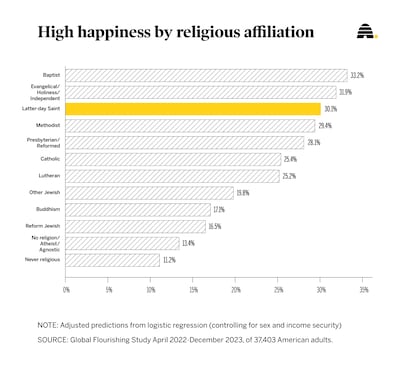
Latter-day Saints are also statistically tied with several other conservative Christian faiths for members who were “highly happy” (30%), which was close to double those surveyed in the study more distant from faith, including “no religion” (16%), “atheist” (14%), “agnostic” (12%) and “never religious” (11%).
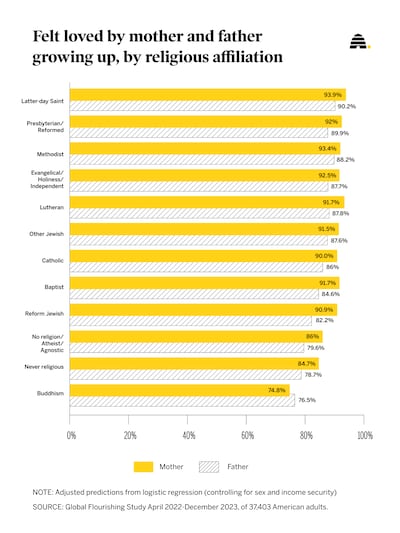
Latter-day Saints also had the highest reports of feeling loved by their mother (94%) and their father (90%) while growing up — about 10 points higher than those more distant from faith, who are 85–87% likely to report feeling loved by a mother and 79–80% likely to report the same for their father. This is similar to other research that finds religion related to fathers being more positively engaged with their children and less likely to be abusive.
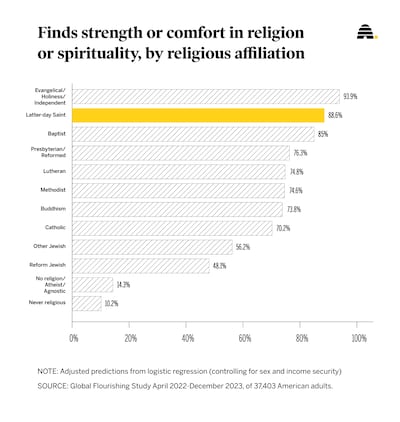
And they were among the highest for finding strength and comfort from their religion or spirituality (89%). Again, given the overall research finding religion related to greater well-being, these findings are unsurprising.
Feeling criticized within a faith community
One area of curiosity is that Latter-day Saints also reported somewhat higher levels of feeling like their religious community was critical of them (11%). This was statistically identical to several other faiths, including Baptist, Presbyterian, Evangelical and Buddhism, and appears to be a broader issue that many religions are working with.
But it’s not entirely clear what the finding means. It may be that given higher expectations, Latter-day Saints may perceive (whether real or not) others judging them for not meeting those expectations. But this may also reflect perceived critique from less religiously orthodox members for others being “too” religious (“Molly Mormon”) or supporting certain prophetic teachings.
President Russell M. Nelson spoke directly to this concern when he said, “My dear brothers and sisters, how we treat each other really matters! … If a couple in your ward gets divorced, or a young missionary returns home early, or a teenager doubts his testimony, they do not need your judgment. They need to experience the pure love of Jesus Christ reflected in your words and actions.”
This may be an area Latter-day Saints need to continually work on. At the same time, it does seem many Latter-day Saints are integrating this teaching. That nearly 90% of Latter-day Saints don’t feel criticized means, for the most part, that people are not feeling excessive judgment. And again, this Latter-day Saint level of criticism is not particularly unique across faiths.
In the end, recent data from one of the best studies finds religion connected with greater flourishing, and Latter-day Saints are no exception. There are certainly areas for Latter-day Saints to improve, and solid research can help us identify and tackle those areas more effectively. As we work to obtain and understand the best data, we can move toward greater flourishing for all.