

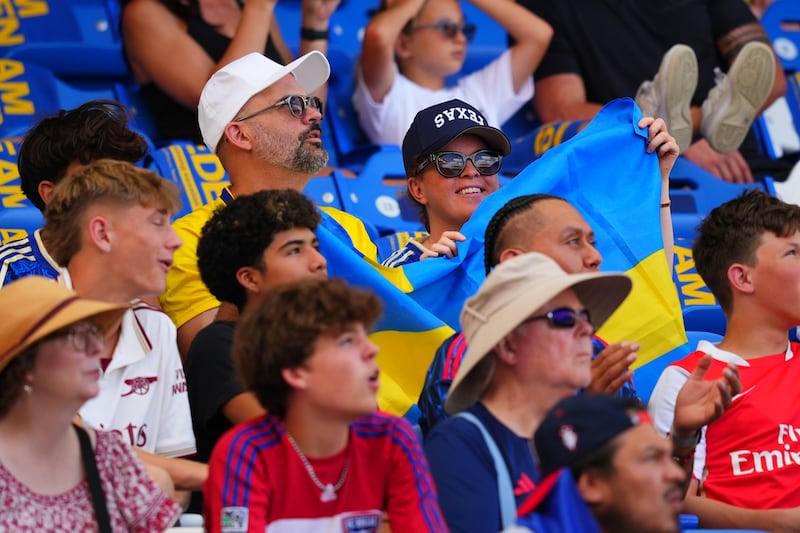
The World Cup may be exactly what the planet needs right now.
Sports has been characterized as a great unifier. That isn’t always true, of course. You don’t need to look far to find examples of college rivalries that get out of hand or hooligans who riot at soccer games in various parts of the world.
But those are exceptions. We agree with the late Nelson Mandela, who said, “Sport has the power to change the world. It has the power to inspire. It has the power to unite people in a way that little else does.”
At its best, sports can bring together President Donald Trump and New York Mayor Zohran Mamdani, along with celebrities such as Spike Lee, Timothée Chalamet and Chris Rock. All were seen in Madison Square Garden this week at the same NBA Finals game. Each shared a rooting interest in the Knicks that, momentarily, at least, set all other concerns aside.
Put them in the same room without sports and the outcome would likely be much different.
48 teams competing

This year’s FIFA World Cup will feature 48 nation-sponsored teams, up from 32 in previous cup tournaments. There will be three host nations — Mexico, Canada and the United States. Games are scheduled in 16 separate cities.
The realities of the outside world do not completely disappear when these teams take the pitch. Iran, for instance, sought permission to move its base camp from the U.S. to Mexico, obviously in response to its ongoing war with the U.S. And, as of Monday, Iranian staff members had been denied visas to enter the United States, and U.S. officials are requiring the Iranian team to fly into the U.S. on the day of their games. These are not unreasonable precautions during a time of heightened tensions, when spies or terrorists may be scheming to find ways to gain access.
Still, it is better to see the Iranian team kicking a ball under any restrictions than to see military hostilities. All teams have implicitly agreed to abide by the same rules of the game, and each has implicitly agreed to submit to the authority of a referee. Fans will cheer and the world will be temporarily diverted to something more fun and wholesome than war.
The 2002 Olympics
Utahns, of all people, understand the mollifying effect of athletic competition. The 2002 Winter Olympics, hosted by Salt Lake City, were held only a few months after the terrorist attacks of 9/11. Those games may have done more to distract and calm a jittery world than anything else at that time. Despite heavy security at each venue, the world saw athletic competitions held free from incidents. It was a moment for the world to collectively exhale.
Mandela understood this power. As Harvard University’s Epicenter noted recently, South Africa once sported an all-white rugby team called the Springboks. Mandela dramatically surprised many by putting on a team jersey and asking South Africans of all ethnicities to support the team in the 1995 Rugby World Cup. This symbolic act formed a new national bond and shared passion that erased old racial divides.
History.com called it “a masterful act of statecraft conducted squarely in the international spotlight.” But he couldn’t have done it without the powerful vehicle of sports.
For 39 days, the World Cup will enthrall much of the world as it unites distant lands in a game that builds national pride. It is an event to celebrate and a vehicle unlike any other. It gives the world a ray of hope.
This is a fragile thing. It could easily be broken by gambling, the plague that threatens to rob games of their integrity.
The world should guard against this loss of credibility at all costs. If people begin treating marvelous events like the World Cup with skepticism, it may be difficult to fix, and the world would seem far drearier.