


Massachusetts Gov. Maura Healey is going viral for signing an executive order making haggis legal in the state — a move the legions of Scottish fans in Boston for the World Cup are sure to appreciate.
Although STV News reports the order was symbolic and no actual laws were changed, Scottish soccer fans are reacting favorably to the news.
Healey’s order, announced Tuesday at the State House in Boston, was in response to the hordes of Scots currently in the city to support their national team at the World Cup. Scotland defeated Haiti 1-0 last week at Boston Stadium and plays Morocco in the same location on Friday.
Videos of Scottish soccer fans celebrating in the streets of Boston — bagpipes and all — have taken over social media. They even took over a Red Sox game and have run the pubs dry.
While those fans may not actually be able to enjoy haggis in the U.S. this week, Healey’s symbolic gesture may pave a way forward for culinary enthusiasts in the future.
I certainly hope so — as someone who has tried haggis several times, here’s my take on the dish.
I tried haggis, and I fear I loved it
To give you a bit of background, I’ve never been much of a carnivore. In fact, I was a vegetarian for a year in middle school and again for most of high school. I generally avoid adventurous cuts of meat, and I eat red meat pretty rarely.
But when I visited Scotland for two weeks a few years ago, I was determined to try the national dish: haggis, a kind of sausage made from offal (sheep’s heart, liver and lungs) mixed with onion, oats, spices and suet. It sounded disgusting, but I just wanted to say I’d had a bite.
On Sept. 16, 2024, I went to a small cafe in Kilmacolm, Scotland, the small town where my great-great-grandmother was born, and endeavored to make her proud by ordering a full Scottish breakfast: two eggs, two rashers of bacon (which is a different cut from American bacon), grilled tomatoes, two fried eggs, baked beans, a slice of toast, a potato scone, sausage, black pudding (aka blood sausage), and a slice of haggis.
Haggis can sometimes be served as a mound of what looks like ground beef, but it’s often packed into sausage casings, sliced and lightly pan-fried, as it was here.
My cousin, who was with me, snapped this picture as I prepared my first bite.

When I bit into the haggis, I thought I’d mixed it up with another sausage, because there was no way haggis would actually taste good. But it was a softer texture than the regular sausage, and it obviously wasn’t the blood sausage, which is nearly black (hence the name “black pudding”).
So I had to face the truth: I, unfortunately, loved haggis.
Here’s the thing about haggis: If you, like me, struggle with gross meat textures, it’s the perfect dish. I’d rather starve than eat fatty pork or even look at tripe, but haggis has a perfectly palatable texture because the organ meat is ground so finely and mixed with oats and onions. Flavor-wise, it’s delicious; pepper, nutmeg and coriander combine with the onions and meat for a delightful, savory taste.
Feeling brave, I went ahead and tried the black pudding, too, which I thought was OK. It’s a simple yet scary recipe of pig’s blood, oats and fat, also stuffed into sausage, sliced and pan-fried. It was a lot softer than the haggis — which makes sense, since there’s actually no meat in it — and the flavor was pretty gamey. I went back to the haggis.
I left that cafe a changed woman. I like to think my ancestors were smiling down on me.
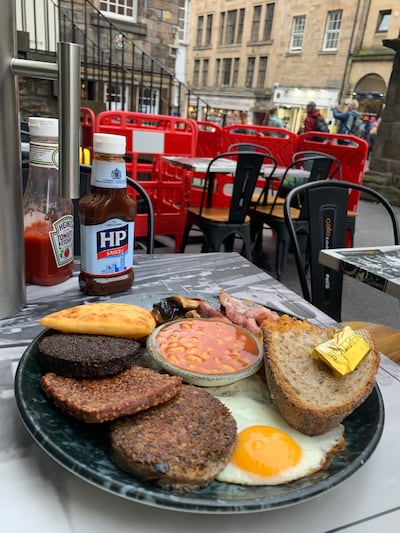
I ordered haggis three more times before I left Scotland — at first to be sure that the first experience wasn’t a weird glitch, and then because it had legitimately become my favorite breakfast meat.
To continue the culinary adventure, I also tried a steak-and-kidney pie on that trip. I did not enjoy the experience. The kidney pieces were rubbery and tasted like old tires.
Why is haggis illegal?
When I returned home to the U.S., I was devastated to learn that the reason you can’t find haggis here isn’t because it’s uncommon; it’s because it’s actually illegal.
In 1971, the U.S. government banned all food containing sheep lung, which is an essential part of haggis. Vice reports that the USDA’s ban arose from concerns about food safety, as stomach fluids could potentially contaminate the sheep lung.

Some U.S. producers make haggis without the lung, but they note that it negatively affects its texture, per BBC.
Although there were rumors in 2010 that the U.S. was ready to lift its ban, those hopes proved false, NPR reported.
So let this be my plea to the USDA: Please let us eat haggis. I can’t pronounce half the ingredients in Cheez Whiz, which I’m pretty sure is just flavored plastic anyway. I’ll take the risk with sheep meat.