


BOSTON — “Don’t get your history from poetry,” the tour guide says, explaining how Henry Wadsworth Longfellow miseducated generations of American children about Paul Revere’s famous ride.
We are standing in the shadow of Revere, or rather the iconic bronze likeness of him created by Cyrus Edwin Dallin, the Utah-born sculptor best known to members of The Church of Jesus Christ of Latter-day Saints for his depictions of Brigham Young and the Angel Moroni.
Here in Boston, however, my tour guide, holding a flute and dressed in 18th-century garb, is prepared to set the record straight about the midnight ride that was a pivotal point in the American Revolution.
Revere most likely didn’t say “the British are coming” or “one if by land, two if by sea,” as Longfellow wrote in “Paul Revere’s Ride.” Pretty much everyone in Boston in 1775 was British, and the Redcoats, or “regulars,” if they approached via water, would be coming in boats on the Charles River, not the Atlantic.
Also, Longfellow left out some other significant details: There were three riders sounding the alarm that night, and only one of them made it to Concord — and it was not Revere, who was intercepted and detained by British soldiers. (The other riders, William Dawes and Dr. Samuel Prescott, didn’t get immortalized in poetry.)
So yes, Rob Crean, tour guide by day and comedian by night, is right: Don’t get your history from poetry.
Get it from walking the streets where the history was actually made.

In his book “The American Revolution: A Concise History,” Boston historian Robert J. Allison recounts how his interest in history was piqued when his mother took him to see Gen. George Washington’s headquarters in Morristown, New Jersey.
“Through a window, I caught a glimpse of a white wig and a Continental uniform as a mysterious figure rose from Washington’s desk, then vanished,” Allison wrote, adding, “Ever since, I have trailed that elusive phantom, and thank many good park rangers — in New Jersey, Massachusetts, and points south and west — for bringing us closer.”
And on the occasion of America’s 250th anniversary, there’s no better place to get closer to that history than the Freedom Trail, a 2.5-mile trek that explores 16 historic sites in the city where the revolution began.
“Trail” is a bit of a misnomer. This excursion is, for the most part, a walk through noisy city streets that at times seem intent on distracting you from the purpose of being here. There are sirens and car horns and tired children in strollers and the shock of trendy chain restaurants amid some of the oldest buildings in America and centuries-old gravestones that are pocked from British soldiers using them for target practice. “Boston is not Colonial Williamsburg; it is a living city,” Allison said. “And having these sites in the midst of a bustling city, I think, enhances them.”
Moreover, it can be hard to sustain a spirit of reverence when a tour guide who also works as a comedian is joking about drinking a Sam Adams beer in a bar across the street from the cemetery where Samuel Adams is buried.
But if you think Boston is chaotic now, imagine the chaos when more than 1,000 people descended on Faneuil Hall (a Freedom Trail stop) to protest a shipment of tea, or when British soldiers, whose legal representation was provided by John Adams, fired on 11 people near the Custom House, killing five in what would later be known as the Boston Massacre.

It’s easier to do so when you’ve stood on the site where it happened.
This is one reason why the Driven 2 Teach initiative, underwritten by the Larry H. & Gail Miller Family Foundation and Zions Bank, sends teachers to visit the Freedom Trail and other historic sites. “You’ll teach differently. You’ll think about history differently by going to the sites,” said BYU history professor Matthew Mason, who accompanied a group of teachers to the Freedom Trail last summer.
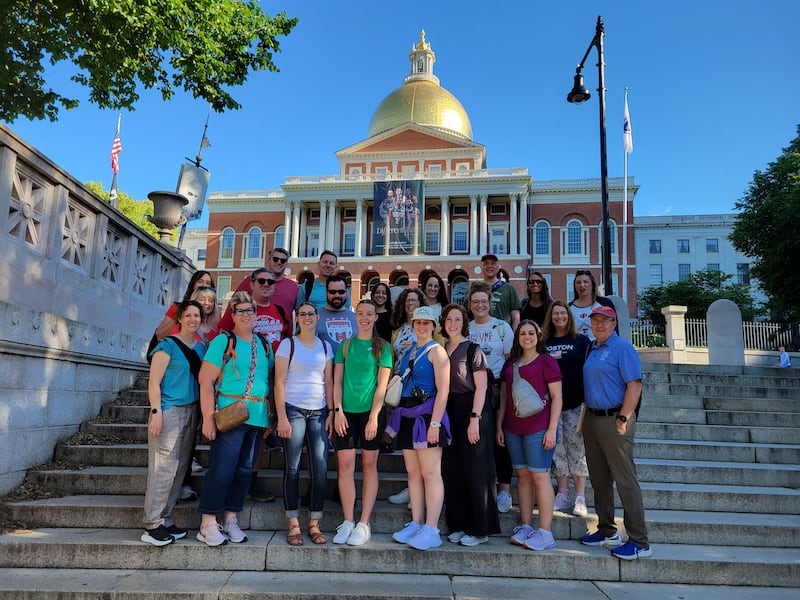
His BYU colleague Jay Buckley concurred, saying, “There’s just something magical that happens when you visit these places.” Buckley has been accompanying Utah teachers to the Freedom Trail through Driven 2 Teach for two decades. “It’s got to be on the bucket list of every American to visit Boston and Philadelphia,” he says.
Allison would argue that Boston should take precedence. “The revolution happened in Boston. Then they went to Philadelphia to fill out the paperwork,” he said in an interview.
About 4 million visitors from all over the world walk the Freedom Trail each year, some listening to narration on a cellphone as they navigate the trail alone, others taking part in guided tours on foot. (There are also trolleys available for those who find it difficult to navigate all of the trail, some of which traverses uneven cobblestones.)
There is a prescribed order to the trail, beginning at Boston Common and ending at the U.S.S. Constitution and partial tours can be completed in less than two hours. But for those with enough time, it’s best to experience the trail over several days, both on your own and with a guide.

The Freedom Trail’s 30 official guides, or players, double as historians and can bring a local’s perspective and point out other interesting things not on the trail, but adjacent to it, such as the oldest continually operating restaurant in the United States, the Union Oyster House.
But tour guides also tend to keep you moving. So if you want to, say, linger at Paul Revere’s grave (where it’s traditional to leave pennies on his marker) or linger outside Revere’s house (the oldest urban dwelling in the United States), it’s best to return to the sites that are most meaningful to you on your own time, following the red line marked in bricks that connect most of them. (The Bunker Hill Monument and the U.S.S. Constitution are in Charlestown, about a 20-minute walk from the last Freedom Trail stop in Boston’s North End, Copp’s Hill Burying Ground.)
That approach also gives you a chance to sample the famous Italian restaurants of the North End, including Mason’s favorite, Regina Pizzeria.

Allison, who teaches history at Suffolk University, said the U.S.S. Constitution is his favorite Freedom Trail site, which is saying a lot, since his office overlooks the Granary Burying Ground. (The ship “technically wasn’t part of the American Revolution,” having been launched in 1797, but is the oldest commissioned warship in the country.)
He quips that the Freedom Trail was created in the 1950s because Bostonians were tired of giving tourists directions, but is gratified by the constant flow of visitors on the trail. “It’s certainly not chronological, but it tells a very important story,” Allison said.
“Sometimes we Bostonians become complacent and find it annoying that there are so many people doing this, but it is a special thing that begins here and it really is incumbent on us to celebrate the story, because it’s not just important to us, but it’s really important to the country and to the world.”

The disparate stops of the Freedom Trail are just 16 threads in a larger tapestry of America’s origin story, but they are powerful strands. Here’s a snapshot of nine of the must-see stops along the trail:
Boston Common: The oldest public park in America, these 44 acres have been a training ground and camp for British soldiers, a field for cattle to graze, and a place of celebration and demonstration going back to the 1600s. (One bit of history that doesn’t remain: the gallows used for public hangings, which were removed in 1817, and the frogs, the namesake for the Frog Pond, long since moved on.)

Granary Burying Ground: “In this two-acre plot are the remains of more famous people than any other small graveyard in America,” says “The Complete Guide to Boston’s Freedom Trail.”
Arlington National Cemetery and Author’s Ridge at Sleepy Hollow Cemetery might beg to differ, but the Granary Burying Ground is remarkable, serving as the resting place of three signers of the Declaration of Independence (John Hancock, Samuel Adams and Robert Treat Paine), the five people who died in the Boston Massacre, Benjamin Franklin’s parents (Josiah and Abiah Franklin) and Revere.

Old South Meeting House: This brick church, constructed in 1730, was the site of numerous gatherings during the revolution, including one that preceded what would eventually be known as the Boston Tea Party. During their siege of Boston, British troops desecrated the church by using it as a stable and bar, and parts were used for firewood. It was later restored and was among the first buildings preserved because of its history.
Old State House: The oldest public building still standing in the eastern U.S., this was first the place where British officials conducted business, and later became the home of the Massachusetts Assembly. Colonists gathered underneath the balcony on July 18, 1776, to hear the Declaration of Independence read for the first time, an event that is reenacted every Fourth of July. The building is now a museum, housing, among other things, a replica of the coat John Hancock wore to his gubernatorial inauguration and a British soldier’s gun found on the street after the Boston Massacre.

Boston Massacre marker: Near the balcony of the Old State House is a circle of cobblestones commemorating the Boston Massacre — even though the firing by British soldiers into an unruly crowd occurred several yards away. (The original spot is now a safety hazard because of traffic; it’s been moved twice.) Three weeks after the deadly altercation, Paul Revere made an engraving based on an artist’s sketch and dubbed what happened a “Bloody Massacre.” The name stuck and the event became a catalyst that, according to the National Constitution Center, lit the fuse of the revolution.
Old North Church: A public plaza known as Paul Revere Mall is flanked by two churches. At one end is St. Stephen’s Catholic Church, which has a bell that was cast by Paul Revere; at the other end is the Old North Church, where two lanterns were surreptitiously hung by the church sexton in the dark of April 18, 1775.

The oldest standing church in Boston, it is an Episcopal house of worship today and visitors are welcome to attend services. You can also take a virtual tour online.
Copp’s Hill Burying Ground: The highest point in Boston’s North End, this cemetery is the resting ground of Cotton Mather, the Puritan minister whose writing led to the Salem witch trials, and Robert Newman, the North Church sexton who hung the lanterns for Revere to see. During the Revolution, British soldiers camped in the cemetery, sometimes using its gravestones for target practice, and they fired on the colonists from here during the Battle of Bunker Hill.
The U.S.S. Constitution: This warship, nicknamed “Old Ironsides,” is the oldest commissioned warship still afloat in the world. Launched in 1797 to protect American merchant ships, it got its nickname because cannonballs bounced off the ship, which was made of live oak from islands off the coast of Georgia. She’s sometimes called Boston’s only undefeated team, having won every battle she’s been in, like the War of 1812, when she sank a British ship within 35 minutes. While still technically afloat because of significant renovations, the Constitution’s role in the Navy today is largely symbolic, but her crew still fires her cannons daily, and sails to Castle Island every Fourth of July as part of Boston’s Independence Day festivities.
Bunker Hill Monument: While the first battles of the American Revolution were at Concord and Lexington, a turning point came at the Battle of Bunker Hill.

That battle is marked by a 221-foot-tall granite obelisk that visitors can climb to the top of — if they’re capable of ascending 294 steps. (If you can’t, or would rather not, there’s a webcam that offers the same views.) This battle is known for the legendary command “Don’t fire until you see the whites of their eyes,” and while officially a defeat for the colonists, “Bunker Hill had nevertheless proven that they could fight,” Allison wrote in “The American Revolution.”
More than a thousand British soldiers were killed or wounded, compared to 441 of the colonists. (And yes, it’s true, most of the action was actually on Breed’s Hill, not Bunker Hill, but like the Longfellow poem and the Boston Massacre site, sometimes history takes little liberties.)
From Boston Common to Bunker Hill, each stop on the Freedom Trail tells a story, and like any historic site, our commemoration of history, whether the preservation of a building or the creation of a monument, tells a secondary story, Mason says. The secondary story is what we value in continuing to preserve and recognize this part of history.

At the Freedom Trail, that’s not hard to figure out. It’s all in the name.
For more information on the Freedom Trail, and a pictorial roundup of all the sites, see the official website, Thefreedomtrail.org. General and specialized tours are available through the organization, as well as through private tour operators in Boston. You can also purchase an app that provides historian-approved narration for $9.99. While there’s no charge to walk through the trail on your own, some of the stops, like the Old South Meeting House and the U.S.S. Constitution Museum, require admission to enter the building.