

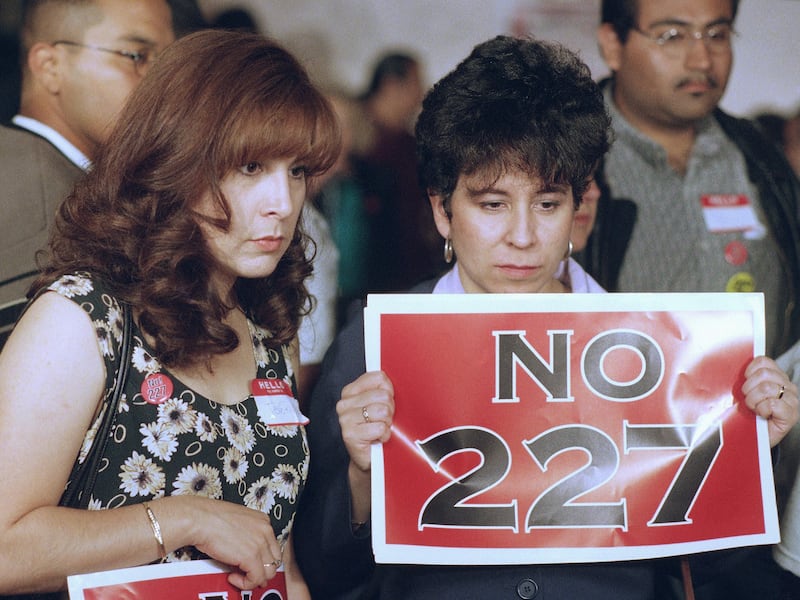
When Californians passed Proposition 227 in 1998 mandating that public-school students be taught in English with intensive English language immersion programs for foreign students, a decades-long national debate over bilingual education effectively ended. Pollsters had covered the debate sporadically, and in 1998, the Public Agenda Foundation explored parents’ attitudes about national identity and civic education.
In anticipation of the 250th anniversary of American independence this July, the American Enterprise Institute conducted a survey updating many of the questions from the 1998 survey. This survey found both stability and change over the past 30 years in how parents have thought about civic values and the role schools play in shaping American identity.
Core values
Given the rancor surrounding bilingual education in 1998 and immigration today, it’s perhaps surprising that American parents have long emphasized tolerance and held positive views of immigrants.
Seventy-two percent of parents in 1998 and 85% of parents in 2026 said they would regard someone as a bad citizen if that person refused to work with people of different races or ethnicities.
Additionally, the vast majority of parents in 1998 (91%) and 2026 (86%) said being tolerant of different backgrounds and lifestyles was an essential or important value to them.
Large majorities of parents then (62%) and now (64%) also agreed that most immigrants come to the United States to settle and become loyal citizens.

There was substantial agreement across the years on how parents rated other civic values. Eighty-eight percent of parents in 1998 and 81% of parents in 2026 reported that they view equal opportunity regardless of race, religion or gender as an essential value.
Respondents in both years also viewed as essential values the belief that with hard work people have a chance to move up and prosper (79% and 72%, respectively) and that people can protest government without fear of punishment (67% and 64%, respectively).
At the same time, more parents in 1998 (89%) than in 2026 (77%) viewed freedom of religion as an essential value, a likely reflection of declining religious affiliation.
Out of many, one?
Both surveys explored concern about civic fragmentation and the schools’ role in helping to form a unified citizenry. Seventy percent of parents in 1998 and 71% in 2026 said the view that schools were paying too much attention to the differences between ethnic and social groups and not enough to what they have in common was very or somewhat close to their thinking.
However, the long debate over bilingual education may have elevated parents’ concerns about assimilation in the 1990s. More parents in 1998 (89%) than in 2026 (71%) said schools should make a special effort to teach new immigrants about American values and beliefs. Similarly, 85% of parents in 1998 compared to 70% in 2026 said it was absolutely essential for public schools to teach kids that whatever their ethnicity or race, they are part of one nation.
California voters repealed Proposition 227 in 2016 by a significant majority, and dual-immersion programs are now popular in states as red as Texas, suggesting Americans have recently embraced more flexible definitions of American identity.
Although parents both in 1998 and 2026 believe that studying the founding era is essential to cultivating a shared understanding of citizenship, parents today are more sensitive to how American history might be perceived by an increasingly diverse student population.
Around 8 in 10 parents in both years agreed that it is more important than ever for public schools to teach all kids the history of our Founding Fathers and how this country was created. But 19% now, up from 9% in 1998, said this would seem irrelevant to kids who come from different backgrounds and make them feel unwelcome.
There is clearly less confidence in American exceptionalism among parents in 2026 than there was in 1998.
Teaching American history
Perhaps because large percentages of Americans believe most of their fellow citizens tend to take our freedoms for granted (90% in 1998 and 77% in 2026), parents in both surveys supported a strong role for schools in teaching U.S. history.
Ninety-one percent of parents in 1998 and 81% now said the idea that all students should be required to study American history was very or somewhat close to their view. In another question, 83% of parents in 1998 and 69% today believe it is absolutely essential for schools to teach kids to appreciate the freedoms guaranteed under the Constitution and the Bill of Rights.
Eighty-five percent of parents in 1998 agreed that to graduate high school, students should be required to show they understand the history and ideas that tie Americans together. In 2026, two-thirds gave this response.
Seventy-nine percent in 1998 said society has to actively teach kids what it means to be an American, while 17% felt it was something that comes naturally as kids grow up. In 2026, 64% believe that American identity needs to be actively taught, but 36% said this happens naturally.
Americans don’t want to whitewash what is taught. Nearly half in 1998 (48%) and 2026 (49%) said they would be concerned if a social science or history teacher always tried to show America in a positive light. In 1998, 21% of parents said schools paid too much attention to the harm done to African Americans in U.S. history, 26% said it was not enough and 47% said it was about right. Parents today are more emphatic about studying this: 27% now report that schools pay too much attention to this subject, 42% too little and 38% about the right amount.
A great country?
The percentage of parents who agreed that the United States is a unique country that stands for something special in the world dropped by more than 20 points between 1998 and 2026 (84% to 62%, respectively). There was also a substantial decline in the percentage of parents who agreed that it is essential or important for schools to teach kids that the United States is a fundamentally good country (95% in 1998 to 78% in 2026) and for schools to teach kids to be patriotic and loyal to the nation (94% in 1998 to 77% in 2026).
There is clearly less confidence in American exceptionalism among parents in 2026 than there was in 1998. Even so, the responses of parents then and now show an enduring commitment to American civic ideals.
The historian Yoni Appelbaum notes that “patriotic” history education, which celebrates the United States for having been founded on the basis of an idea, has recently fallen out of fashion among factions on both the left and right. Parents across the past three decades seem to agree with Appelbaum that by lacking a coherent national story that encompasses both the nation’s accomplishments as the world’s oldest continuous democracy along with its shortcomings, “we will fail to be a coherent nation.”
The national responses for this survey are available here. For more information on the America at 250 initiative, see https://america250.aei.org/