
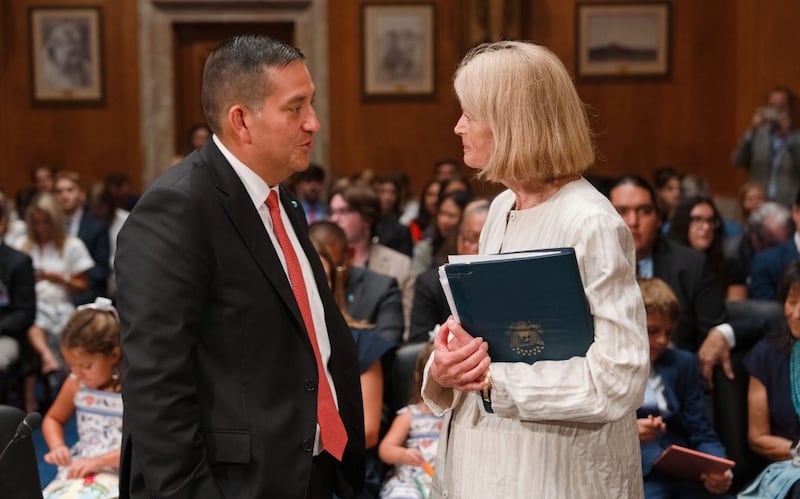

- Barack Obama and Donald Trump nominated Latter-day Saints to be their secretaries for Indian Affairs.
- Billy Kirkland testified before a Senate committee but is stuck in a confirmation backlog.
- Trump's 2026 budget proposal cut nearly $1 billion from the Bureau of Indian Affairs.
Soon after President Donald Trump nominated William “Billy” Kirkland to oversee the country’s Indian Affairs in February, Kirkland called one of his predecessors, Larry Echo Hawk, a fellow member of The Church of Jesus Christ of Latter-day Saints.
Echo Hawk was the assistant secretary for Indian Affairs at the Interior Department from 2009 to 2012, during the Obama administration, when he was called to serve as a General Authority Seventy of the church, where he remained until he was released in 2018.
In an interview with the Deseret News, Echo Hawk said he and Kirkland talked about the biggest challenges he will face if confirmed by the U.S. Senate, as well as Kirkland’s lack of experience dealing with government operations on reservation lands.
Unlike Kirkland, who worked in the first Trump White House as director of intergovernmental affairs, Echo Hawk has an extensive background in Native American issues as former attorney general of Idaho, a tribal lawyer and a professor of Indian law.

But Echo Hawk said his religious beliefs are what sustained him in the demanding position. Over his three years in office, Echo Hawk said he traveled to 47 states to visit tribal communities, and everywhere he went he took the Book of Mormon.
“The Book of Mormon says it’s written to the Lamanites, a remnant of the House of Israel,” said Echo Hawk, a member of the Pawnee Nation. “I thought that I had a spiritual responsibility there to take care of these important needs.”
The 574 federally recognized tribes in the U.S. vary widely by size and resources. Budget priorities for the roughly 1 million Native Americans living on the nation’s 326 reservations are public safety, education and infrastructure, Echo Hawk said.
Kirkland declined to comment for the story since he has not yet received confirmation in the Senate, which faces a backlog of more than 130 Trump nominees. But his confirmation hearing last month highlighted the approach he hopes to take.
Who is Billy Kirkland?
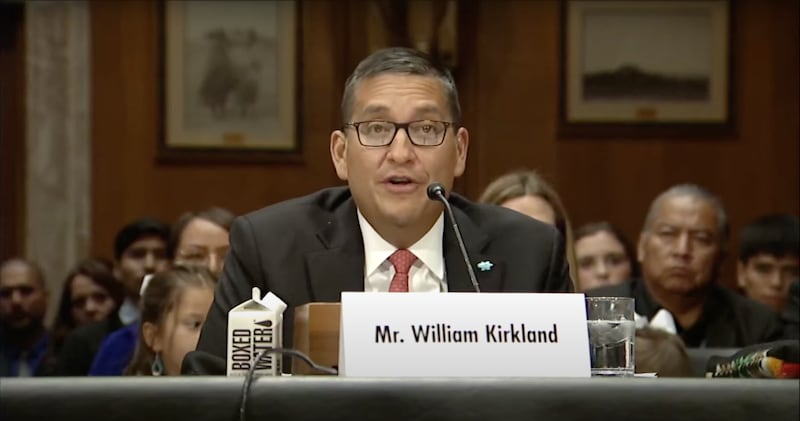
In his testimony before the Senate Committee on Indian Affairs on July 16, Kirkland, joined by his wife, Paige, and three children, embraced the unorthodox background he brought to the position.
A Navajo Nation citizen, Kirkland said he was born just north of the Four Corners region historically inhabited by the Diné people, and grew up helping his grandma herd sheep at the LeChee reservation south of Page, Arizona.
“It is where I learned firsthand the infrastructure struggles that are far too common still today in Indian Country,” Kirkland said. “I know we can — and must — do better."
Kirkland never learned to speak the native language as his family moved 15 times across the country because of his father’s military employment, eventually settling in Georgia where Kirkland started a career as a political consultant.
In 2016, Kirkland was a senior adviser for Trump’s campaign in Georgia before working on the White House Inauguration Committee, as a senior strategist for Vice President Mike Pence and later as campaign manager for former Georgia Sen. Kelly Loeffler’s reelection bid.
During his committee hearing, Kirkland denied having any involvement in Trump’s effort to challenge the results of the 2020 election in Georgia, and said that he would sell his PWK consulting group if confirmed to the role.
The committee’s Democratic senators questioned Kirkland about whether he supported Trump’s proposed $886 million cut to tribal law enforcement, infrastructure funding and education construction.
Sen. Catherine Cortez Masto, D-Nevada, referred to a Bureau of Indian Affairs study showing that even without these reductions there is an estimated $3 billion shortfall in funding for public safety on Indian reservations.
“Public safety in Indian Country is already severely underfunded,” Cortez Masto said in a statement to the Deseret News. “I have yet to see a plan from this nominee or the Trump administration on how they are going to keep people safe in Indian Country and elsewhere.”
The primary job of the assistant secretary for Indian Affairs at the U.S. Department of the Interior is to fulfill the federal government’s tribal trust and treaty obligations, including divvying up the estates of tribal members after they die.
But amid a backlog of 48,000 unresolved probate cases, the Trump administration has made changes that have reduced the Indian Affairs workforce by nearly 20%, said Committee Chair Sen. Lisa Murkowski, R-Alaska.
The recently passed One Big Beautiful Bill Act and rescissions bills also increased requirements for Medicaid and decreased funding for public broadcasting, which disproportionately impact Native Americans on reservations, committee members said.
Kirkland, who has received the endorsement of the Coalition of Large Tribes, National Congress of American Indians and Navajo Nation President Buu Nygren, said he recognized the needs on reservations and would collaborate with Congress to make tribal voices heard.
”If confirmed, I intend to spend my first 90 days listening to tribal leaders and the congressional committees of jurisdiction to understand top priorities and develop a clear action plan," Kirkland said.
Priorities for tribal lands
According to Echo Hawk, Kirkland’s biggest task will be to persuade lawmakers to increase the Bureau of Indian Affairs, or BIA, budget which has increased from $2.6 billion to $2.9 billion since Echo Hawk was in office.
Kirkland will have to compete with other agencies to secure funding for nearly 200 tribal schools, water rights and infrastructure for the roughly 40% of Navajo Nation homes that have no running water and Indian law enforcement officers, which must double to meet demand, Echo Hawk said.
During their conversation, Echo Hawk said he told Kirkland to take advantage of his 4-5 political appointees to bring in advisers experienced with tribal governance to help him manage the roughly 10,000 employees under the BIA.
Rory Kallappa, the chief of public safety for the Jamestown S’Klallam Tribe in Washington, said the biggest issue for tribes is illicit drug distribution. But jurisdiction issues can sometimes prevent law enforcement action, he said.
Tribes are sovereign bodies who can contract with local law enforcement, Kallappa said. However, partnerships with police forces often hinge on whether sheriff departments have a good relationship with tribal authorities.
The vast differences between tribes — with some “checkerboarded” like Jamestown and others spanning 17.5 million acres like Navajo Nation — means Kirkland needs to bring reservation voices to Washington, D.C., Kallappa said.
If confirmed, Kirkland would become the first Navajo citizen to hold America’s top-ranking position over Indian affairs.
Kirkland’s work with tribes in Georgia and during the first Trump administration, as well as his unique tie to the largest tribe in the U.S., make him an exciting prospect for the job, Utah state Sen. Kirk Cullimore said.
“Those ties, I think, are critical because it does just open the door,” Cullimore said. “It gives a lot of comfort to the tribes that somebody in D.C. is listening and is concerned about them.”
Cullimore, R-Sandy, received a degree in Indian law before his election to the state Senate where he has worked on multiple pieces of legislation impacting the Native Americans on Utah’s nearly 6 million acres of reservation land.
Kirkland’s connection to Utah and the church will also help him in his position, according to Cullimore, because reservations in the Beehive State are in the unique position of not being able to profit from casinos.
During his committee testimony, Kirkland said his approach will focus on consulting tribal leaders to reach consensus with the understanding that “Indian Country is not a homogenous community, one size does not fit all.”
“My goal will be to honor the diversity of Indian Country by ensuring our policies are responsive, respectful, and rooted in partnership and meet our trust responsibilities,” Kirkland said.