



A district court judge rejected a new congressional map drawn by the Utah Legislature on Monday night in favor of one provided by nonprofit groups that likely ensures a Democratic seat in Salt Lake County.
The bombshell ruling was published shortly before midnight, barely meeting a deadline set by the Utah Lieutenant Governor’s Office to give state officers time to implement electoral changes by the 2026 midterm elections.
In a 90-page ruling, 3rd District Judge Dianna Gibson said lawmakers failed to comply with the Utah law, known as Proposition 4, which was narrowly approved by voters through the Better Boundaries initiative in 2018.
Gibson excoriated the Legislature’s proposed “Map C” as unlawful and criticized lawmakers for passing a set of tests to clarify Proposition 4’s requirements, along with the map, during a special legislative session on Oct. 6.

“Based on the evidence presented, the Court finds that Map C was drawn with the purpose to favor Republicans ... and it unduly favors Republicans and disfavors Democrats,” Gibson wrote. “In short, Map C does not comply with Utah law.”
Gibson’s decision, which bypasses the Legislature’s constitutionally mandated authority over congressional districts, marks a steep escalation in a yearslong legal battle pitting lawmakers against the judicial branch.
Republican state lawmakers previously vowed to appeal the case that forced them to redraw Utah’s congressional boundaries to the Utah Supreme Court, and potentially all the way to the United States Supreme Court.
Gibson’s ruling will draw national attention with the creation of a likely Democratic seat in a closely divided Congress. Multiple Utah Democrats, including former congressman Ben McAdams, have already signaled interest in running.
But for the parties involved, the ruling signals a seismic shift in Utah’s separation of powers, with the judiciary affirming its ability to enforce the intent of voter initiatives against the wishes of a majority of elected representatives.
What is the new map?

Gibson chose to replace Utah’s current congressional map, drawn in 2021, with one put forward by the plaintiffs in the case, including the League of Women Voters Utah and Mormon Women for Ethical Government.
“We hope this sends a message to our legislators that the voices of their constituents’ matters and we are confident that voters will continue to see Prop 4 as a law that will preserve their constitutional rights,” said Katharine Biele, president of the League of Women Voters of Utah.
The map dramatically changes the boundaries for Utah’s four members of the U.S. House of Representatives.
The 1st Congressional District will shift from northern Utah to the densely urban top half of Salt Lake County. This will be a “clearly blue-leaning seat,” according to an analysis from the Center for Politics at University of Virginia.
The 2nd District will now encompass all of northern Utah, including Logan, Ogden and North Salt Lake. The expansive 3rd District will now include Orem, Provo, all of eastern Utah and all of southern Utah, including St. George.
The 4th District will now be comprised of southern Salt Lake County, Tooele County, parts of Utah County and some of central Utah. This district, like the 2nd and 3rd, will remain “firmly red,” the analysis said.
“Next year, instead of gerrymandered maps that diluted voters’ voices and kept communities divided, Utahns will finally have districts that give them a fair chance to elect representatives who truly reflect their values and priorities,” Better Boundaries director Elizabeth Rasmussen said.
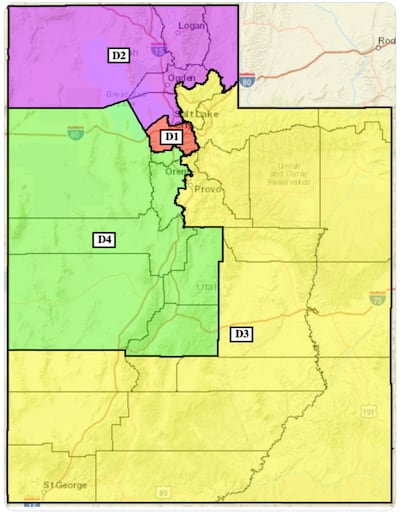
In their legal filings, plaintiffs said this map “derived from an ensemble of 10,000 maps generated by a computer algorithm designed to comply with Proposition 4’s priority-ordered redistricting criteria in a partisan-blind manner.”
Despite a rushed timeline implemented by Gibson, the Legislature’s Map C came after extensive committee review, including 10 days of nonpartisan public comment. The map was also endorsed by the state Republican Party.
Utah GOP chair Rob Axson said that Gibson stretched the law “to justify taking control of redistricting” and had chosen to replace lawmakers’ proposal with the “map of activists who are not accountable to Utahns.”
“This is not interpretation. It is the arrogance of a judge playing King from the bench,” Axson said. “This is bigger than maps — it is a direct threat to our constitutional order. Prop 4 created confusion; this ruling escalates it into a constitutional crisis."
How did we get here?

In 2018, Utah voters narrowly approved Proposition 4 with 50.3% of the vote, establishing an independent commission to recommend new congressional maps to the Legislature every 10 years and outlining redistricting requirements to prevent unfair partisan gerrymandering.
The Utah Legislature passed a law in 2020 designating the commission’s proposals as advisory, and in 2021 adopted a map critics said did not follow Proposition 4’s intent because it appeared to split up the Democratic vote in Salt Lake County, making congressional seats less competitive.
Plaintiffs, including the League of Women Voters of Utah and Mormon Women for Ethical Government, sued the state Legislature in 2022, alleging that lawmakers had violated the state Constitution by repealing voters’ right to initiate legislation and to act as a check on gerrymandering.
The Legislature has since faced a series of unfavorable court decisions, prompting legislative discussions about new laws that could serve as an additional check on the judiciary by making judges more accountable to voters and by giving elected leaders more influence over judge-selection.
In 2024, the Utah Supreme Court reinstated the original version of Proposition 4 in a decision that claimed the Legislature cannot substantially amend or repeal changes to state law that are made by ballot initiatives — if the initiatives alter the structure of government.
The Legislature subsequently introduced a constitutional amendment to give lawmakers the authority to override any citizen-passed initiative. Gibson quickly labelled the proposed amendment void, citing unclear ballot language and a lack of distribution in newspapers.
In September, Gibson ruled that the Legislature’s 2021 map violated Proposition 4 and ordered lawmakers to create a new map on a truncated timeline. GOP lawmakers lambasted the judgment but complied, begrudgingly approving a map on Oct. 6 after weeks of committee deliberation.
The Legislature also interpreted Gibson’s ruling to mean that Proposition 4’s requirements were too vague, and passed a law with three tests to ensure “partisan symmetry.” Democratic opponents argued the tests were inappropriate for a state like Utah that leans toward one party.
What’s next for Utah?
At the root of Utah’s redistricting saga is a fundamental disagreement over the separation of powers between the Republican-led Legislature and the state’s court system.
At dispute is whether the Legislature fulfilled its electoral responsibility, or violated the will of the people, by side-stepping the Proposition 4 law in 2021, and whether the courts have authority to tell lawmakers how to exercise a job expressly assigned to them in the state Constitution.
GOP legislators have accused the Utah Supreme Court of inappropriately increasing judicial interference in the legislative process by creating a new category of ballot initiative “super laws” which cannot be amended, almost like a constitutional amendment.
“It is deeply troubling that a Utah court would assume the responsibility assigned by the federal and state constitutions to create election maps,” said Bill Duncan, the Law & Religious Freedom Fellow at Sutherland Institute.
“Even more troubling, the map chosen was not created by representatives of the state’s citizens and appears to be influenced by partisan considerations that are completely alien to the court’s role.”
This new court-ordered status-quo removes the ability for elected representatives to craft the best policy, according to legislators, and tips the balance of power in favor of courts, by empowering judges to reverse legislative changes to ballot initiatives — even years after the fact.
Meanwhile, critics of the Legislature have argued that courts are simply requiring lawmakers to respect the will of the people by following laws that were created by voters, who enjoy co-equal constitutional authority to decide how their government system should be organized.
“The people have a right to alter and reform their government, and now, they are finally getting the un-gerrymandered maps they voted for,” Utah Democratic Party chair Brian King said. “It’s clear that the GOP is terrified of voters actually getting a voice in who represents them in Congress.”
Utah Republican leadership have made it clear that Monday’s ruling has not put a stop to Utah’s debate over how ballot initiatives should be treated and who should have the final say over which maps determine the boundaries of congressional elections for a decade at a time.
During floor discussion in October, lawmakers promised to appeal Gibson’s decision back to the Utah Supreme Court, or to the U.S. Supreme Court, if needed, before the 2026 midterm elections. The U.S. Supreme Court has a precedent of leaving redistricting decisions up to the legislative branch.
The Utah Republican Party has also decided to take an unorthodox approach to protesting and reversing Proposition 4. Party chair Rob Axson has filed a ballot initiative of his own which would give voters a second chance to vote on whether to have an independent redistricting commission.
On Oct. 24, Axson filed an application for a direct initiative, sponsored by several leading Republicans, including Utah Sen. Mike Lee and Utah Attorney General Derek Brown, that would allow voters to remove “the language of Prop 4 from Utah code” during the 2026 election.
A Deseret News-Hinckley Institute of Politics poll conducted in October found that a plurality of Utah voters continue to support Proposition 4, with 44% of respondents saying they would support a similar proposal again, 20% saying they would oppose it and 36% saying they did not know.
Before the initiative language gets placed on the ballot, the GOP must submit 140,000 valid signatures by Feb. 14. The party will begin collecting signatures this week, Axson said, after completing 14 public hearings to inform voters about why they should reverse the 2018 initiative with another one.
Contributing: Suzanne Bates