


High school and college students, dressed in a blend of Sunday best and Republican red, strained to hear the words bouncing off the marble walls of the Utah Capitol rotunda.
The air echoed with grief for slain conservative activist Charlie Kirk, who had been killed a month earlier at Utah Valley University. Then a statement of hopeful resolve cut through the garbled reverb.
“Our generation will be the most patriotic, the most courageous and the most prosperous generation in this country’s history,” the speaker said. “Why? Because we were born for this. Born to rebuild.”
Aubree Hudson, age 22, stood at the podium, her finger pointed skyward, urging her peers to rise above the contempt that seems only to have multiplied since Kirk’s death shocked the nation on Sept. 10.
Hudson, who serves as chair of Turning Point USA’s off-campus chapter for Brigham Young University students, had posed with Kirk just minutes before he was shot. The traumatic moment, Hudson said, marked a crossroads for her generation.
As the founder of Turning Point USA, Kirk embodied the youth wave that helped President Donald Trump return to the White House. He was, according to internet metrics, the dominant voice of MAGA for voters under 30.
In a role that has yet to be replicated, Kirk balanced “America First” stances on issues like immigration with condemnations of bigotry on the political right, all while advocating for solutions to the factors driving young people toward ideological extremism.
During his final months, Kirk became more outspoken about what he called “Jew hate” among Generation Z, the youngest cohort of voters. In more than one Q&A, he condemned antisemitism which he said was the result of “hyper-online brain rot” which shuns personal responsibility and ignores the value that Israel, and the Jewish people, have brought to the West.
“There is a corner of the internet of people that want to point and blame the Jews for all their problems,” Kirk said at an event in August. “Everybody, this is demonic, and it’s from the pit of hell, and it should not be tolerated. Period.”
Kirk’s assassination violently redirected the anxieties of American conservatism toward Gen Z. These concerns intensified following the amplification of the 27-year-old white nationalist Nick Fuentes by Tucker Carlson, sparking a debate over how to reach young people disillusioned with U.S. politics.
The vacuum left by Kirk has since been filled with in-fighting over whether Fuentes’ popularity is a reaction to the problems plaguing Gen Z — troubled by pandemic lockdowns and “woke” identity politics — or whether the attention given to Fuentes’ brand of racist trolling and authoritarian musings is a warning sign of a conservative movement in crisis.
Beginning as a dispute between the biggest names in conservative media over what MAGA means independent of Trump, the fight quickly breached its online origins, turning one of the GOP’s most influential institutions, the Heritage Foundation, on its head — with one Brigham Young University graduate, Ryan Neuhaus, at the center of the chaos.
Underlying the political earthquake is the fact that Gen Z conservatives really have shifted in a more globally isolationist and economically pessimistic direction. Poll results show young Republicans are wary of foreign alliances and worried about achieving the American Dream anchored in home ownership.
Just as central to the conversation is another fact: Gen Z, or “Zoomers,” born between 1997 and 2012, came of age amid a social media environment that exposed them to endless streams of alternative viewpoints, expanding the paths to radicalization on the fringes of both the political left and right.
“We’re getting an overwhelming amount of information. That makes people question — which is a good, or a bad thing,“ Aubree Hudson said in an interview with the Deseret News. ”But it also can be hard to discern truth in that way."
On the night of what would have been Kirk’s 32nd birthday, Hudson implored her generation to take up Kirk’s mantle “not with hate, but with conviction.” Faced with incentives to choose “pride” and “fear,” Hudson said they could still respond with “prayer,” “faith” and “courage.”

The BYU grad in the middle of the Heritage meltdown
Depending on who you ask, America’s next generation of conservatives are either throwing off the shackles of Republican orthodoxies, or are on track to rehabilitate the nativist ideas the party has attempted to subdue for decades.
Ryan Neuhaus finds himself firmly in the former camp.
After graduating from BYU in 2019, Neuhaus worked in positions at Utah’s Sutherland Institute, Students for Life of America and as a legislative director for Utah Sen. Mike Lee. In January, Neuhaus was hired as chief of staff to Heritage Foundation President Kevin Roberts.
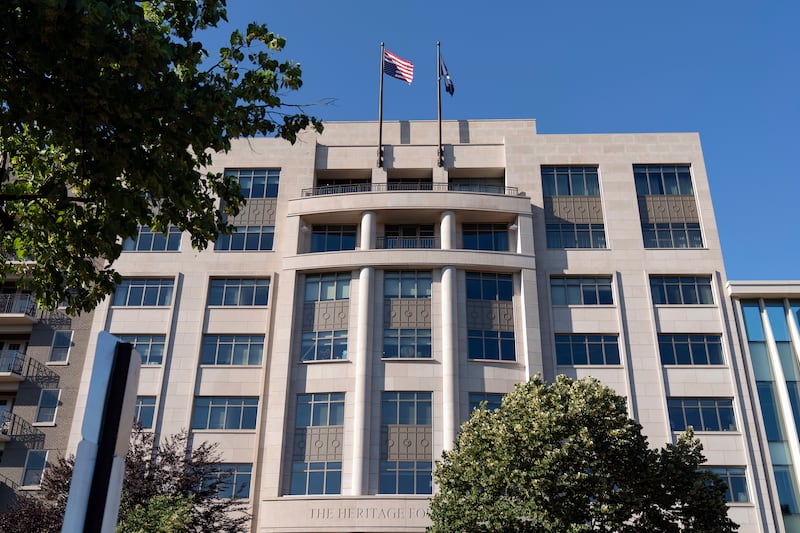
Neuhaus’ climb to the top of MAGA intellectual circles came to an abrupt halt in October, however, with one brief video Roberts recorded in defense of Carlson after the former Fox News host welcomed Fuentes on his show for a friendly interview.
Carlson, who had recently grilled Texas GOP Sen. Ted Cruz over military action in Iran, offered minimal pushback as Fuentes blamed “organized Jewry in America” — and identified the “common denominator” of “Jewishness” — as the “main challenge” to keeping the country together.
Carlson did not ask Fuentes about his well-known stances downplaying the Holocaust, praising Hitler and Stalin, trivializing rape, and declaring the need to remove all Jews from government, to force women to “shut up,” to incarcerate most black people and for white men “to run everything.”
Three days later, Roberts jumped into the fray, saying that while he abhorred “things that Nick Fuentes says,” Carlson would always be “a close friend” of the institution. Carlson’s critics were a “venomous coalition ... sowing division,” Roberts said, and conservatives should not focus on “attacking our friends on the right.”
Amid a firestorm of pushback, Roberts said Neuhaus had written the script for the video but that as president of Heritage he was responsible for its contents. As the organization lost donors, scholars and partnerships in quick succession, Neuhaus quietly tendered his resignation.
Critics of Roberts — and Neuhaus — alleged that his reaction to Carlson elevating Fuentes to one of the biggest platforms in America indicated that the Heritage Foundation was not interested in enforcing clear guardrails against extremism.
Neuhaus did not want to speak about the specific details of what happened at Heritage.
But in an interview with the Deseret News — his first with a news outlet since his resignation — Neuhaus said he believes if the conservative movement wants to maintain Trump’s “current political coalition,” then it must avoid policing its newest voters and supporters, including the factions among Gen Z.
“President Trump has remade the Republican Party by refusing to alienate people, but alienating bad ideas,” Neuhaus believes. “And I think that’s a playbook for preserving the political coalition for the future.”
While he said he is no fan of Fuentes, Neuhaus believes the GOP establishment is at risk of missing a major opportunity if it chooses to spend its political capital on gatekeeping instead of addressing the issues that have created a constituency for Fuentes’ grievance politics.
Neuhaus said Gen Z has experienced what he calls an agenda of “managed decline,” and want outcomes that ensure affordability and accountability for abuses of power. But Neuhaus rejects the idea that conservatives in their twenties are characterized by cynicism toward the political system.
“They’re driven by a longing for something better than they’ve received because they know that what they’ve been handed is not what was promised, and they don’t just want that for themselves, they want that for the next generation,” Neuhaus said.
A vision for a family-focused domestic policy, paired with an intense skepticism of foreign entanglements — particularly with Israel — was reflected nearly unanimously across more than a dozen other Deseret News interviews with young conservatives.
These political operatives — ranging from 20 to 31 years old, and representing all wings of the Republican Party — shared the same sentiment: If Gen Z has its way, the GOP of tomorrow will look very different from the one they grew up in.

‘Zoomercons’ turn on Israel
The conservative movement’s generational divide extends beyond anecdotes and podcast feuds.
Survey after survey tells the same story: Conservatives who have only ever known Trump’s GOP are ready to move on from the limited-government-at-home, big-military-presence-abroad default of Ronald Reagan’s party.
Nowhere is this change more prominent than on the topic of support for Israel.
A Pew survey from March found that the share of Republicans under 50 who have unfavorable views toward Israel increased from 35% to 50% over a three-year period. Meanwhile among Republicans over 50, unfavorable views toward Israel remained constant at around 20%.

This finding was reinforced by poll results published recently by the Manhattan Institute, which showed that 23% of Republican presidential voters under 50 view Israel as a liability, pulling the U.S. into unnecessary wars and antagonizing Muslim states, compared to 6% of GOP voters over 50.
Growing negativity toward Israel on the right is still less prevalent than anti-Israel sentiment among young voters on the left. Following months of campus protests characterized by antisemitic slogans, songs and signs, the same Pew poll found that 71% of young Democrats had unfavorable views of Israel.
But it’s not just Israel: 61% of Republicans under 30 say they believe the U.S. spends too much on foreign aid, while more than a third say the U.S. should withdraw from NATO entirely or scale back involvement, according to the 2025 Harvard Youth Poll.
Right now, Gen Z is engaging in a debate on foreign policy intervention versus isolation, said Zac Wilson, the former chair of Utah Young Republicans who ran for Congress last year.
Whereas 20 years ago the debate was taking place between former Vice President Dick Cheney and former Texas Sen. Ron Paul, Wilson said today it is taking place online between Daily Wire founder Ben Shapiro and Carlson.
And from what Wilson, age 30, has seen of his conservative contemporaries, it appears that Carlson — and a handful of like-minded talkers, like Candace Owens — are winning the war of words among those positioned to inherit the GOP.
This has also been the experience of Lexi Langley, a grassroots engagement director at Americans for Prosperity, who, like Wilson, is an alumnus of BYU. Langley, age 23, said she has seen an acceleration among Gen Z toward Carlson, Owens, and even Fuentes.
The Manhattan Institute poll found that Carlson is viewed favorably by 65% of younger GOP voters. Shapiro was viewed favorably by 64%. And Owens was viewed favorably by 62% of those under 50, but by just 42% of those over 50.
Predictably, the conservative cohort attracted to Carlson and Owens — who center a large portion of their content on criticizing U.S.-Israel relations — have become more interested in, and more negative toward Israel, according to Langley.
“Of all my friends, Israel is the very first thing that they want to learn about and understand, because it does go back to America First,” Langley said. “I, in fact, have not talked to one Gen Z conservative that has been pro-Israel. Everybody I’ve talked to is questioning Israel.”
Langley denies that Gen Z’s animus toward America’s Middle East ally is a sign of growing antisemitism. It reflects a belief that Israeli influence has contributed to “corruption among our political leaders” — a feeling that has only grown amid coverage of convicted sex offender Jeffrey Epstein, Langley said.
This trend has less to do with the facts on the ground than the way social media creates echo chambers, according to Nikaela Penrod, a Republican consultant based out of Utah County. Apps like TikTok feed people quick takes without the nuance to understand issues like America’s relationship with Israel.
While at BYU, Penrod, age 29, worked as the campus liaison for AIPAC, a pro-Israel lobbying group. Penrod’s trips to Israel, and her decision to stay off of TikTok, helped her to see why a relationship with Israel is in America’s interests. But she said this might make her an outlier among the “younger generation.”
One veteran of young conservative circles is convinced Utah is different. Grayson Massey, the former western region vice chair of the Young Republican National Federation, said he has seen how Utah’s pioneer values promote solutions over identity politics. But social media could change that.
“I think it’s good to question things, good to have diversity of thought. But what I would say is don’t become beholden to just one person’s viewpoint,” Massey, age 31, said. “You think the world is black and white, and you get older and you realize the world is very gray.”
Can ‘America First’ bring back the American Dream?
The young conservatives who spoke with the Deseret News nearly all said a top issue that differentiates Gen Z from prior generations is the perception that the American Dream is out of reach. Surveys from Pew, Marist Poll and Change Research found that young voters are 20-30 percentage points more likely than older groups to feel this way.

The average age of the first-time home buyer has hit an all-time high of 40, amid rising housing prices, tuition and college-grad unemployment. This has pushed many Americans to wait to get married and have kids, according to Riley Beesley, a 20-year-old University of Utah student, and the vice chair of the Utah Federation of College Republicans.
Beesley sees this as a policy problem with an “America First” solution. To strengthen the economy for young adults, the U.S. government should limit legal immigration, reduce foreign military engagements and crack down on “crony capitalism.” Young conservatives aren’t extreme, Beesley said, they just want “opportunity.”
“I don’t care about doing any of these things other than what benefits and puts the American people first,” Beesley said. “That’s what this movement is. That’s what this movement ought to be.”
For some young Republicans, the unique issues of the 21st century — from home ownership to opioid overdose — have pushed them away from wanting to be the party of “no,” to instead being the party that actively uses government to support conservative ends.
At 28, state Rep. Tyler Clancy, R-Provo, represents the face of this philosophy in Utah, where he has spearheaded policies on homelessness, drug addiction and health care that have not shied away from increasing the state budget.
The Manhattan Institute poll found that while longstanding GOP voters prefer spending cuts over increasing taxes for government services by 71% to 26%, the GOP’s new voters since 2020 are split 48% to 47% on shrinking versus expanding the size of government.
If conservatives are unable to find solutions for young people who feel like they cannot buy a home, the country will face a “five alarm fire,” Clancy said, because “if people don’t feel bought in to the rules of the game, that’s where you see radical extremism begin to pop up and to explode.”
Social media is also perfectly suited to stoke “fringe ideas,” according to Clancy. A decentralized media ecosystem is valuable for letting users access information they might not be able to otherwise, Clancy said. But it is also designed in a way that elevates “the most radical perspectives.”
After years of mainstream media and elected officials framing white, Christian, men as the root cause of American racism, and promoting calls for “antiracist discrimination” against white people, Clancy worries that internet algorithms will boost a backlash in the form of right-wing identity politics that could be just as toxic.
“People are forgetting their basic Christian call to treat everyone equally and with respect and with dignity,” Clancy said. “The risk that I would say all conservatives have is that as the pendulum shifts back ... is to make sure we don’t lose our moral compass.”
Clancy, along with several other sources interviewed by the Deseret News, believes the popularity of Fuentes — and his internet followers, sometimes called “groypers” — is “dramatically overstated.” Some reports have estimated up to 40% of young GOP staffers in Washington, D.C., are Fuentes acolytes.
As the former president of BYU’s College Republicans chapter, and as a nationally recognized voice of “national conservatism” with a large network of Gen Z conservative activists, Clancy said he doesn’t know one person who subscribes to Fuentes’ worldview.
“There’s no place for that kind of behavior in any movement that I would be a part of,” Clancy said. “If there are people who are lost, the movement as a whole can be a beacon of hope and positivity to help bring people away from those destructive ideologies.”
The social media generation
But social media may have taken the “movement” out of leaders’ and institutions’ hands. The percentage of young voters who regularly get their news from TikTok more than quadrupled over the past five years, increasing from 9% in 2020 to 43% in 2025, a recent Pew survey found.
BYU student Kai Schwemmer believes this is a good thing. At 22, Schwemmer has already made a reputation for himself as the field director of Utah Federation of College Republicans and as a political commentator with an online following of over 20,000 across X, Instagram and video streaming platforms.
Social media is clearly behind the shifts on key issues among Gen Z conservatives, Schwemmer said, because being online exposes them to different opinions, and shows that many of the views labeled as “extreme” by the media and politicians actually have a long history in U.S. politics.

“Social media is the No. 1 place where kids kind of wake up about this stuff,” Schwemmer said. “That has absolutely increased the amount of young people who are starting to see errors in, we’ll say, the establishment way of thinking, and are starting to go back to this kind of older way of doing politics, or at least a more truly conservative way of doing politics.”
TikTok introduced Schwemmer to the anti-immigration, and pro-protectionist talking points that led him to question his libertarian leanings. When he discovered Fuentes circa 2021, Schwemmer resonated with his proposals to ban pornography, restrict legal immigration and prohibit those with dual citizenship from running for higher office.
By 2022, Schwemmer was getting favorable mentions on Fuentes’ show, appearing in photos with Fuentes at his America First Political Action Conference, engaging in online conversations with Fuentes and sharing posts on Telegram in support of Fuentes.
Later that year, after participating in a Turning Point USA debate over how Christians should think about the conflict in Israel, Schwemmer said of Fuentes, “I think he’s cool.” Less than two months later, Schwemmer said that a Vice article calling him a “groyper” could not have made him “sound any cooler.”
Now, his ties to Fuentes are limited to streaming on the same platforms, Schwemmer said. He does not use the term “groyper” to refer to himself or his ideology. However, Schwemmer, who says he will run for political office someday, joked in July about wanting to join Fuentes as his vice presidential candidate for the 2036 presidential election.
Schwemmer acknowledged that there is still “definitely overlap” between his views and those of Fuentes. While Schwemmer says hateful discrimination based on race is “opposite of what my moral worldview is,” he said he does not think it is discriminatory to consider whether someone’s loyalty to another country means their interests are “not going to be perfectly aligned with ours.”
However, this view bleeds into what many would define as antisemitism. Schwemmer said that it is “particularly difficult in the case of Jewish people” to know whether their political motivations are in line with the country’s best interests because their religious beliefs coincide with an ethnic identity that is tied to the land of Israel.
Article VI of the U.S. Constitution explicitly rejects religious tests as a qualification for office. Members of The Church of Jesus Christ of Latter-day Saints, including its founder Joseph Smith, have long stood up for religious liberty in the political sphere, after they themselves were the subject of violent persecution by those who feared the political power of church members.
But Schwemmer believes right-wing identity politics is simply a way for “young, white Christian men,” to “stick up for yourself.” Ignoring that Fuentes’ followers exist has done nothing to stop him from becoming “a rising figure on the right,” Schwemmer said. When Schwemmer first started watching Fuentes, his livestreams received around 4,000 views each. Now they consistently rack up over 1 million views.
“Refusing to debate or address Nick Fuentes, how much has that really done?” Schwemmer said. “These older Republicans still think that that’s what you have to do, or that that’s going to work. In the age of the internet that does not work. He’s going to have the influence that he has. And the conservative position ought to be to have conversations.”
A bright future?
However, Hudson the president of Turning Point USA’s chapter for BYU students, said if those conversations happen, they should be used to draw a line in the sand, to mark where the conservative movement’s coalition comes to an end.

Carlson’s interview with Fuentes “watered down how extreme he really is,” Hudson said. A more complete look at what Fuentes regularly says reveals that he does not align with anything she believes as a conservative, “especially as a conservative woman,” Hudson said.
“If someone who considers themselves aligned with the conservative movement agrees with the outrageous things that Nick Fuentes says, I would question if they really were a conservative,” Hudson said.
But Fuentes, and others who think like him, appear to be having an influence among young conservatives and how they view the world. The Manhattan Institute poll found that:
- 49% of younger GOP voters believe the Holocaust was exaggerated or did not happen as historians describe, compared to 29% of older voters.
- 58% of younger voters say people with sympathies toward another country, even for religious reasons, risk undermining what it means to be American, compared to 40% of older voters.
- Over one quarter of younger GOP voters say they openly express racist or antisemitic views, compared to just 4% of older voters. Another 40% said these views should be tolerated within the political movement.
- Only 28% of younger voters said that those who hold antisemitic views “aren’t welcome and don’t represent what I stand for,” compared to 62% of older voters who drew the line at antisemitism.
The Republican establishment needs to grapple with the underlying reasons why Gen Z diverges from older generations, not just outline their views and label them unacceptable, according to Joseph Addington, an associate editor at The American Conservative, a magazine founded by Pat Buchanan.
Addington, a 26-year-old BYU grad living in Washington, D.C., says Gen Z grew up under the shadow of failed wars in Iraq and Afghanistan, and amid the disruptive forces of technological revolution and mass immigration, which destroyed the sense of a unified American culture for young people.
It’s no use trying to “cancel” Fuentes because social media has removed institutions’ ability to control the conversation, Addington said. The GOP must convince the constituency who follow Fuentes that there is a constructive political outlet for their disillusionment, without welcoming Fuentes into the conservative movement.
“That doesn’t necessarily mean that they have to adopt every single hair-brained idea that Zoomers might support,” Addington said. “But it does mean that they should be willing to incorporate their feedback and take their concerns and challenges seriously, because if they don’t, I don’t think that there’s much of a future for the Republican Party.”
But young conservatives also have a role to play in countering these worrying trends, according to Chris Barnard, who, at 27, serves as the president of a youth outdoors advocacy group, the American Conservation Coalition, and sits on the Youth Advisory Council for the Republican Party.
Faced with a loud but small minority of Fuentes-esque voices on the right, members of Gen Z need to provide “a very firm account of what conservatism looks like in the future,” breaking with past dogmas when needed, but holding true to “an authentic, true conservatism,” Barnard said — “like successors to Charlie Kirk.”
Gen Z organizations seeking to build up a bench of traditional conservative leaders are already making headway. Run Gen Z, which claims to have the largest network of young conservative officials in the country, pairs Gen Z candidates with a pool of conservative mentors to help them succeed.
The group’s executive director, Adam Pennings, age 25, who is based out of Texas, said the top issue that animates these young conservatives is affordability, and that the solutions that attract them are overwhelmingly derived from free-markets, federalism and limited government.
These are the principles that one newly elected member of Gen Z says guide his approach to politics. Alex Johnson, a candidate-elect for Riverton City Council at 28, said the appeal of Fuentes is largely online and irrelevant to actual Republican governance in America.
In Johnson’s experience, young Republicans are attracted to public service for the same reason he is: A desire to find fiscally conservative solutions to kitchen table problems while transcending the “divisiveness and hate” in politics which, he said, is “all we’ve known.”
During the months since a shot rang out across UVU’s courtyard, over the heads of 3,000 students, and into the phones of millions more, Hudson said she has seen Kirk’s legacy of political activism — focused on church attendance, family formation and self-reliance — grow into an “awakening” among her peers.

Her own personal awakening came while on a mission for the church to Washington, D.C. She had known that politics was her calling much earlier — by 7th grade she was campaigning for her county commissioner in Colorado. But for 18 months she was forced to take a step back and view politics from a different perspective.
“I don’t think any of my positions softened, but I feel like where I softened is in the sense of why I love America,” Hudson said. “I will disagree with you on anything that I think I should, but also, I love you enough to fight for your freedom of speech, and I love you enough to see you as a child of God.”