

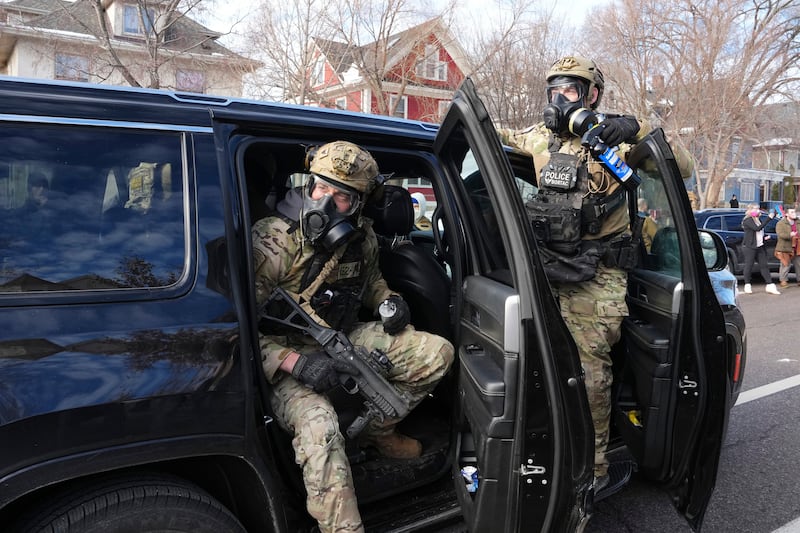

WASHINGTON — Full-year spending for the Department of Homeland Security has hit some roadblocks in Congress after an Immigration and Customs Enforcement officer shot and killed a woman in Minneapolis last week.
The political climate after the shooting, as Republicans and Democrats disagree over what happened leading up to the death of Renee Nicole Good in Minnesota — who the DHS says was shot as she attempted to run over a law enforcement officer, while Democrats say she was trying to get away — has complicated negotiations.
In the wake of the shooting, Democrats say they want additional guardrails added to the funding bill.
The House unveiled its latest spending package over the weekend to fund the Financial Services, General Government and National Security as well as the State Department bills for the rest of the 2026 fiscal year. But the two-bill package did not contain language for Homeland Security funding despite initial plans to do so — an omission that top appropriators say stemmed from reactions to the ICE shooting.
“We had to push back the bill on Homeland simply, largely because of Minnesota. So that’s complicated,” House Appropriations Committee Chairman Tom Cole, R-Okla., told reporters on Monday. “My colleagues felt like it would not be good to attach it this week, and so we’re still talking through how we can get it. … This one’s tricky, just simply, because of the political situation.”
The spending bill to fund the Department of Homeland Security is often one of the most complicated to negotiate in Congress due to partisan disagreements over border security and immigration policy. Appropriators had hoped to move it forward two weeks before the next shutdown deadline, but those plans were scrapped amid national outrage over the incident in Minneapolis.
Democrats want increased restrictions for ICE agents
Now, Democrats are demanding increased guardrails and restrictions for ICE agents to be added in the final DHS funding bill, subtly threatening they won’t vote for the package if it’s not included. That could put the funding bill in peril due to Republicans’ slim margins in both the House and Senate.
“Either Republicans will continue their ‘my-way-or-the-highway’ approach as it relates to the Homeland Security bill, and if that happens, then it’s going to be on them to figure out a path forward,” House Minority Leader Hakeem Jeffries, D-N.Y., told reporters on Monday. “Clearly, there’s some common sense measures that need to be put in place so that ICE can conduct itself in a manner that is at least consistent with every other law enforcement agency in the United States of America, at the state, local and federal level. That’s not too much to ask.”
Rep. Rosa DeLauro, the top Democrat on the House Appropriations Committee, said there is not yet a plan on how to deal with the Homeland bill, noting “we got to see what the guardrails are” regarding ICE language.
“This is an out of control process, a lawless process that this administration continues to be engaged in,” DeLauro, D-Conn., said. “How do we try to move forward?”
But whatever the final bill is, Republicans will need Democrats in the Senate to overcome the 60-vote filibuster threshold — and some Democratic appropriators in the upper chamber are urging their colleagues to use the rare leverage point to secure a policy win.
“I’m prepared to admit that we’re not going to fix all the problems in DHS, but I think it’s hard for Democrats to not try,” Sen. Chris Murphy, D-Conn., who sits on the Senate Appropriations Committee, told reporters. “Or to tell Republicans that if they want our votes, there’s got to be a little bit less diversion of funds and a little bit less diversion of personnel than there have been in the last year.”
Senate Majority Leader John Thune, R-S.D., acknowledged the Homeland funding bill is “obviously the hardest one” to pass, suggesting lawmakers may need to explore alternative options if they can’t find an agreement for 2026 levels. One proposal is to attach the DHS bill to a larger spending package extending current spending levels until the end of the fiscal year known as a continuing resolution.
Doing so could allow the political temperature to come down and let lawmakers come back to the negotiating table later this year.
“It’s possible that if we can’t get agreement, that there could be some sort of a CR that funds some of these bills into next year,” Thune said on Tuesday. “But my hope still is, and my expectation is, that there’s going to be enough interest in cooperating to get bills through the process in regular order that we can actually execute in getting as many of these as close to the new bill as possible.”
The House and Senate are plowing ahead with separate spending packages this week as they inch closer to completing the 2026 fiscal year budget by the end of this month. The government is scheduled to shut down at midnight on Jan. 30, after which funding for a slew of government agencies will lapse if a spending deal is not passed.