

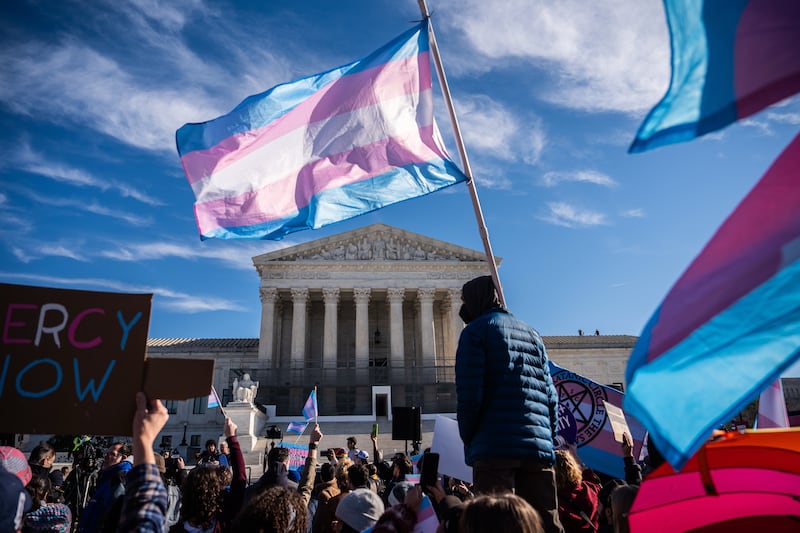

WASHINGTON — The Supreme Court appears poised to uphold state bans on transgender athletes playing on women’s and girls sports teams.
Attorneys for the interested parties delivered oral arguments to the justices on Tuesday in the two cases, Hecox v. Little and West Virginia v. B.P.J.
In recent years, several states have enacted bans for transgender students to play on girls teams at public schools. It’s become a flashpoint issue across the country, as seen by the large public attendance in the courtroom, a rally in front of the Supreme Court in Washington, D.C., and gaining the attention of President Donald Trump.
Over the last few years, more than two dozen states have passed laws that ban transgender athletes from playing on some sports teams. The cases stem from appeals to lower court’s ruling that said a student’s rights are violated if they’re banned from participating on the teams.
The defendants argue that the state ban in West Virginia and in Idaho for Hecox’s case, violated the Title IX sex discrimination in education law and violated the Constitution’s equal protection clause.
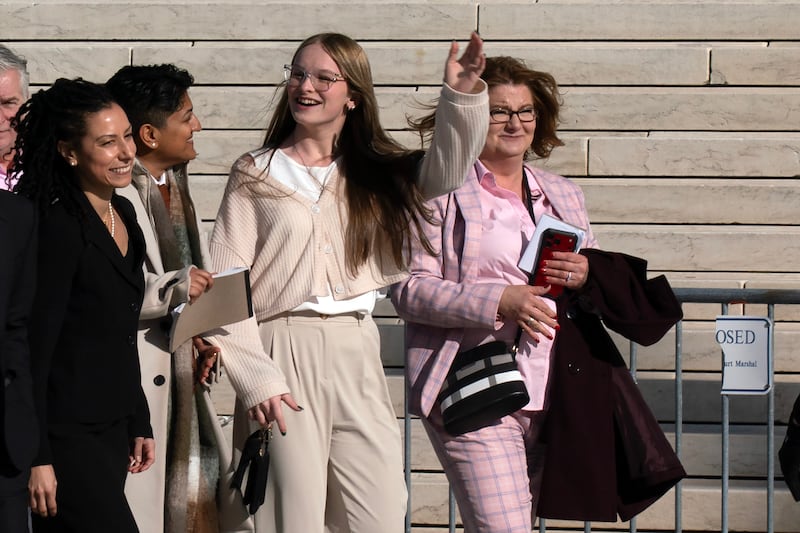
It follows another transgender rights case from the court’s previous term, United States v. Skrmetti, in which the justices decided to uphold a Tennessee law banning gender-related medical treatment for transgender minors. The Skrmetti case was mentioned several times during arguments Tuesday and coupled with how the justices rule in these cases, it could impact several states, including Utah.
Alan Hurst, the Idaho solicitor general and a graduate of Brigham Young University, argued on behalf of the state in the Hecox v. Little case.
“Sex is what matters in sports,” he began his oral arguments.
He faced tough questioning from some of the bench’s more liberal justices, including Justice Sonia Sotomayor who said some of Hurst’s arguments “make no sense” to her.
Justice Neil Gorsuch, who notably was quiet during the questioning in the Skrmetti case, sought clarification for several of his questions on Tuesday. He asked Hurst if transgender people should be given a discrete status given the history of discrimination against them.
“There has been some discrimination against transgender people, significant discrimination against transgender people in the history of this country. The same can be said of many groups,” Hurst replied.
Hurst went on to say that women, African Americans and other groups have specific status as it pertains to race and sex. Transgender individuals do not fall into the same category, he argued. “These things don’t compare,” Hurst said.
Justice Amy Coney Barrett earned a concession from Hurst, who noted that in Idaho, the ban is only for transgender girls playing on girls teams, not transgender boys playing on boys teams. She also posed a hypothetical about a transgender 6-year-old wanting to play on a girls team and how that would impact the state’s argument about testosterone levels being the reason a transgender girl can’t play on girl’s teams.
Kathleen Hartnett, who represented Lindsay Hecox, faced sharp questions from the justices, and Chief Justice John Roberts appeared skeptical of her position, pointing to the possibility that the justices will side with the state.
Hartnett argued that transgender athletes can take medication to lower their testosterone levels since the bans are focused on the safety of girls if they are playing against a biological male.
Hartnett faced many questions from the more conservative justices. Justice Samuel Alito questioned her quite a bit and Justice Brett Kavanaugh argued that over the last 50 years, the growth of girls sports has been “inspiring,” and if transgender athletes are allowed to play on their teams, it will reverse that success.
Does Title IX include transgender athletes?
In the second case, West Virginia v. B.P.J., West Virginia Solicitor General Michael Williams argued on behalf of the state. Discussions in this case leaned heavily on Title IX rights, which Becky Pepper Jackson, the transgender girl involved in the case, said were violated when the state created the ban.
Williams, in his argument, said that Congress passed Title IX to advance educational opportunities for girls, and if the justices were to rule against the states, it would wind up denying those opportunities. The lower court’s decision, he said, constitutionalizes one side’s view of the “hotly debated issue.”
“Respondent attacks the law by searching for a transgender classification that simply isn’t there,” he argued. “The law is different to gender identity because sports are indifferent to gender identity.”
“Ultimately, West Virginia’s law, like the laws of at least 26 other states, simply preserves the enduring structure on which girls’ sports depends. It should be upheld,” Williams said.
Williams faced sharp questions from Barrett and Kavanaugh. Seen as less conservative than justices like Alito and Justice Clarence Thomas, they, along with Roberts, will likely play a large role in determining how the case will be decided.
Josh Block of the American Civil Liberties Union represented Pepper-Jackson, who challenged the state over participating on a high school track team.
Block, who was on the legal team that secured the same sex marriage win in the Obergefell case, said Pepper-Jackson doesn’t have a physiological advantage despite being a transgender girl. Pepper-Jackson has performed well at some meets and not well at others, Block said.
Block also leaned heavily on the Title IX argument, and said all that Pepper-Jackson needs to establish in the case is differential treatment on the basis of sex.
“West Virginia’s law treats (Pepper-Jackson) differently from other girls on the basis of sex, and it treats her worse in a way that harms her. Outside the context of athletics, that’s all (Pepper-Jackson) would need to establish a Title IX violation,” he said.
Block faced questioning from almost every justice, including on whether Pepper-Jackson does not have an advantage because of not going through male puberty and taking female hormones.
The two cases generated a lot of attention. Outside the courthouse steps, many gathered in support of either side, including activist and former swimmer Riley Gaines, who competed against transgender swimmer Lia Thomas.
“Far more people have shown up to the Supreme Court to support women than the opposing,” she wrote online. “2026 looks a whole lot different than 2022. Praise God for it.”
Education Secretary Linda McMahon was also outside the court, where she delivered remarks to the crowd. She noted that attorneys from the Alliance Defending Freedom were delivering arguments to the justices.
“Freedom not just for states to legislate in accordance with their citizens’ will, but for women to compete in sports without being pitted unfairly against biological males,” she said. “How tragic that women are still fighting for their right to have equal access and equal opportunity in athletics programs.”
She said that the first Trump administration sought to continue the Title IX fight and criticized the Biden administration for putting girls in danger.
“This gender ideology has transformed once-great academic and athletic institutions into embarrassments — with tragic consequences for women and girls," McMahon said.
She said the Trump administration will continue to enforce Title IX the way it was intended, “rooted in biological reality to ensure fairness, safety and equal access to education programs for women and girls across our nation.”
While it’s not known when a decision from the court could come down, it will likely be near the end of the session in June. It’s also not known how the justices will rule in the case, but after oral arguments Tuesday, it appeared likely that the bans will stand.