



- Poll finds 26% of Utah voters support effort to repeal the state's redistricting law, 29% oppose it and 44% don't know.
- Utah GOP chair Rob Axson said this puts his ballot initiative in the "perfect spot" to change minds before November.
- Washington County commissioners voted last month to not adopt the state's new court-ordered congressional map.
Utahns are almost evenly divided on whether to repeal Utah’s Proposition 4 redistricting law eight years after it narrowly passed as a ballot initiative, according to the latest Deseret News/Hinckley Institute of Politics poll.
As Republican lawmakers seek to reverse a series of court decisions that allowed 3rd District Judge Dianna Gibson to implement a new congressional map, the state GOP is collecting signatures to put the underlying law on the ballot — again.
The GOP, with the help of national get-out-the-vote groups, is in the middle of gathering more than 140,000 verified signatures from voters across the state. It must do so before Feb. 14 to give voters the chance to repeal Proposition 4 in November.
Passed with 50.3% of the vote in 2018, Proposition 4, or the Better Boundaries initiative, established an appointed redistricting commission and codified anti-gerrymandering restrictions to guide the redistricting process every decade after the census.
More than 4 in 10 Utah voters don’t know whether they support the GOP’s effort to eliminate Utah’s independent redistricting commission, the poll found. The rest of the voters are split, with 26% supporting the proposition and 29% opposing it.
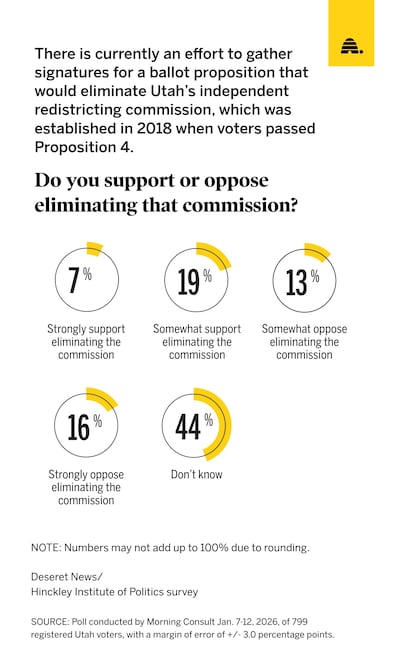
Voters are undecided across the political spectrum.
Among Republicans, 33% support the repeal, 22% oppose it and 45% don’t know. Support falls to 22% among Democrats, with 40% opposing and 37% feeling uncertain. Just 20% of independents support repealing the proposition, while 34% oppose it and 46% don’t know.
The poll was conducted by Morning Consult between Jan. 7-12, among a sample of 799 registered Utah voters. Results from the full survey have a margin of error of +/- 3%.
GOP, Better Boundaries respond
The uncertainty of Utah voters is not alarming to Utah GOP chair Rob Axson. It is encouraging, he said, because it reveals even after nearly a decade, and millions of dollars spent on behalf of Proposition 4, that “it is not sitting right with the people of Utah.”
“I think we’re in a perfect spot,” Axson told the Deseret News. “We have not even begun to communicate broadly what the issue is beyond our signature gathering efforts, and we’ll have the rest of 2026 to engage substantively in dialogue and discussion.”
As of Thursday afternoon, with one month left to submit signatures, the Lieutenant Governor’s Office had verified the signatures of 45,505 Utah voters who wished to see the question of repealing Proposition 4 placed on the general election ballot.
This number is not reflective of the total number of signatures gathered so far, however. Once a signature packet is started, the GOP has 30 days to turn it in. The county clerk then has 21 days to verify those signatures, with a deadline of March 7.
Sponsors of the initiative are “very confident” they will gather enough verified signatures in time, according to Axson. “We look forward to having Utahns get to make this decision with a broader understanding of the issue than they had back in 2018,” he said.
Better Boundaries, the political interest committee that fundraised and advertised for the Proposition 4 initiative, told the Deseret News the organization looks forward to revisiting the reasons why Utahns decided to pass the law eight years ago.
“Utahns across the political spectrum supported Proposition 4, and this polling reflects that,” Better Boundaries executive director Elizabeth Rasmussen said. “We will continue to defend Utahns’ right to pick their politicians and ensure fair representation.”
The group referred to the GOP’s initiative as “a real opportunity” to “get back to the basics and make the case again for why Utahns passed Prop 4 in the first place.” Based on the poll data, both sides have a lot of undecided minds left to convince.
And it’s no wonder. The state’s redistricting saga has been long, complicated and filled with conflicting claims from the top of Utah politics about who should have the final say on drawing congressional maps: lawmakers, a commission or the courts.
Washington County rejects new map
In 2021, legislators adopted new electoral boundaries that split Democratic voters in Salt Lake County after rejecting the redistricting commission’s recommendations, which they had made nonbinding during the prior legislative session.
This invited a lawsuit in 2022 that resulted in a Utah Supreme Court ruling in 2024 that the Utah Legislature cannot, in most cases, amend ballot initiatives that reform government. Based on this, Gibson threw out Utah’s map in October.
Gibson then ruled in November that a replacement map adopted by lawmakers did not comply with the original intent of Proposition 4. Instead, she chose a map submitted by nonprofit groups that created a deeply Democratic seat in Salt Lake County.
Over the past three months, disagreement over Proposition 4 has boiled over into GOP allegations that Gibson gerrymandered a map to benefit Democrats, and that the new legal precedent undergirding her decision has created a “constitutional crisis.”
This is the view of Washington County Commissioner Victor Iverson, who joined fellow commissioner Adam Snow last month in voting to not update the county’s voter precinct maps to come into compliance with the new court-ordered boundaries.
At the heart of Iverson’s criticism is a belief that by installing a map not approved by the Legislature, Gibson violated the state Constitution which says, in Article IX, that “the Legislature shall divide the state into congressional ... districts.”
“We believe in separation of powers,” Iverson told the Deseret News. “If Judge Gibson wants to take over the powers of the governor, lieutenant governor and Legislature, well, maybe she can come down here and take over the power of the county commission.”
The Legislature has already begun the process of appealing Gibson’s ruling to the Utah Supreme Court. In the meantime Iverson said lawmakers should vote on a new map during the upcoming legislative session, and get the federal courts involved.
Iverson framed the commission’s Dec. 15 vote as a way to “send a message” to Lt. Gov. Deidre Henderson that the process leading to the new map is unacceptable. The Utah Democratic Party, in turn, framed the move as “political obstruction.”
“Counties do not get to nullify state law or judicial rulings when it’s inconvenient,” party chair Brian King said in a statement. “This kind of behavior erodes public trust and tells voters that the rules only apply when those in power approve of them.”
Proposition 4 deserves to be upheld, by courts and counties, according to King, because Utahns voted in 2018 to place constraints on lawmakers “to ensure fair maps, fair elections, and the basic idea that no one is above the law.”
If the Utah Republican Party’s 2026 ballot initiative rerun is successful, Utah voters will get the chance to decide whether they believe Proposition 4 is — after years of legal battles — the right way to make that happen.