


WASHINGTON — Utah voters are largely split on whether they agree with the U.S. strikes against Venezuela earlier this month — and whether President Donald Trump had the authority to approve the strikes without congressional oversight.
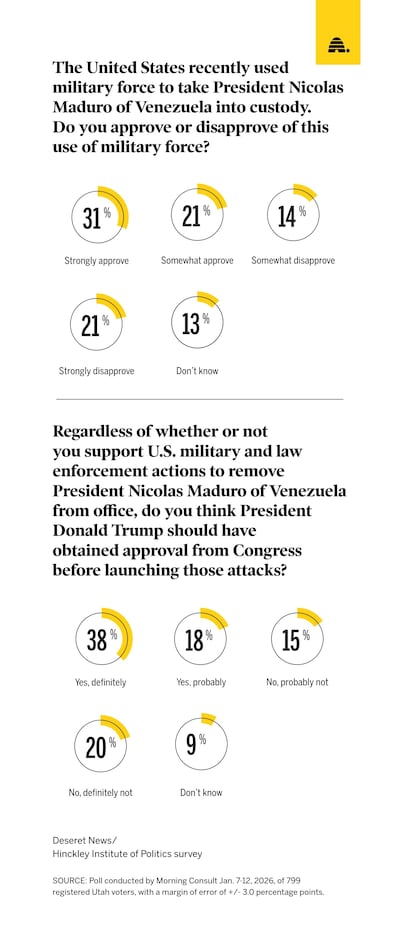
A new Deseret News/Hinckley Institute of Politics poll shows a majority (52%) of Utah voters approve of the use of military force to capture Venezuelan President Nicolas Maduro during the U.S. mission in the country compared to just 35% who say they disapprove. Another 13% say they don’t know.
But even more voters say Trump should have gotten congressional approval before signing off on the order. About 56% of voters said the president should’ve gotten the green light from Congress compared to just 35% who said he didn’t need it. Nine percent said they weren’t sure.
That same disparity has been on display on Capitol Hill as lawmakers grappled with the news of the strike and whether they should have been briefed on the operation before it was carried out.
“Nicolás Maduro represented a clear threat to U.S. security interests due to years of empowering narco trafficking groups, inviting China and Russia to gain footholds in the Western Hemisphere, and supporting terrorist organizations like Hezbollah. It is good that he is facing trial for federal criminal charges that date back to 2020,” Rep. Blake Moore, R-Utah, told the Deseret News.
“I am hopeful that the Trump Administration has plans to help ensure a peaceful transition that empowers the Venezuelan people,” he added. “However, if the United States is pursuing sustained military or law enforcement presence in the region, the Trump Administration needs to ask Congress for an Authorized Use of Military Force.”
In the immediate aftermath of the Venezuela strikes, lawmakers on both sides of the aisle questioned whether the mission was unconstitutional because members were not briefed in advance. Only Congress can declare war under the Constitution.
But after multiple briefings from Trump administration officials such as Secretary of State Marco Rubio, Republicans signaled they were comfortable with the situation so long as the president didn’t send troops into the country.
What do Utahns think of Secretary of state Marco Rubio?
Utah voters are similarly split on Rubio’s performance after the strikes, with 38% who say they approve of his job performance compared to 37% who disapprove, according to the poll. Another 25% say they don’t know.
The poll was conducted by Morning Consult of 799 registered Utah voters on Jan. 7-12, and has a margin of error of +/- 3.0 percentage points.
Senate Democrats sought to claw back their war power authority earlier this week with a resolution to limit what military action Trump can order “within or against Venezuela,” but that vote failed after only three Republicans joined all Democrats to support it.
Republicans who initially supported reining in Trump’s authority ultimately voted against the bill after an intense pressure campaign from the White House, but only after they said they got assurances there would be no boots on the ground without a vote in Congress.
“I’ve talked to (the) DOJ, I’ve talked to (the) State Department, I’ve talked to the secretary, I’ve talked to the president,” Sen. Josh Hawley, R-Mo., told reporters. “I think this is directly responsive to my concerns. I didn’t write the resolution, obviously, but my concerns have been about ground troops, and this is — I want to take yes for an answer here.”
What does Utah’s delegation think about it?
After being briefed by the Trump administration, members of Utah’s congressional delegation largely backed the operation as justified and well executed.
“The Nicolás Maduro regime has long operated as narco-terrorists and a serious driver of drug cartel activity throughout the United States,” Rep. Mike Kennedy, R-Utah, told the Deseret News in a statement. “The exploitation of Venezuela’s resources by the regime to fund cartel operations has also led to a major surge of unvetted migrants to the United States.”
Moore similarly lauded the mission for cracking down on the Maduro regime, but signaled he would not support an escalation of efforts without explicit approval from Congress.
“This is something the Administration declined to do during its strike campaign this fall on suspected drug trafficking boats,” Moore said. “A campaign of such consequence — with the balance of power in our hemisphere at stake — requires congressional oversight.”
Moore also hinted at exploring other options to crack down on the flow of drugs into the country, noting he hopes the recent strikes show the limitations of the U.S. military in solving a serious and devastating problem at home.
“Curbing the domestic demand for drugs obviously requires a whole of society effort, and we can’t rely only on military strength,” he said.
Rep. Burgess Owens, R-Utah, told the Deseret News he agreed with the Trump administration’s characterization of the mission as a “law enforcement operation,” exempting the president from needing congressional approval in advance.
“President Trump has the authority to ensure that U.S. laws are enforced and those indicted face justice,” Owens said in a statement. “Nicolas Maduro flooded the world with drugs as an indicted trafficker and cartel kingpin who enriched himself at the expense of the Venezuelan people.”
Sen. Mike Lee, R-Utah, had told the Deseret News he believes the action falls under the president’s Article II authority to protect the country from “actual or imminent attack,” a position he has held since speaking with Rubio at 3 a.m. on the morning of the attacks.