


In October of 2025, when President Donald Trump was winning praise for his role in brokering peace between Israel and Hamas, Time magazine featured the president on its cover, and the White House tweeted it out.
“Trust in Trump. Always,” the post said, ending with a flag emoji.
But do we?
A new poll from the Deseret News and the Hinckley Institute of Politics sheds light on who trusts what the president says, and who doesn’t — at least in the red state of Utah.
The poll also assesses the level of trust Utahns have in their Republican governor, Spencer Cox, and in politicians in general.
The results mirror national and even global polls that show trust in politicians at record low levels. If you want to be trusted in your profession, it appears, you’re better off choosing a career that doesn’t require votes.
And yet, the poll also suggests that Utahns tend to trust individuals more than labels or groups, which is good news for Trump and Cox.
Do people trust politicians?
The poll, conducted by Morning Consult Jan. 7–12, surveyed 799 registered voters in Utah on a variety of topics.
One of the topics was trust in what elected officials say, a topic that has national relevance given declining levels of trust across a wide range of institutions.
First, respondents were asked how often they trust what elected officials say. Their choices were all of the time, most of the time, some of the time, rarely, never and don’t know.
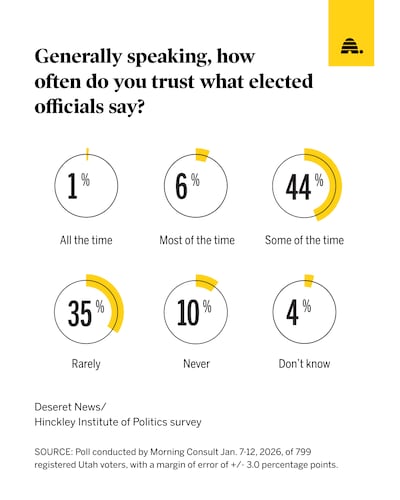
Few people — just 1% — said they trust what elected officials say all the time. But for elected officials, the good news is that more people trust them at least some of the time than rarely or never.
Ten percent of respondents said they never trust what elected officials say, while 35% said rarely.
Most people — 44% — said they trust what elected officials say some of the time. Combined with the 6% of respondents who say they trust what elected officials say most of the time, that means slightly more than half of Utahns trust what elected officials say at least some of the time, compared to 45% who say they trust them rarely or never.
Do Utahns trust what Spencer Cox says?
Morning Consult then asked how often they trust what the Utah governor says. On this question, trust improved.
Four percent said they trust what Cox says all of the time, 25% said most of the time, and 30% said some of the time. This means nearly 6 in 10 Utahns trust him at least some of the time.
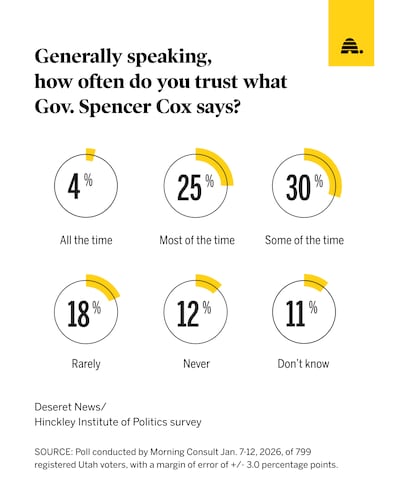
Eighteen percent said rarely, 12% said never and 11% said they didn’t know.
While the people who said they never trust Cox (12%) is higher than the “nevers” among elected officials generally (10%), his trust ratings are higher overall — just like those of Donald Trump
Do Utahns trust what Donald Trump says?
Trump won Utah in the 2024 election by 21.6 percentage points; it was his biggest winning margin in the state. The final tally showed Trump with 883,818 votes (59.4% of the total vote) to Vice President Kamala Harris’ 562,566 votes.
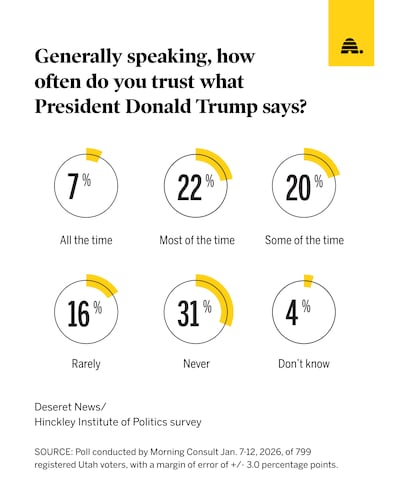
The president’s core support in Utah is reflected in the poll: Trump has the highest number of people who said they trust what he says all the time — 7% — compared to 4% for Cox and 1% of elected officials in general.
But also reflected in the poll is Trump’s tendency to be polarizing. He also has the greatest share of people who say they never trust what he says — 31% — compared to 12% for Cox and 10% of elected officials in general. And 16% of Utahns said they rarely trust what Trump says.
But here’s where Trump and Cox converge: Both men are trusted more than elected officials generally. That “reflects a familiar pattern in American politics,” Jason Perry, director of the Hinckley Institute at the University of Utah, said in an email.
“People tend to distrust politicians as a group but are more willing to trust leaders they know or feel aligned with,” Perry said.
Is trust in free fall?
Americans’ trust in institutions has been declining for the past half-century. According to Pew Research Center, “The shares saying they can trust the government always or most of the time have never been higher than 30% since 2007.”
A similar decline has been seen in Utah. According to a previous Deseret News/Hinckley Institute poll, about “20% of respondents had zero confidence in the Utah Legislature, the governor, the U.S. Supreme Court and the Utah Supreme Court," Renae Cowley and Frank Pignanelli wrote last year.
And 1 in 4 Americans fall into a category of what has been termed “the super distruster” — people who don’t trust anyone or anything. In one survey of this group, “31% ‘did not trust at all’ the federal government, 29% did not trust CEOs, 28% did not trust the media, 26% did not trust their elected officials, and 24% said they did not trust the things they read online.”
But there’s a catch.
When broken down along partisan lines, trust in government rises among people who identify with the party in power. That’s one reason Gallup’s survey on trust last year found more Republicans trusted government than Democrats, whose trust fell to its lowest point ever.
Ideological leanings may also explain why 76% of people who identified as conservative in the new survey said they trusted all, most or some of what Trump says. (Just 7% of liberals did.) Human beings generally trust people within their group than those in another.
But even so, Americans have less trust in other Americans — even those that aren’t elected officials — than they used to. According to Pew, citing figures from the General Social Survey, “The share of adults who said ‘most people can be trusted’ declined from 46% in 1972 to 34% in 2018.”