

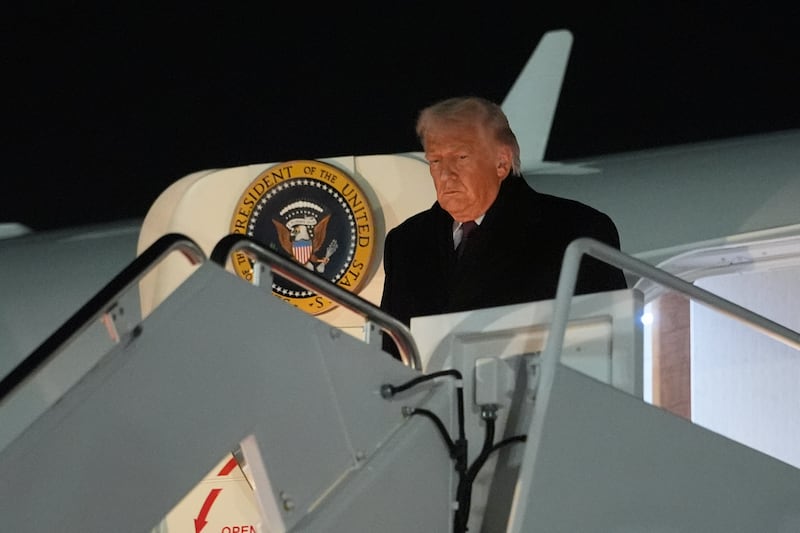

- President Trump encouraged Utah voters to sign the state GOP's initiative to repeal a 2018 redistricting law.
- Utah's Republican U.S. House delegation expressed support for the initiative that could shape future elections.
- The effort to give voters a second chance to vote on Proposition 4 has gathered 56,000 verified signatures.
President Donald Trump endorsed the Utah Republican Party’s effort to repeal the Proposition 4 redistricting law on Friday, urging voters to sign the initiative before the February deadline to put the question on the ballot.
The president claimed in a Truth Social post that the GOP’s signature-gathering campaign is needed to ensure congressional map-drawing remains accountable, to stop “Radical Leftist Judges” and to keep “KEEP UTAH RED.”
“The Great State of Utah, a place I love and WON BIG in 2016, 2020, and 2024, sent four terrific Republicans to Congress, and we want to keep it that way!” the post read. “MAKE UTAH, AND AMERICA, GREAT AGAIN!”
Trump’s recognition of the GOP initiative is the culmination of increasing attention from the heights of the MAGA movement as Utah GOP Chair Rob Axson cashes in on national relationships to bring attention to the repeal.
GOP get-out-the-vote guru Scott Presler visited the state last weekend to help gather signatures. This was preceded by commitments from Turning Point Action and Donald Trump Jr. to lend their clout and resources to the cause.
Trump has pressured Republicans around the country to engage in mid-cycle redistricting ahead of the midterm elections.
But Axson has made a point of distinguishing this partisan push from Utah’s yearslong redistricting saga.
“The president cares deeply about right and wrong,” Axson told the Deseret News. “It’s wrong for the people of Utah to be denied the opportunity to decide for themselves how to proceed, and that’s what our Prop 4 repeal effort is.”
What is Prop 4?
Passed narrowly by voters in 2018, Proposition 4 created an appointed commission to recommend new electoral boundaries for U.S. House seats after each census. The maps would need to comply with partisan fairness rules.

The new law quickly became a source of constant contention for the state’s GOP-led legislature, which was sued in 2022 after lawmakers made Proposition 4 nonenforceable and adopted a map that split up the state’s Democratic voters.
A series of legal rulings determined the Legislature had violated the Utah Constitution by amending an initiative that sought to reform government, and that the map passed by the Legislature in 2021 had violated Proposition 4.
Based on these rulings, 3rd District Judge Dianna Gibson threw out the map, as well as a remedial map approved by the Legislature in October, in favor of one submitted by nonprofit plaintiffs that created a deeply Democratic seat in Salt Lake County.
A month before this ruling, Axson announced he would be sponsoring a ballot initiative to repeal Proposition 4 entirely. That efforts is supported by Sen. Mike Lee, Attorney General Derek Brown and former U.S. Rep. Rob Bishop.

Supporters of the initiative have centered their arguments around constitutional concerns over a judge being allowed to make the final determination on electoral boundaries, instead of the people’s elected representatives.
But, if it remains in effect, Gibson’s order also directly impacts the makeup of Utah’s congressional delegation. In addition to likely sending a Democrat to Washington, the map would force four Republicans to battle over three seats.
Congressional delegation responds
In statements to the Deseret News, 2nd District Rep. Celeste Maloy and 3rd District Rep. Mike Kennedy expressed their appreciation for the GOP’s initiative, and shared that they had both given their signatures to support it.
“I appreciate President Trump’s encouragement to sign the repeal of Prop 4,” Maloy said in a statement. “I support representative government, and I believe our elected representatives should draw our congressional boundaries and amend laws when necessary.”
A campaign spokesperson for Kennedy said the congressman’s family is actively working to circulate sign-up sheets for the initiative. The former state senator believes map-drawing responsibility belongs to the Legislature, his spokesperson said.
“He supports placing this issue on the ballot so voters can decide after seeing Proposition 4 in practice,” the spokesperson said. “Utahns across the state have raised serious concerns about accountability and judicial overreach in the map-drawing process.”

In a post on X, 4th District Rep. Burgess Owens also said he had signed the initiative. Owens encouraged “every Utahn who values representative government” to also support putting the question before voters in November.
“President Trump is spot on,” the post said. “The alternative is representation dictated by judges and activists.”
Rep. Blake Moore, who represents Utah’s 1st District, said he agrees that “a judge doesn’t have the constitutional right to choose maps in Utah.”
“At the very least, if the judge didn’t believe the Utah Legislature followed the statute, she should have continued to allow for our elected representatives to finalize the map drawing process instead of delaying a ruling until the last 10 minutes before the deadline and choosing a map drawn by plaintiffs unaccountable to voters,” he said in a statement to the Deseret News. “The Utah Legislature is responsible for drawing the maps, and they must also be able to adjust ballot initiatives to meet constitutional parameters.”
What’s next?
The comment from the president elicited fiery responses from Democrats, and Better Boundaries, the political interest committee that has led advocacy for Proposition 4 for nearly a decade.
Better Boundaries, which received millions of dollars from national special interest groups — including Democratic megadonors — said Trump’s endorsement was a sign the GOP’s initiative was stumbling despite outside money.
“That tells you everything,” Better Boundaries executive director Elizabeth Rasmussen said in a statement. “If this repeal were popular with Utah voters, it wouldn’t need national megaphones and millions of dollars to survive.”
This was the same tone taken by Utah Democratic Chair Brian King, who called securing Trump’s support an act of “desperation” and “a strong-arm tactic” by the GOP “to intimidate voters instead of facing the truth.”
“Republicans are scrambling because they know how unpopular their gerrymandering scam is, and they’re trying to distract Utahns from the real issue: they’re trying to bully voters into looking the other way,” King said in a statement.
The initiative campaign to repeal Proposition 4 must submit more than 140,000 verified signatures to county clerks by Feb. 14. As of Friday, the Lieutenant Governor’s Office had recorded just over 56,000 signers.
Utahns for Representative Government, the group funding the campaign, told the Deseret News this mostly represents signatures gathered in November and December because the group has 30 days to turn in a signature packets.
